
Korea: Baekje, Silla, Seokguram
Peninsula · Three Kingdoms
Korea: Baekje, Silla, Seokguram
On a ridge 750 metres above the sea, a granite Buddha sits in a domed chamber built without mortar, overlooking the East Sea. It was begun in 751, the year the Great Buddha of Todai-ji was completed across the water. Korea did not merely pass Buddhism to Japan: it sent monks, painters, tile-makers and temple-builders, and Japan's first great temple at Asuka was raised with Baekje's help. Added below: Bulguksa and its two pagodas, Mireuksa and the pagoda that took nineteen years to rebuild, the tomb of King Muryeong and the pagoda at Sabi, Hwangnyongsa and its lost nine-storey pagoda, Wonhyo and the legend of the skull, the Tripitaka Koreana at Haeinsa, a traveller's page, three more Korean works in the Met, a comparison of early printing in East Asia, a glossary and a collector's eye.
Fact sheet
Four ideas to carry in
- State religion early. Silla adopted Buddhism officially in 528, after the martyrdom of the courtier Ichadon the year before.1
- Baekje as teacher. In the sixth century, visiting envoys from Baekje helped bring Buddhism to Japan.5
- A grotto without mortar. Seokguram's rotunda was assembled from granite blocks held by stone rivets.4
- The pensive pose. The pensive bodhisattva, one leg crossed over the other and a hand at the cheek, was especially popular in the first half of the seventh century.5
The Grotto on Mount Tohamsan
First lookSeokguram lies about 750 metres above the sea on Mount Tohamsan, overlooking the East Sea.4 The Wikipedia article reports that construction began in 751 under Kim Daeseong and was finished in 774, after his death.4 The main Buddha is 3.5 metres tall and sits on a lotus pedestal 1.34 metres high; the rotunda is about 6.8 metres across and was built without mortar, its blocks held by stone rivets.4
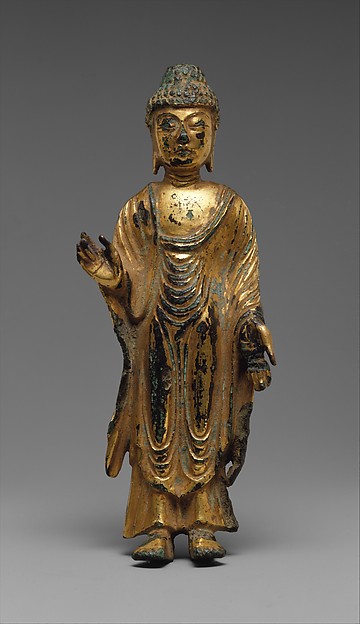
Korea · South and North Kingdoms period (676–935), Unified Silla · 8th century · Gilt bronze
Look closer: This figure is only 14 centimetres tall, and the Met catalogues it as Unified Silla, eighth century, in gilt bronze. Look at the raised right hand and at the robe falling in curved lines to the feet, then recall the essay's description of Unified Silla faces as round and dreamy.5
The Metropolitan Museum of Art, New York, Rogers Fund, 1912, accession 12.37.136. Public domain, Met Open Access. Museum record
Around the walls the carvers placed a whole assembly: a Vajrapani at the entrance, the Four Heavenly Kings in the corridor, bodhisattvas, ten disciples, Brahma and Indra, and, on the back wall, an eleven-faced Avalokiteshvara 2.18 metres high, the only relief that faces forward.4 UNESCO inscribed Seokguram, with Bulguksa, in 1995.4
The modern history is a lesson in conservation. A restoration in 1913 to 1915, under Japanese colonial rule, encased the grotto in concrete, which caused humidity; drainage was added in 1917, asphalt in 1920 to 1923 and steam cleaning in 1927.4 We include it because the conservation history of a monument is part of how it reaches us.
The Peninsula Chooses the Buddha
The connoisseur's eyeThe Three Kingdoms received the teaching at different dates and by different roads. By tradition, a monk called Sundo reached Goguryeo in 372 from the Former Qin court, though a tomb near Pyongyang with Buddhist ceiling motifs suggests the faith arrived earlier.1 In 384, Marananta came to Baekje.12 Silla was last. In 527, the court official Ichadon was executed under King Beopheung, the legend adds that milk instead of blood flowed from his neck, and in 528 Silla adopted Buddhism as the state religion.1
Silla unified the peninsula in 668, and the Unified Silla period, whose end the Met dates to 935, was the high point of Korean Buddhist scholarship.15 Wonhyo and Uisang are its two great figures: Uisang studied under Zhiyan and Fazang in China.1 Seon, the Korean form of Chan, arrived late in the Silla period through Beomnang, and the nine mountain schools followed.1
| Kingdom | Buddhism arrives (by tradition) | What followed |
|---|---|---|
| Goguryeo | 372, with the monk Sundo from the Former Qin court; King Sosurim1 | Evidence of earlier contact in a mid-4th-century tomb1 |
| Baekje | 384, with the monk Marananta12 | King Seong makes it the state religion in 528 in one account2 |
| Silla | Ichadon executed in 527 under King Beopheung1 | State adoption in 5281 |
| Unified Silla | From 668; the period runs to 935 in the Met's reckoning15 | Wonhyo and Uisang; Seon through Beomnang1 |
Baekje: Pagodas, Tombs and Teachers
The connoisseur's eyeBaekje is the kingdom of the peninsula that Japan most owes. The Baekje Historic Areas, inscribed by UNESCO on 8 July 2015, comprise eight sites at Gongju, Buyeo and Iksan from the period 475 to 660, and the inscription records that exchanges with China and Japan spread Buddhism and temple-building.3 The Wikipedia article on the kingdom reports that it brought Chinese writing, Buddhism and iron processing to Japan, and that the man'yogana script came with it.2

Korea · Three Kingdoms period (57 BCE–676 CE) · mid-7th century · Gilt bronze
Look closer: The right foot rests on the left knee, and the right hand rises to the cheek in the pose the Met's essay calls pensive, popular especially in the first half of the seventh century and often a sign of Maitreya, the Buddha of the future. Compare the essay's description of Baekje statues, with their gentle faces and harmonious proportions.5
The Metropolitan Museum of Art, New York, Purchase, Walter and Leonore Annenberg and The Annenberg Foundation Gift, 2003, accession 2003.222. Public domain, Met Open Access. Museum record
The remains are specific. The tomb of King Muryeong, excavated in 1971, yielded more than 4,600 antiquities; the five-storey pagoda of Jeongnimsa stands about eight metres high; and the Mireuksa site at Iksan is the largest temple site in Korea.3 The heritage page states that between the fifth and seventh centuries Baekje helped build temples in China and Japan.3
The end came in 660, when the capital Sabi was taken by Silla and Tang, and many Baekje refugees went to Japan; in 663 the battle of Baekgang followed.2
Korean Builders at Asuka
The connoisseur's eyeIn Japan the teaching took root through people. Asuka-dera, the first large temple, was instigated by Soga no Umako in 587 and begun in 588, when, according to the Nihon Shoki, Baekje sent monks and technicians, among them temple craftsmen, roof-tile makers and a painter. It was completed in November 596, and the Asuka Daibutsu was ordered in 605, or 609 in another source, from the sculptor Kuratsukuri no Tori. Excavation in 1956 and 1957 showed a layout of one pagoda and three golden halls.6

Japan · Asuka period (538–710) · second half 7th century · Earthenware with traces of color
Look closer: A square clay tile in relief shows a Buddha seated between two standing attendants on lotus bases. The Met dates it to the second half of the seventh century, in Japan's Asuka period, the decades after Baekje sent tile-makers and a painter to Asuka-dera, according to the Nihon Shoki.6
The Metropolitan Museum of Art, New York, Mary Griggs Burke Collection, Gift of the Mary and Jackson Burke Foundation, 2015, accession 2015.300.249. Public domain, Met Open Access. Museum record
Two teachers arrived from Goguryeo. Hyeja came in 595, tutored Prince Shotoku and lived at Asuka-dera with the Baekje priest Eso; when he heard of Shotoku's death in 622 he is said to have vowed to die on the same day the next year, in order to meet him in the Pure Land, and he died on 22 February 623 by the lunar calendar.9 Damjing came around 610; the Nihon Shoki, compiled in 720, credits him with colours, paper, ink and a watermill, and the claim that he painted the Horyu-ji murals rests, the Wikipedia article says, on no surviving documents.10
The surviving sculpture is harder to attribute. Koryu-ji in Kyoto holds two wooden half-seated Maitreya, National Treasures. The Crowned Maitreya is made of Japanese red pine, and the prevailing view is that it came from the Korean peninsula, though Japanese manufacture has been proposed; the Weeping Maitreya is camphor.7 At Horyu-ji, founded in 607 by tradition, the Kudara Kannon, in camphor and 209 centimetres high, has an origin that remains unclear, and the Shaka Triad of 623 is by Tori Busshi.8 The Asuka-period murals burned on 26 January 1949.8 A Korean monk, Hyegwan, had already introduced the Sanron school in 625.12
Sculpture, Wood and Doubt
The deep endThe Met's essay on Korean Buddhist sculpture is a short course in how to read these objects. Early sculptors on the peninsula adapted the styles of the Northern Wei, which ruled from 386 to 534; Baekje statues have gentle faces and harmonious proportions; the Unified Silla figures have round faces and a dreamy air.5 The essay observes that in the sixth century, visiting envoys from Baekje helped bring Buddhism to Japan.5
The chain from China to Korea to Japan is therefore documented link by link: peninsular sculptors adapting Northern Wei models,5 Baekje craftsmen at work at Asuka-dera,6 and a Maitreya at Koryu-ji that the prevailing view calls Korean.7 No single object proves the whole chain. The house tries to word its own catalogue notes with the same restraint.11 The two Goryeo paintings below, catalogued by the Met as from the dynasty of 918 to 1392, show the tradition's later life on the peninsula.
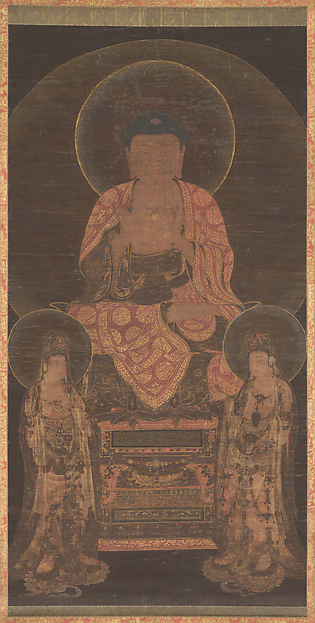
Korea · Goryeo dynasty (918–1392) · ca. 13th century · Hanging scroll; ink, color and gold on silk
Look closer: A Goryeo hanging scroll, ink, colour and gold on silk, showing Amitabha, the Buddha of the Pure Land, between two attendants. The Pure Land teaching reappears in Japan in the tenth chapter of this wing.
The Metropolitan Museum of Art, New York, Rogers Fund, 1930, accession 30.76.298. Public domain, Met Open Access. Museum record
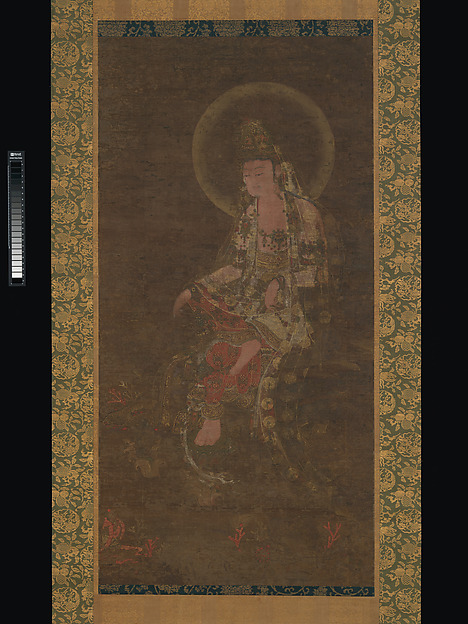
Korea · Goryeo dynasty (918–1392) · 14th century · Hanging scroll; ink, color, and gold on silk
Look closer: The Water-Moon Avalokiteshvara, a Goryeo form of the bodhisattva, painted in the fourteenth century in ink, colour and gold on silk.
The Metropolitan Museum of Art, New York, H. O. Havemeyer Collection, Bequest of Mrs. H. O. Havemeyer, 1929, accession 29.100.461. Public domain, Met Open Access. Museum record
Bulguksa and Its Two Pagodas
The connoisseur's eyeSeokguram has a sister on the slope below. The Wikipedia article on Bulguksa says a small temple stood on the site under King Beopheung in 528, that the present temple was begun in 751 under King Gyeongdeok and his chief minister Kim Daeseong, to honour his parents, according to the Samguk Yusa, and that the court completed it in 774, after Kim's death, and named it Bulguksa, the Temple of the Buddha Land.14

Bulguksa, Gyeongju, South Korea. Stone pagoda, Unified Silla
Look closer: Read the parts from the base upward: a broad base with a staircase, a middle storey of square pillars and railings, and above it an octagonal railing and the spire. The ornament here is far richer than on its twin, the Seokgatap, shown next.14
Photograph: Leonard J. DeFrancisci. CC BY-SA 3.0, with attribution. Source: Wikimedia Commons. CC BY-SA 3.0 File record

Two stone pagodas face each other in the main court. The Seokgatap is 8.2 metres high and plain, a simple Korean-style pagoda; the Dabotap is 10.4 metres high and highly ornate, dedicated to the Many Treasures Buddha of the Lotus Sutra, and appears on the South Korean ten-won coin.14 Both pagodas are National Treasures, and so is the Cheongungyo bridge, one of two bridges the article dates, with some hedging, to about 750.14

Bulguksa, Gyeongju, South Korea. Stone pagoda, Unified Silla
Look closer: Compare the profile with the Dabotap. This pagoda is a stack of plain stone storeys narrowing upward to a spire of metal rings, with no stairs and no railings. The Wikipedia article gives its height as 8.2 metres.14
Photograph: Bernard Gagnon. CC0. Source: Wikimedia Commons. File record

The wooden buildings did not last. The article reports that they burned to the ground in the Imjin War of 1592 to 1598, that rebuilding began after 1604 and that there were about forty renovations until 1805.14 The modern temple is largely the work of a campaign ordered by President Park Chung Hee between 1969 and 1973, after a partial restoration in 1966.14 The article adds that a sarira pagoda was taken to Japan in 1906 and returned in 1933.14
One object found at the temple is among the oldest printed things in the world. A Dharani Sutra, printed on a mulberry paper scroll 8 centimetres high and 630 centimetres long, was found at the temple in 1966 and is dated to between 704 and 751.14 The article does not say where in the temple it lay, and we do not guess.
Mireuksa and the Pagoda Rebuilt
The connoisseur's eyeMireuksa stands at Iksan, in North Jeolla Province, and is the largest temple site in Korea, as the Baekje Historic Areas page says.315 The Samguk Yusa tells how King Mu and his queen saw a vision of Maitreya, the Buddha of the future, rising from a pond on Yonghwasan, and how the king had the pond drained so that a temple could be built there; the Wikipedia article dates the temple to 602.15

Mireuksa, Iksan, South Korea. Photographed in April 2015
Look closer: A white, many-tiered stone pagoda stands alone on open ground at the edge of a field, with spring-green trees in front of it. The file record says only Mireuksa in Iksan, and gives 17 April 2015; it does not say which pagoda this is, so we do not either.15
Photograph: Korea.net, Jeon Han. CC BY-SA 2.0, with attribution. Source: Wikimedia Commons. CC BY-SA 2.0 File record

The layout was unusual. Three pagodas stood in a straight line from east to west, each with a hall to its north, and covered corridors enclosed each pagoda-and-hall unit, so that the whole looked like three separate temples side by side.15 The central pagoda was of wood, and the article credits the craftsman Abiji with a nine-storey wooden pagoda, without giving a date; the two flanking pagodas were of stone.15
Only the west stone pagoda survives, and its story is one of repair. The article says it was designated a National Treasure, number 11, on 20 December 1962, that it dates to the reign of King Mu, 600 to 640, and that it has six floors now, though the original height is uncertain.15 In 1910 only part of it stood; Japanese authorities added concrete support in 1914; the site was excavated in 1980; dismantling began in 1999; and the restoration was completed in June 2018, the article gives 20 June.15
The dismantling also produced a find. In January 2009 a gold plate was recovered from the pagoda, bearing a Classical Chinese inscription about when and why the temple was built; it dates an enshrinement of relics to the twenty-ninth day of the first month of the Gihae year, which the article equates to 9 March 639 in the Julian calendar.15 UNESCO inscribed the temple site in 2015 with the rest of the Baekje Historic Areas, reference 1477.15
Muryeong's Tomb and the Jeongnimsa Pagoda
The connoisseur's eyeBaekje left one royal tomb intact. King Muryeong ruled from 501 to 523, and his tomb at Gongju was found in 1971 during drainage work on neighbouring tombs, untouched for more than a thousand years.19 The Wikipedia article reports 2,906 objects in 108 categories, a brick chamber of black brick with lotus motifs measuring 4.2 by 2.72 by 3.14 metres under a mound about 20 metres across and 7.7 metres high, two pairs of gold diadems made for the king and queen, and a rare stone guardian beast, a seoksu, set in the tomb.19 The king lay in the east and the queen in the west.19 The Baekje Historic Areas page counts more than 4,600 antiquities from the tomb, a different tally that we give beside the first.3

Jeongnimsa site, Buyeo, South Korea. National Treasure
Look closer: The pagoda rises in five narrowing storeys from a low base, each roof a thin slab with upturned corners. Behind it stands a modern hall with a tiled roof, and visitors give the scale. The file description calls it the five-storied stone pagoda of the Jeongnimsa Temple site.18
Photograph: Bernard Gagnon. CC0. Source: Wikimedia Commons. File record

Sabi, the last Baekje capital, kept the other great monument. Jeongnimsa was a major temple there, built in 538 according to the Wikipedia article, and it was still in use in the Goryeo period.18 Today the site holds a five-storey stone pagoda, a National Treasure, and a stone seated Buddha of the Goryeo period, protected by a building put up in 1933; the Baekje Historic Areas page puts the pagoda at about eight metres high.183
The temple's excavation history is partly a Japanese story. A building was put up in 1933 to protect the stone Buddha, and in 1942 the Japanese archaeologist Fujisawa Kazuo excavated the site and found an inscription that commemorates the rebuilding of the Daejangdang hall in 1028, in the Goryeo period.18 Chungnam National University dug there in 1979 and 1980, and the Buyeo National Research Institute of Cultural Heritage did so from 2008 to 2010.18
Hwangnyongsa and the Lost Nine-Storey Pagoda
The connoisseur's eyeSilla's greatest temple is now a field of foundation stones. According to the Wikipedia article, work at Hwangnyongsa in Gyeongju began in 553 under King Jinheung and was not finished until 644.20 The site was about 80,000 square metres inside walls whose longest side ran about 288 metres, and the main hall measured about 47 metres by 17.20
The wonder of the temple was a nine-storey wooden pagoda built by the Baekje architect Abiji with about two hundred artisans, resting on sixty foundation stones in a base of about 565 square metres.20 The article gives its height as 68 metres in one place and 80 metres in others, and it credits Queen Seondeok as its patron.20 A Silla temple was thus raised by a builder from Baekje.
Legend adds a great golden Buddha cast under King Jinheung, the gold of which was said to have come from King Ashoka of India.20 The foundation stones show that monumental figures stood in the temple, among them a seated Sakyamuni about 5 metres tall.20 The Mongols burned the temple in 1238, and it was never rebuilt.20
Wonhyo and the Harmony of Doctrines
The connoisseur's eyeWonhyo, who lived from 617 to 686 and was born at Amnyang, near modern Gyeongsan, is the most beloved Silla monk.16 His life is told through a legend. In 661, on his way to Tang China with Uisang, a sudden downpour drove the two to shelter in an ancient tomb with human skulls; Wonhyo drank what he took for cool water from a gourd, and it was brackish water from a skull. Realising this, he gained insight into the doctrine of mind-only and decided not to go on to China.16 Uisang, who lived from 625 to 702, went on and studied under Zhiyan and Fazang.161
The rest of his life broke the mould. The article says he left the priesthood after an affair with Princess Yoseok, taught afterwards as a layman who called himself the Layman of Minor Lineage, and had a son, Seol Chong, who became a well-known Confucian scholar.16 He wrote commentaries on the Vajrasamadhi Sutra, the Awakening of Faith, the Nirvana Sutra and the Flower Ornament Sutra, and one short treatise, the Ten Approaches to the Reconciliation of Doctrinal Disputes, which sets out his method of hwajaeng, the harmonising of disputes between schools.16
For ordinary people he taught reciting the name of Amitabha with a sincere mind, and the Pure Land writings in his name include a commentary on the Amitabha Sutra.16 His reach crossed the sea: the Japanese Kegon monks Gyonen, Zenshu and Joto were influenced by him, as the article names them.16 After his death in 686 his son placed his remains at Bunhwangsa.16
The Tripitaka Koreana at Haeinsa
The connoisseur's eyeThe Tripitaka Koreana is the whole Buddhist canon cut into wooden printing blocks. The Wikipedia article gives about 81,352 blocks, carrying 1,496 titles in 6,568 books and some 52.3 million characters; each block is about 24 centimetres high and 70 centimetres long, weighs roughly three to four kilograms, and holds 23 lines of 14 characters on each side.17

Haeinsa, Hapcheon, South Korea. Photographed on 12 August 2017
Look closer: Plain halls with tiled roofs close a gravelled courtyard, and a few visitors stand in the open space. The file name places the picture at the Janggyeong Panjeon, the depository of the blocks, and the buildings are plain, and we describe nothing of their construction that we have not read.17
Photograph: SpongeFan0304. CC BY-SA 4.0, with attribution. Source: Wikimedia Commons. CC BY-SA 4.0 File record

There were two carvings. The first began in 1011, during the war with the Khitan, and was finished in 1087, based on the Kaibao Canon; its blocks were destroyed by fire in 1232, when the capital had moved to Ganghwa Island in the face of the Mongols.17 King Gojong ordered a second carving, begun, by the article's account, in 1237 and finished about twelve years later, as a prayer for divine help against the Mongols, and this second set is the one usually meant.17 A team of about thirty carvers is now estimated to have cut it, though the even hand once led people to credit a single carver.17
In 1398 the blocks were moved to Haeinsa, where they have been housed in four depository buildings.17 The set is South Korean National Treasure 32, designated on 20 December 1962, and it was entered in UNESCO's Memory of the World register in 2007.17 In the early 1970s a new depository damaged some blocks that had been moved in as a trial, and the blocks were returned; the building is now a Zen Center.17
Two corrections to popular belief come from the same page. The set is not free of error: a survey found missing characters and mistakes, and Sugi, the monk in charge of the work, checked the text and published thirty volumes of Additional Records recording its errors and omissions.17 And it has an afterlife in Japan, which asked Korea for copies from 1388 onward and, by the article's count, received about 45 complete printings; the set also underlies the modern Japanese Taisho Tripitaka.17
Visiting Korea's Temples: A Careful Note
The connoisseur's eyeThe sources used here are encyclopaedic, so they give practicalities only in outline, and a traveller should confirm hours, fees and access locally. At Bulguksa the article says the entrance stairway has 34 steps at a slope of 30 degrees, that the upper bridge, Cheongungyo, has 16 steps and is 6.3 metres long, that the lower, Baegungyo, has 18 steps and is 5.4 metres long, and that the carvings of the Lotus Flower Bridge have faded from pilgrim traffic so that visitors are now barred from walking on it.14

Seokguram, Gyeongju, South Korea. Photographed on 6 October 2022
Look closer: A broad path of earth and stone steps climbs through woods toward a small tiled hall high on the slope, with rows of coloured lanterns strung over the way. The grotto itself is out of sight; the file record calls the view the Seokguram Grotto.4
Photograph: Bernard Gagnon. CC0. Source: Wikimedia Commons. File record

A stay inside a working temple is a well-organised option. The Templestay programme, the Wikipedia article says, began with the 2002 FIFA World Cup, when the Jogye Order launched it, and the order announced on 2 July 2002 that it would continue permanently; the number of participating temples grew from 31 in the first year to 110 in 2015, and about 700,000 people took part in the first decade, by statistics released in May 2011.21 The OECD named it one of five successful culture and tourism combinations in 2009.21 The article gives no prices and no booking steps, so we give none.21
A sensible order for a first journey follows the chapter: Gyeongju for Bulguksa, Seokguram and the Silla foundations, Gongju and Buyeo for Baekje's tomb and pagoda, Iksan for Mireuksa, and Haeinsa for the blocks of the canon. The Baekje sites share an inscription, the Baekje Historic Areas of 2015, with eight sites at Gongju, Buyeo and Iksan.3
| Place | Region | Best for |
|---|---|---|
| Bulguksa and Seokguram | Gyeongju144 | Silla temple, pagodas and the grotto |
| Hwangnyongsa site | Gyeongju20 | Foundation stones of the lost nine-storey pagoda |
| Muryeong's tomb | Gongju19 | The Baekje royal tomb, found in 1971 |
| Jeongnimsa site | Buyeo18 | The five-storey pagoda |
| Mireuksa site | Iksan15 | The largest temple site and the rebuilt pagoda |
| Haeinsa | Hapcheon17 | The Tripitaka Koreana |
Early Printing in East Asia Compared
The deep endKorea sits at the centre of the story of the printed Buddhist word. The Dharani Sutra of Bulguksa, dated to 704 to 751, is one of the earliest woodblock prints known.14 Japan's Hyakumanto Darani, also of the eighth century, is the earlier print that the Diamond Sutra article cites when it says that the Dunhuang scroll of 868 is the oldest complete dated book but not the oldest print.23 The Tripitaka Koreana of 1237 to about 1249 then brought the whole canon into wood.17
None of the sources used here says that one of these influenced another, and we do not claim it. What the table shows is how widely, and how early, the idea of reproducing a sacred text by a block of wood was held across the three countries.
| Work | Where | Date | Note |
|---|---|---|---|
| Dharani Sutra | Bulguksa, Korea14 | 704 to 751 | Mulberry paper scroll, 8 cm by 630 cm; found 1966 |
| Hyakumanto Darani | Japan23 | 8th century | Cited as earlier printed paper |
| Diamond Sutra | Dunhuang, China23 | 11 May 868 | Oldest complete dated printed book |
| Tripitaka Koreana, first carving | Korea17 | 1011 to 1087 | Blocks burned in 1232 |
| Tripitaka Koreana, second carving | Korea17 | From 1237, about twelve years | Housed at Haeinsa from 1398 |
Three More Korean Works at the Met
The connoisseur's eyeThree further Korean objects in the Metropolitan Museum show the range of the tradition. We take only what the Met's own records give: the title, date, medium, size and credit line.22
The first is an illustrated manuscript of the Lotus Sutra, volume two, dated ca. 1340, an accordion-fold book written in gold and silver on indigo-dyed mulberry paper; the image area is 22.9 centimetres high.22 The second is a roof end tile of the eighth or ninth century, in stoneware, 14 centimetres wide and 7.9 centimetres across the disc.22 The third is a gilt-bronze standing Buddha of the eighth century, 17.1 centimetres high, which the Met acquired in 1917 with the Rogers Fund.22
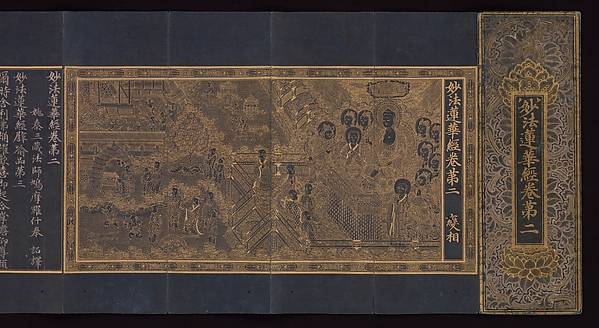
Korea · Goryeo dynasty (918–1392) · ca. 1340 · Accordion-fold book; gold and silver on indigo-dyed mulberry paper
Look closer: A band of gold line drawing on indigo paper shows a crowded scene of seated and standing figures, with a gold-bordered title label at the right edge and columns of text on the left. The Met dates the book to ca. 1340 and says it is an accordion-fold volume of the Lotus Sutra.22
The Metropolitan Museum of Art, New York, Purchase, Lila Acheson Wallace Gift, 1994, accession 1994.207. Public domain, Met Open Access. Museum record
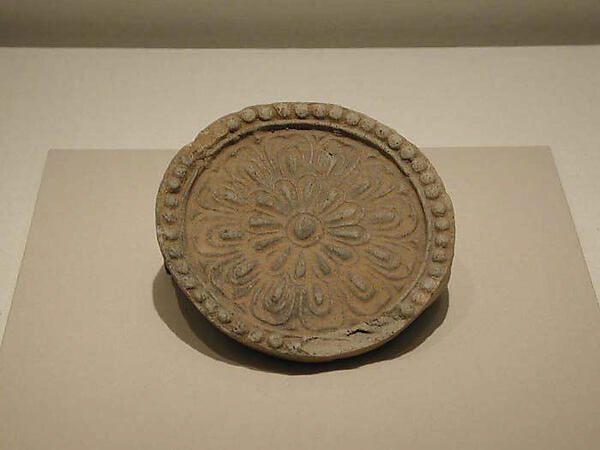
Korea · Unified Silla dynasty (676–935) · 8th–9th century · Stoneware
Look closer: A round clay disc with a beaded rim carries a many-petalled lotus rosette in low relief around a central boss. The Met gives it as an eighth to ninth century roof end tile in stoneware; a tile of this kind finished the end of a row of eave tiles.
The Metropolitan Museum of Art, New York, Gift of Mrs. Charles H. Sheldon, 1960, accession 60.130.3. Public domain, Met Open Access. Museum record

Korea · South and North Kingdoms period (676–935), Unified Silla · 8th century · Gilt bronze
Look closer: A small standing Buddha in gilt bronze raises the right hand, with the left hand lowered and the robe falling in close folds to the feet. Much of the gilding has worn away. The Met dates it to the eighth century and gives the height as 17.1 centimetres.22
The Metropolitan Museum of Art, New York, Rogers Fund, 1917, accession 17.118.53. Public domain, Met Open Access. Museum record
A Short Glossary for Korea
The connoisseur's eyeWords the chapter uses, with the Korean form first.
| Term | Meaning |
|---|---|
| Seon | The Korean form of Chan, the school of meditation1 |
| Hwajaeng | Wonhyo's method of harmonising disputes between doctrines16 |
| Tap | A pagoda; the Dabotap and Seokgatap at Bulguksa are examples14 |
| Samguk Yusa | The Memorabilia of the Three Kingdoms, source of many temple legends1415 |
| Seoksu | A stone guardian beast in the tomb of King Muryeong19 |
| Tripitaka | The Buddhist canon, in three baskets; the Koreana is its woodblock edition17 |
| Templestay | A programme of stays in working temples begun in 200221 |
| Mireuk | The Korean name of Maitreya, the future Buddha, for whom Mireuksa is named15 |
| Sangha | The community of monks and nuns |
A Collector's Eye on Korean Buddhist Work
The connoisseur's eyeThe first rule is to read the material and the period together. A gilt-bronze standing Buddha of the eighth century, such as the Met's, is only 17 centimetres high and worn in its gilding; a hanging scroll of the Goryeo period is silk with gold. The Met pieces named in this chapter are a yardstick, because each record gives a date, a material and a size.22
The second rule is to expect disagreement, and to say so. The Crowned Maitreya of Koryu-ji is Korean in the prevailing view though cut from Japanese red pine, and the dates in the temple histories above are traditions that the articles themselves hedge.714 The house's page on the ethics of collecting religious objects sets out how it words a piece whose age or place is uncertain.11
The third is to look for Japan's own copies. A small gilt-bronze Buddha found in Japan may be Japanese, Chinese or Korean, and a piece described as Korean should have its reasons stated. For a first piece, the house describes what a work appears to be, never more than the evidence allows.
Korean Pieces in the House
The house holds a small number of Korean pieces found in Japan: Joseon and Goryeo wares, among them celadon, and Korean Buddhist art, tagged by period and style. Dates in titles are the catalogue's best reading, and the ethics page explains how the house phrases age and provenance.11
The strip below fills from the live shelf on the day you read this. If it is empty, the pieces are between displays, and the links under it lead to the full shelves.
Pieces in the house now
- Asian Antiques Found in JapanKorean, Chinese, Tibetan and wider Asian pieces
Filter by what you have just read
Answered plainly
When did Buddhism reach Korea?
By tradition in 372, when the monk Sundo reached Goguryeo, and in 384 for Baekje. A tomb near Pyongyang with Buddhist motifs suggests earlier contact.1
Why is Seokguram famous?
It is a granite grotto begun in 751 and finished in 774, with a 3.5 metre Buddha, built without mortar, and a World Heritage site since 1995.4
What did Baekje give Japan?
Chinese writing, Buddhism and iron processing, according to the Wikipedia article on the kingdom, along with monks and craftsmen who built the first temples.26
Who built Asuka-dera?
Soga no Umako instigated it in 587 and Baekje sent monks and technicians in 588. It was completed in 596.6
Is the Koryu-ji Maitreya Korean?
The prevailing view is that the Crowned Maitreya, made of Japanese red pine, was brought from the Korean peninsula, though Japanese manufacture has been proposed.7
What is a pensive bodhisattva?
A figure with one leg crossed over the other and one hand touching the face; it was popular in the first half of the seventh century and is often Maitreya.5
What is Bulguksa?
The Silla temple begun in 751 by Kim Daeseong and completed in 774, with two stone pagodas, the Dabotap and the Seokgatap, both National Treasures; it was inscribed by UNESCO with Seokguram in 1995.14
What is the oldest printed object at Bulguksa?
A Dharani Sutra printed on a mulberry paper scroll, found in 1966 and dated between 704 and 751.14
Has the Mireuksa pagoda been restored?
The temple site at Iksan was excavated in 1980, and the restoration of its west stone pagoda, begun in 1999, was completed in June 2018.15
What was found at Mireuksa in 2009?
A gold plate with a Chinese inscription about the building of the temple, dating an enshrinement of relics to 9 March 639 in the Julian calendar.15
What is special about the tomb of King Muryeong?
It was found intact in 1971 and held 2,906 objects, including gold diadems for the king and queen and a stone guardian beast.19
Why is Wonhyo famous?
He is the best-loved monk of Silla, remembered for the legend of the skull, his commentaries and his method of harmonising disputes between schools.16
Did Wonhyo go to China?
He set out with Uisang in 661 but turned back after the night in a tomb, while Uisang went on.16
What is the Tripitaka Koreana?
The Buddhist canon carved on about 81,000 wooden blocks, stored at Haeinsa since 1398, with a second carving begun in 1237.17
Is the Tripitaka Koreana free of errors?
No. A survey found missing characters and mistakes, and the monk Sugi published thirty volumes of Additional Records recording them.17
Can I stay in a Korean temple?
Yes, through the Templestay programme begun in 2002, which had 110 temples in 2015; check prices and booking with the programme.21
What happened to the nine-storey pagoda at Hwangnyongsa?
It was built by the Baekje architect Abiji and lost when the Mongols burned the temple in 1238; its height is given as 68 or 80 metres.20
Where next
Sources and image credits
- Wikipedia, Buddhism in Korea Arrival dates, Ichadon, unification, Wonhyo, Uisang, Seon.
- Wikipedia, Baekje Baekje's transmissions to Japan, fall in 660.
- Wikipedia, Baekje Historic Areas UNESCO inscription of 2015, Muryeong, Jeongnimsa, Mireuksa.
- Wikipedia, Seokguram Construction, dimensions, sculptures, restoration history.
- The Metropolitan Museum of Art, Korean Buddhist Sculpture, 5th to 9th century (Soyoung Lee, 2002) Three Kingdoms styles, the pensive pose, Unified Silla.
- Wikipedia, Asuka-dera Construction, Baekje craftsmen, the Asuka Daibutsu.
- Wikipedia, Koryu-ji The two Maitreya and the Korean-origin view.
- Wikipedia, Horyu-ji Foundation, the Kondo, the Kudara Kannon, the 1949 fire.
- Wikipedia, Hyeja Goguryeo teacher of Shotoku.
- Wikipedia, Damjing Goguryeo priest and artisan.
- Japonista, The ethics of collecting religious objects How the house describes provenance.
- Wikipedia, Nanto Rokushu Context for the Nara schools.
- Wikipedia, Todai-ji The Great Buddha's eye-opening in 752.
- Wikipedia, Bulguksa Founding, pagodas, the Dharani Sutra, restoration, bridges, visitor facts.
- Wikipedia, Mireuksa Legend, layout, the west pagoda, the 2009 gold plate, restoration to 2018.
- Wikipedia, Wonhyo Life, the skull legend, works, Pure Land, influence on Japan.
- Wikipedia, Tripitaka Koreana Blocks, two carvings, Haeinsa, designations, errors, Japan.
- Wikipedia, Jeongnimsa Sabi temple, pagoda, excavations.
- Wikipedia, Tomb of King Muryeong Discovery, objects, chamber, UNESCO 2015.
- Wikipedia, Hwangnyongsa Silla temple, nine-storey pagoda, size, destruction in 1238.
- Wikipedia, Templestay The programme begun in 2002, growth and recognition.
- The Metropolitan Museum of Art, object records 36451, 42264 and 51304 Korean Lotus Sutra manuscript, roof tile and gilt-bronze Buddha: titles, dates, media, sizes.
- Wikipedia, Diamond Sutra The 868 colophon and earlier printed materials.
Last reviewed 28 October 2026. Dates in this chapter follow the cited pages; where the sources disagree, the chapter says so. Every picture is public-domain or openly licensed, and its credit and licence stand beneath it.
If a Korean piece, or a Japanese Buddhist work with a peninsular air, has caught your eye, the concierge desk will search Japan on your behalf.
Private concierge
Looking for something in particular?
Describe the piece or the project you have in mind. A senior advisor in Tokyo reads every case file personally and replies within two business days, with fees set out in writing before any work begins.