
Rakan: The Arhats
Sixteen to Five Hundred
Rakan and the Arhats
羅漢
The Buddha's most advanced disciples, ordered to stay in the world and protect the Law: shown as sixteen emaciated sages, eighteen, or five hundred faces carved one by one.
Identity card
Know the figure at a glance
- Robe. Rakan are shown as priests wearing the monk's robe, the kesa (JAANUS).
- Shaved head. The head is shaved, in the manner of a monk (JAANUS).
- Alms bowl. In the Cleveland Korean scroll and in Hiroshige's print, an arhat holds a bowl from which a dragon rises (Cleveland, Met).
- Staff. Staves appear in the Metropolitan Museum's fourteenth-century scroll and in Hiroshige's print; no source consulted fixes a single meaning for them.
- Dragon or tiger. Animals attend the sages in the scrolls shown below: a dragon, a tiger, a lion-like beast.
- Guarding the Law. When Shaka entered nirvana the rakan were ordered to remain and protect the True Law (JAANUS).
Worthy ones who stay behind
JAANUS defines rakan as an abbreviation of arakan, the Chinese rendering of the Sanskrit arhan, and adds that they are also called ōgu, the worthy ones. They were the highest disciples of Shaka. In Hinayana Buddhism they had completed their training and ranked as mugaku, those with nothing more to learn, the highest level a disciple could reach; in Mahayana Buddhism, the entry says, rakan who seek only their own salvation rank just below the bodhisattvas. Wikipedia's article on the arhat explains the Sanskrit root, to deserve, and notes that the Theravada tradition counts the Buddha himself as the first arhat, while Mahayana texts urge practitioners towards the bodhisattva path instead.
The legend that gives the rakan their place in art is a task. When Shaka entered nirvana, says JAANUS, the rakan were ordered to remain in the world and protect the True Law. The travel site Japan Experience adds that they keep and proclaim it until the coming of Miroku, the future Buddha, and Wikipedia says the Eighteen Arhats are said to await Maitreya's return. Art shows them as priests, in the kesa and with shaved heads, and the sixteen in particular as aged and emaciated, in the frugal clothing of Indian ascetics.
Names from the Fazhuji
JAANUS says the sixteen were saintly ascetics who attended the Buddha's death and were ordered to remain as witnesses to the Law. Their names are given in the Fazhuji, known in Japan as the Hōjūki, which Xuanzang translated into Chinese: Bindorabaradaja, Kanakabassa, Kanakabaridaja, Subinda, Nakora, Badara, Karika, Bajaraputara, Jubaka, Hantaka, Ragora, Nagasena, Ingada, Banabasu, Ajita and Chudahantaka. The Amidakyō lists a largely different group, sharing only Bindorabaradaja and Chudahantaka, which is a reminder that the sixteen were never a closed canon.
The cult grew after the translation. JAANUS says that rakan appeared in painting as early as the Six Dynasties and that, after Xuanzang's translation of the Hōjūki, their worship became popular; from the ninth century on many paintings and sculptures were made in China and Japan. The subject is said to have been introduced to Japan in 982 by the priest Chōnen, who died in 1016. Chinese sets survive in Japanese collections, and Japanese versions were usually sets of sixteen hanging scrolls.
Guanxiu's ink and Li Longmian's colour
JAANUS distinguishes two Chinese manners. The Zengetsu style, an ink monochrome of bold, exaggerated line, belongs to the Five Dynasties priest Guanxiu, who lived from 832 to 912. The Riryūmin style, orthodox, careful and rich in colour and gold, is tied to Li Longmian, also called Li Gonglin, of the Northern Song, who lived about 1049 to 1106. Many surviving paintings, the entry cautions, fit neither. Wikipedia places Guanxiu's first famous portraits of the Sixteen Arhats in 891 and says he gave them to Shengyin Temple at Qiantang, modern Hangzhou.
Both manners reached Japan, and between them they explain the range one sees in a gallery: the weathered, almost caricatured sage and the courtly figure in gold-edged robes.
A dragon in the alms bowl
The Metropolitan Museum holds two arhat scrolls from series of sixteen. One, dated to the late fourteenth century, belonged to a set once owned by Hōkokuji, a temple on Shikoku, of which only seven survive, each figure named in a cartouche at the upper corner; the other, shown below, is dated to the fourteenth century. The museum's wider note describes arhats as protectors of the Dharma who also use magical powers to help the faithful, often painted in sets of eight, sixteen, eighteen, twenty-eight or five hundred. In the scroll shown below the sage sits on rocks beside peonies, with a staff on his shoulder and a pair of shoes at the lower left.
Cleveland's Rakkan is a Japanese hanging scroll of the Kamakura or Nanbokuchō period, in ink, colour and cut gold, showing a haloed sage seated beneath a tree with a tiger at his side. Cleveland also holds a Korean arhat dated 1235, called Segongyang jonja and numbered the 464th of five hundred; the museum says he sits on a woven bamboo stool luring a dragon into an alms bowl, and that the scroll is one of only about ten known works of its kind, all of the others in Korea or Japan. The dragon and the bowl return in a print by Hiroshige of 1820, a year of the dragon, titled The Rakan Handaka Sonja with Dragon: smoke from a bowl in the sage's hand twists upward into a dragon, inside a picture of a hanging scroll.
Arhats upstairs in the temple gate
JAANUS notes that polychrome wooden sculptures of the arhats were often placed in the second-floor chamber of the sanmon, the great gate of Zen temples, naming Tōfukuji, Nanzenji and Myōshinji in Kyoto. Japan Experience calls rakan imagery especially significant in the Ōbaku school, one of the three main Zen schools beside Sōtō and Rinzai, and describes the rakan as role models. The Metropolitan Museum's catalogue note on its statue uses the same word, saying the arhats serve as models for Zen monks.
Wikipedia's article on arhat halls adds a Chinese background. The tradition became prominent in the Five Dynasties, in the tenth century, when the King of Wuyue commissioned five hundred bronze arhats for Fangguang Temple on Tiantai Mountain; by 985 there were 516 statues at Shouchang Temple on the same mountain. Smaller temples, the article says, usually enshrine the Eighteen Arhats and larger ones the Five Hundred.
A peak beyond the stone bridge
JAANUS says the source of the five-hundred grouping is unknown, and that it is unclear whether the number means five hundred individuals or simply a great many. Chinese belief placed them on a peak beyond the Stone Bridge on Mount Tiantai, probably a Buddhist adaptation of Daoist stories of immortals living there; Tang-period Chinese also knew Indian legends of five hundred arhats on a mountain near Rājagṛha. From the fifth century large groups were often shown seated.
The best-known painted set is one hundred scrolls by Lin Tinggui, active 1174 to 1189, and Zhou Jichang, in the late twelfth century. An inscription of 1178 records that a merchant family gave it to a temple; the set is divided among Daitokuji in Kyoto, the Museum of Fine Arts, Boston and other collections. It was complete in Japan by the late fourteenth century, and Minchō, who lived from 1351 to 1431, made copies for Tōfukuji in 1386 and for Engakuji. Ike no Taiga painted an unorthodox set of sliding doors at Manpukuji, and Kanō Kazunobu painted a hundred scrolls at Zōjōji in Tokyo. Cleveland holds a Chinese handscroll of the subject by Wu Bin, active between 1591 and 1626, more than twenty metres long.
Genkei and the Temple of the Five Hundred
The Metropolitan Museum's Seated Arhat is one of five hundred figures carved over nearly ten years by the monk-sculptor Shōun Genkei, who lived from 1648 to 1710, for the Ōbaku temple Gohyaku Rakan-ji, then on the eastern edge of Edo. It is wood with lacquer, colour and gold leaf, about 85 centimetres high. The museum notes that such figures often have highly individual faces that suggest an extreme ascetic life; the face in the gallery below smiles broadly.
Wikipedia says Genkei carved the temple's statues between 1688 and 1704, raising funds across Edo, and made more than 536, of which 305 survive; the Met gives 1688 to 1695 for its own figure, and Japan Experience gives 1695 for the set, saying he was inspired by Chinese sculptures at Manpukuji near Kyoto and that the faces may have been modelled on real people. The sources differ on the closing date, so the page gives both. The temple is now in Meguro. Katsushika Hokusai's Sazai Hall at the Temple of the Five Hundred Arhats, of about 1830 to 1832, from the Thirty-six Views of Mount Fuji, shows visitors on its veranda looking out towards the mountain.
Stone, gardens and parody
Wikipedia says devotion to the five hundred spread in the Edo period, and gives Chikuraku-ji in Tokushima, built in 1775, where about two hundred of the original five hundred statues remain behind the main hall. JAANUS lists stone sets at Kitain in Saitama, Rakanji in Ōita and Sekihōji in Kyoto, and says Edo images were also made for secular settings, that ukiyo-e artists parodied the subject, and that some Edo gardens use sixteen stones to refer to the arhats.
Across Asia
The same sage under a different name in each country.
| Where | Form and name | What the record shows |
|---|---|---|
| India | Arhat, arahant | One who deserves; freed from rebirth (Wikipedia). |
| China | Luohan 羅漢 | Sixteen, eighteen or five hundred; painted by Guanxiu and Li Longmian (JAANUS, Wikipedia). |
| Korea | Nahan | Cleveland's scroll of 1235 numbers one of five hundred (Cleveland). |
| Vietnam | La Hán | The hall is La Hán Đường (Wikipedia). |
| Japan | Rakan 羅漢; Arakan 阿羅漢; Ōgu 応供 | Hall: Rakan-dō (JAANUS, Wikipedia). |
Beside the guardians
The rakan are not gods but disciples, and the almanac gathers them with the guardians because their task, to protect the Law until Miroku arrives, is a guardian's task.
| Companion | Why they meet |
|---|---|
| Shaka | The Buddha who ordered the rakan to stay and guard the Law (JAANUS). |
| Miroku | The future Buddha whose arrival ends their watch (Japan Experience). |
| The Four Heavenly Kings | Guardians of a different kind, who stand at the gates of the world. |
Where to see them
| Place | What to look for |
|---|---|
| Gohyaku Rakan-ji, Meguro, Tokyo | Statues by Shōun Genkei, 305 of which survive (Wikipedia). |
| Kita-in, Kawagoe | A temple with five hundred rakan (JAANUS, Japan Experience). |
| Tōfukuji, Nanzenji and Myōshinji, Kyoto | Zen gates with arhats upstairs (JAANUS). |
| Chikuraku-ji, Tokushima | About two hundred of five hundred statues behind the main hall (Wikipedia). |
| Metropolitan Museum of Art, New York | A Genkei arhat, fourteenth-century scrolls, and prints by Hiroshige and Hokusai, in open access. |
| Cleveland Museum of Art | A Korean arhat of 1235 and a Japanese Rakkan scroll, in open access. |
Six faces of the arhat

Shōun Genkei, Japan, 1688-95. One of a set of five hundred; wood with lacquer, color and gold leaf; H. 85.1 cm, W. 73 cm, D. 66.7 cm. Metropolitan Museum of Art, 27.69.
Look closer: Note the broad, humorous smile and the gold pattern still visible along the collar of the robe.
The Metropolitan Museum of Art, Fletcher Fund, 1927. Open Access.

Japan, 14th century. Hanging scroll; ink and color on silk; image H. 116.5 cm, W. 49.2 cm. Metropolitan Museum of Art, 1975.268.24.
Look closer: Note the peonies at the left and the shoes set down on the rocks beside the seated figure.
The Metropolitan Museum of Art, The Harry G. C. Packard Collection of Asian Art, Gift of Harry G. C. Packard, and Purchase, Fletcher, Rogers, Harris Brisbane Dick, and Louis V. Bell Funds, Joseph Pulitzer Bequest, and The Annenberg Fund Inc. Gift, 1975. Open Access.

Japan, Kamakura period (1185-1333) to Nanbokucho period (1336-92), 1300s. Hanging scroll; ink, color and cut gold (kirikane) on silk; overall H. 95.7 cm, W. 40 cm. Cleveland Museum of Art, 1991.61.
Look closer: Note the round halo drawn as a thin gold line and the tiger resting close at the sage's side.
Cleveland Museum of Art, Seventy-fifth anniversary gift of Leighton R. Longhi. CC0 (Cleveland Open Access).

Korea, Goryeo dynasty (918-1392), 1235. Hanging scroll; ink and slight color on silk; image H. 52.7 cm, W. 40.6 cm. Cleveland Museum of Art, 1979.71.
Look closer: Note the small dragon curling up from the bowl at the sage's knee and the red label beneath the stool.
Cleveland Museum of Art, Purchase from the J. H. Wade Fund. CC0 (Cleveland Open Access).

Utagawa Hiroshige, Japan, 1820 (year of the dragon). Woodblock print; surimono; image H. 21 cm, W. 16.2 cm. Metropolitan Museum of Art, 2017.284.
Look closer: Note the smoke from the bowl that turns into a dragon, and how the arhat is shown as a painted scroll within the print.
The Metropolitan Museum of Art, Gift of Miki and Sebastian Izzard, 2017. Open Access.

Katsushika Hokusai, Japan, ca. 1830-32. Woodblock print; ink and color on paper; Oban, H. 26 cm, W. 38.7 cm. Metropolitan Museum of Art, JP2984.
Look closer: Note the small figure of Fuji in the distance and the group leaning over the veranda rail to see it.
The Metropolitan Museum of Art, Henry L. Phillips Collection, Bequest of Henry L. Phillips, 1939. Open Access.
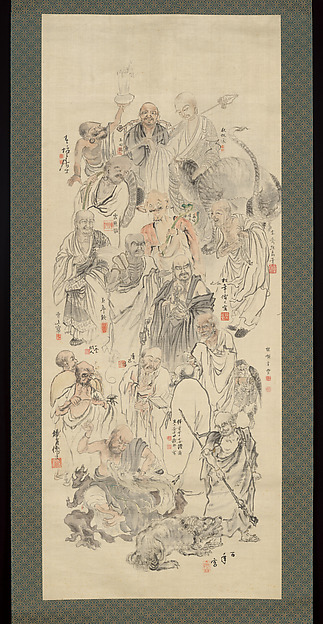
Suzuki Hyakunen, Japan, late 1870s-early 1880s. Hanging scroll; ink and color on satin; image H. 161.9 cm, W. 66 cm. Metropolitan Museum of Art, 2020.92.
Look closer: Note the dragon and the tiger crouched at the lower edge beneath the crowd of sages, and the many small red seals of the painters.
The Metropolitan Museum of Art, Gift of George Crawford, 2020. Open Access.
At the desk
A rakan carving, scroll or netsuke appears below when we hold one. If none shows, the concierge desk can search for it.
Answered plainly
What is a rakan?
An arhat, one of the Buddha's most advanced disciples (JAANUS).
What did they promise?
To remain in the world and protect the True Law after Shaka's nirvana (JAANUS).
How many are there?
Most often sixteen, eighteen or five hundred (JAANUS).
Who named the sixteen?
The Fazhuji, translated by Xuanzang, lists their names (JAANUS).
Who carved the Edo set?
The monk-sculptor Shōun Genkei, for Gohyaku Rakan-ji (Met, Wikipedia).
Why are they at Zen gates?
Their statues stood in the upper chamber of the sanmon at temples such as Tōfukuji (JAANUS).
Where next
Sources and image credits
- JAANUS, Rakan 羅漢 (Columbia University)
- JAANUS, Jūroku rakan 十六羅漢
- JAANUS, Gohyaku rakan 五百羅漢
- Wikipedia, Arhat
- Wikipedia, Arhat Hall
- Japan Experience, The rakan, the greatest disciples of Buddha
- Metropolitan Museum of Art, Seated Arhat (27.69)
- Metropolitan Museum of Art, Arhat from a series of sixteen Arhats (1975.268.24)
- Metropolitan Museum of Art, Arhats (1975.268.23)
- Metropolitan Museum of Art, The Rakan Handaka Sonja with Dragon (2017.284)
- Metropolitan Museum of Art, Sazai Hall at the Temple of the Five Hundred Arhats (JP2984)
- Metropolitan Museum of Art, Collaborative Painting of Sixteen Arhats (2020.92)
- Cleveland Museum of Art, Rakkan (Arhat), 1991.61
- Cleveland Museum of Art, Arhat, 1979.71
- Cleveland Museum of Art, The Five Hundred Arhats, 1971.16
Last reviewed 28 October 2026. Pictures are public-domain or open-access, each credited beneath it. Diagrams on this page are drawn by Japonista.
Looking for a rakan carving, scroll or netsuke? Tell the concierge desk what you have in mind and we will search Japan for it.
Private concierge
Looking for something in particular?
Describe the piece or the project you have in mind. A senior advisor in Tokyo reads every case file personally and replies within two business days, with fees set out in writing before any work begins.