
Kishimojin
The Mother of Children
Kishimojin
鬼子母神
A demoness who devoured other mothers' children until the Buddha hid one of her own, and who then became the protector of children and of women in childbirth.
Identity card
Know the figure at a glance
- Song robes. JAANUS says she is dressed in Song dynasty robes.
- The fruit. She holds a pomegranate in the right hand (JAANUS); in the legend she vows to eat pomegranates instead of children (Wikipedia). The diagram draws a generic round fruit.
- A child. She may cradle a child in the left arm (JAANUS); the diagram leaves the arm empty.
- More children. She may appear with three, five, seven or nine children (JAANUS).
- A lotus seat. The diagram sets her on a lotus; JAANUS names no seat.
From devourer to protector
The Japan Architecture and Art Net Users System (JAANUS) lists her under the Shingon name Kariteimo, the Japanese form of the Sanskrit Hārītī. It describes her as an Indian deity, the wife of Pāñcika, who was originally considered an evil deity who ate children. Her translated names are Kishimojin, Kangimo and Aishimo.
Wikipedia gives the Chinese Guizimu, also written Helidi or Helidimu, and the Korean Gwijamoshin. In Japan, it says, she is called Kishimojin, and in Shingon Karitei or Kariteimo.
The On-Mark Productions entry on Kariteimo adds the vocabulary of the Japanese hall. It says the Shingon school gave the transliterated names, Kariteimo and Karitei, while the translated names are Kishimojin, also read Kishibojin, and Kangimo, 'the joyful mother'. A third name, Koyasu Kishibojin, marks the form that gives children and an easy delivery. It records the seed syllable as the Sanskrit RO and the mantra as On dodomari kyakitei sowaka. Her husband is Pāñcika, in Japanese Sanshika, whom the page calls a general under Bishamon and whom it connects, by way of the Flammarion guide, with the Mahāvaṃsa.
Wikipedia frames her more widely than any Japanese text does. It calls her a female rākṣasī or yakṣiṇī, a spirit of the natural world, who appears in all Buddhist traditions, a fierce protector of the Dharma and a goddess of fertility in the Mahāyāna. It also records a Tagalog form, Haliti, which shows how far the name travelled. The rest of this chapter follows her from the Indian story to the Gandhāran stone, the Chinese stage and the Japanese festival, and it marks the places where the sources do not agree.
The bowl and the pomegranate
JAANUS gives the story in a few lines: the Buddha hid one of her five hundred children, and this made her understand a parent's suffering at the loss of a child, so she embraced Buddhism. Wikipedia gives the Mahāyāna version in more detail. Hārītī was a rākṣasī of Rajgir, when Gautama Buddha lived there. She had hundreds of yaksha children but abducted and killed other people's children to feed them. The Buddha hid her youngest son, Piṅgala, under his alms bowl.
After searching for him, Hārītī appealed to the Buddha. He asked her to consider how much greater the suffering must be of parents whose only child was devoured. She vowed to protect all children and to eat pomegranates instead of children's flesh. The Buddha then revealed her son under the bowl, and she became the protector of children and of women in childbirth.
On-Mark gathers the Japanese retelling from the Kishimo Sutra and the Binaya Zōji, as quoted in a glossary it cites. In this version the terrified people of the city ask Śākyamuni for help. The Buddha hides her youngest son, whom the page names Binkara. She searches for seven days without success, then asks the Buddha where he is. He rebukes her, makes her vow never to kill again, and returns the child.
A second Japanese telling, which On-Mark attributes to the Udumbara Foundation and Reverend Raido Hirota, hides a daughter instead: her tenth, Sarvasattvojahārī, 'Plunderer of Vital Energy of All Beings'. She searches until she nearly loses her mind. The Buddha leads her to the child and says that by losing one she has learned what other mothers suffer. The page adds a remark of Nichiren, that she hated Śākyamuni because the honest straight string showed up her crookedness. It is a vivid image, and it is one more version rather than a correction of the others.
Mother Dhamma and the jar of rain
The story most Japanese readers know begins with a child-eater. Wikipedia records another beginning that belongs to the Theravāda world. It describes a Thai and Burmese oral story, popular in South-East Asia, that places her origin under the Buddha Vesabhu. In it she is a daughter of Mother Dhamma, born from that mother's compassion after a hungry yaksha infant prayed to her and was nursed. Kubera, king of the yakshas, proposes marriage, and with Mother Dhamma's permission she becomes the mother of all asuras, the demons.
The same account calls her steadfast in ethics, mindfulness and wisdom and credits her with mysterious wealth. In a tale of drought, monks advise the people to pray to Kubera and Hārītī; rain falls, the crops return, and she creates a divine jar of prosperity. Nothing in it resembles the hunting of children. The article gives no dates and no manuscript for the story, so it is best read as a living tradition rather than a text.
The Theravāda version of the Rajgir story, as Wikipedia gives it, is also gentler. She is childless in it and abducts unhappy human babies. The Buddha takes one child to his vihāra. Hārītī searches, then appeals to him, and he asks her to consider the greater suffering of the other mothers. She returns the babies, practises loving-kindness and compassion, and declares herself 'mother of all beings'. The Buddha names her Jagatmātā, 'Mother of All Realms', and some Theravāda schools call her the Supreme Mother who removes obstacles to the Dhamma.
The Mahāyāna version is harsher and the Japanese one harsher still. In the Mahāyāna she is a rākṣasī of Rajgir with hundreds of yaksha children, and she kills other people's children to feed them. She is not childless; her sin is a mother's greed. The difference is worth stating because it shows the story being retold to fit each audience: a childless woman in one, a woman with too many children in the other, and in both a Buddha who answers hunger with a lesson in sympathy.
Yakshis, Kubera and the mothers of India
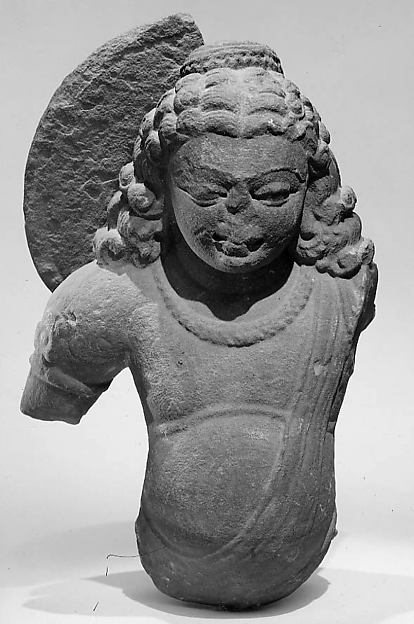
India, 6th century. Red sandstone; 33 cm. Metropolitan Museum of Art, 67.214.
Look closer: Note the heavy face, the curled hair and the broken halo: Kubera, whom the Hopp Museum identifies with Hariti's husband Pancika.
The Metropolitan Museum of Art, Gift of Mrs. Jacob M. Kaplan, 1967. Open Access.
Hārītī was a yakṣiṇī before she was a Buddhist protector, and the yakshis of early India are well recorded in museum collections. The Metropolitan Museum holds a third-century sandstone torso titled Yakshi, 19.7 centimetres high; its record gives no description, and in the photograph a worn, heavy-bodied woman raises one arm. It also holds a first-century BCE wooden plaque from West Bengal, 15.7 centimetres high, titled Plaque with Standing Yakshi, in which a woman with a tall headdress and rosettes stands with a hand on her hip in a beaded border. These are not images of Hārītī, and neither record claims they are. They show the kind of spirit Wikipedia has in mind when it calls her a yakṣiṇī, a female nature spirit shown as a full-bodied woman.
Her husband belongs to the same world. The Hopp Museum, described below, identifies Pāñcika with Kubera, the god of abundance, and the Wikipedia article says Kubera was proposed to Hārītī in the Theravāda story. On-Mark says Pāñcika is a general under Bishamon. These accounts express one idea in different words: a yaksha of wealth stands beside a yakshi of children, and the two are a household. The Metropolitan Museum has a red sandstone Kubera of the sixth century, 33 centimetres high, with a heavy face, curling hair and a halo fragment behind the head. Its record gives no description and says nothing about Hārītī; it is shown here only as the god who, in the Hopp Museum's reading, is her husband.
The same household reaches Japan by another road. Bishamonten has his own chapter in this almanac, and On-Mark makes her husband a general under Bishamon, so a reader who knows the warrior king of the north will meet Kishimojin's family again in his court. The pair is a reminder that the Buddhist heaven is a household as well as an army.
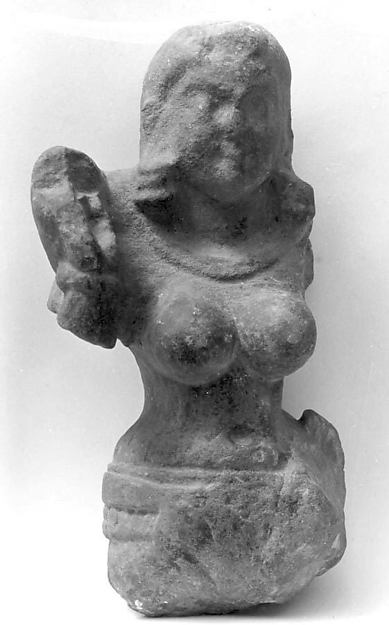
India, 3rd century. Brown sandstone; 19.7 cm. Metropolitan Museum of Art, 33.50.1.
Look closer: Note the full body and the raised arm: a yakshi of the third century, the kind of spirit from whom Hariti descends.
The Metropolitan Museum of Art, Rogers Fund, 1933. Open Access.
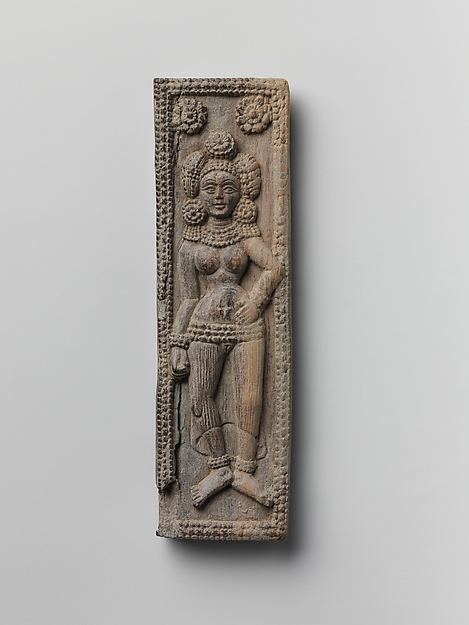
India (West Bengal), 1st century BCE. Wood; 15.7 cm. Metropolitan Museum of Art, 1999.203.
Look closer: Note the rosettes beside her headdress and the hand on her hip: a standing yakshi of the first century BCE.
The Metropolitan Museum of Art, Purchase, Friends of Asian Art Gifts, 1999. Open Access.
Hārītī in Gandhāra
Wikipedia lists Gandhāran images with dates: Hārītī with children, front and back views, first century BCE; a rondel with the goddess Hārītī, first century CE; Hārītī and Pāñcika, about the second century CE; and a seated Hārītī with children from the Yusufzai country near Peshawar, second to third century CE, in the British Museum. It names two common types: a monumental yakshī accompanied by or carrying children, and a seated figure with children.
The Metropolitan Museum holds one of the rondels: a silver disc with gold foil, about the first century, 8.9 centimetres across, from the ancient region of Gandhāra, titled Rondel with the Goddess Hariti. A gilded face rises from a seated figure in the centre, holding a child, with a vessel on a stand beside her, inside a border of petals and beads.
A relief in the Hopp Ferenc Museum in Budapest, accession number 50.43.1, shows the couple together. The museum dates it to the second to fourth century CE, in grey schist, 19.5 centimetres high and 19 centimetres wide, and describes two seated figures, Pāñcika, whom it also identifies as Kubera, the god of abundance, and his wife Hārītī. Their hairstyles and clothing are Hellenistic and they sit in a Western posture. Hārītī holds a lotus in her right hand, and her missing left hand is presumed to have held a cornucopia. The museum's own description calls the stone both 'grey schist' and 'Himalayan grey slate', which do not agree, and this page repeats the first.
The most thorough English account of the Gandhāran images is a 2002 University of Oregon master's thesis by Jennifer Gilmanton Rowan, titled Danger and Devotion: Hariti, Mother of Demons in the Stories and Stones of Gandhara. It translates six Buddhist texts on Hārītī in its appendices and catalogues the images by site. This page read the visible part of the thesis and its companion page of photographs, and it uses only what they state. The thesis names a Hārītī with a child on an auspicious pot at Takht-i-Bahi, a four-armed Hārītī with a trident at Sahri-Bahlol, and Hārītī with children at Sikri, Shaikhan Dheri and Nimogram. It records an inscribed image from Skarah Dheri dated 'year 399', and says the era of that date is uncertain, with proposals running from the second century BCE to 342 CE.
The companion page of photographs describes eight images. The tall schist stele from Sahri-Bahlol, now in the Peshawar Museum, is 122 centimetres high and dated to the second to fifth century CE: a rigidly frontal, four-armed goddess holding a trident, a waterpot, a footed cup and a small seated child, with two small worshippers beside her. The page says the identification is difficult because of the extra arms and unusual attributes. The 'Yusufzai' Hārītī in the British Museum is grey schist, 77 centimetres high: she sits on a backless throne with a naked boy on her lap, other children cluster round her, one holds a parrot, and a larger child sits between her feet. The page sees Iranian influence in the Parthian-style garments. A smaller piece from Shaikhan Dheri, of the early second century CE, shows her on an elaborate throne among several children, holding a cluster of grapes.
The Kushan setting matters because the Kushan kings issued coins with goddesses of abundance. The thesis notes that Kanishka's coins show non-Buddhist deities including Ardokhsho and Pharro, and links them to the cornucopia-goddess imagery it studies. Its photograph page shows a green micaceous schist panel from Shnaisha Gumbat, 26 centimetres high, dated to the reign of Huvishka, about the second century CE, in which a goddess sits on a cushion of coins holding a cornucopia between two donors, and it calls her Ardokhsho-Hārītī. Wikipedia makes the same point from the Greek side: her Gandhāran imagery resembles that of the Greek goddess Tyche, with the cornucopia, the rudder and the wheel of fortune, and it suggests transmission through the Greco-Buddhist world.
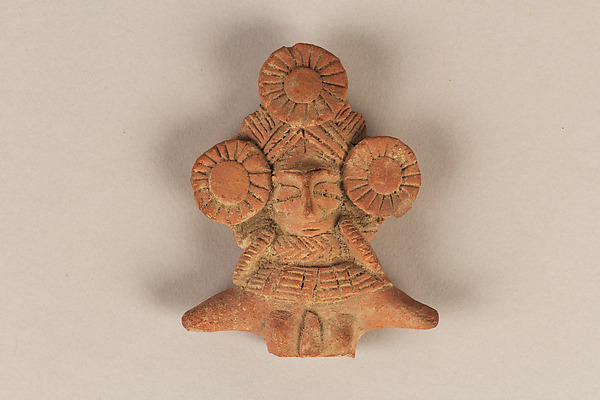
Pakistan (ancient region of Gandhara), 2nd century BCE. Terracotta; 8.9 cm. Metropolitan Museum of Art, 2000.284.21.
Look closer: Note the large round rosettes at each side of the headdress: a mother goddess of Gandhara from before the Buddhist images of Hariti.
The Metropolitan Museum of Art, Samuel Eilenberg Collection, Bequest of Samuel Eilenberg, 1998. Open Access.
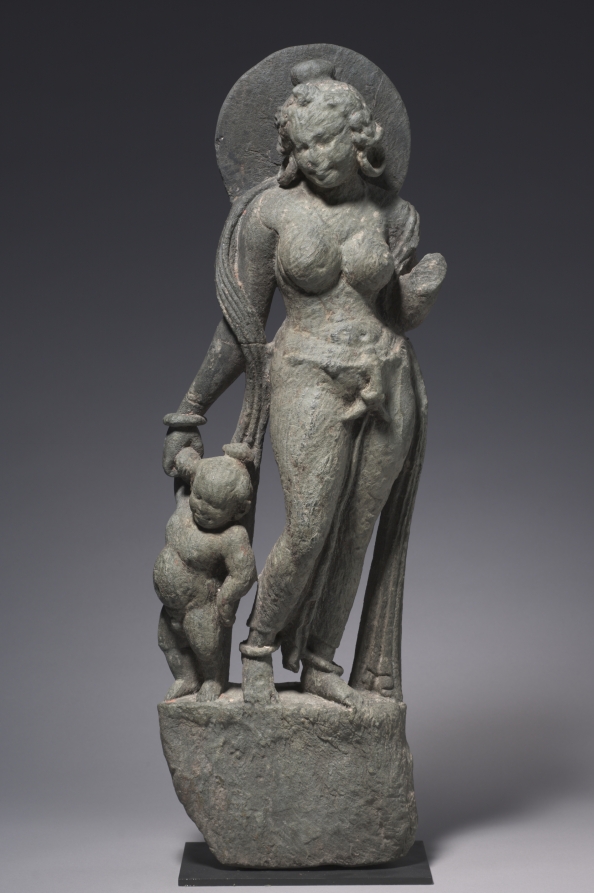
Northwestern India, Rajasthan, Udaipur District, c. 600. Schist; 79.4 x 23.2 cm. Cleveland Museum of Art, 1970.12.
Look closer: Note the hand closed round the toddler's wrist and her patient, smiling face: the Cleveland Museum says sets of such mothers were installed in shrines near temple entrances.
Cleveland Museum of Art, Purchase from the J. H. Wade Fund. Open Access (CC0).
Guizimu on the Chinese stage

China, Tang dynasty (618–907). Ivory; 8.7 cm. Cleveland Museum of Art, 1915.333.
Look closer: Note the baby cradled against her chest and the lotus base beneath her feet: the protector of children in Tang ivory, 8.7 centimetres tall.
Cleveland Museum of Art, Gift of A. W. Bahr. Open Access (CC0).
Wikipedia says her worship in China dates from the translation of Buddhist scriptures between the Western Jin (266 to 420) and the Tang (618 to 907). In the Song (960 to 1279) and Yuan (1271 to 1368) her story became a popular subject of zaju opera, and the jiebo scene, raising the alms-bowl, a favourite motif. She is usually counted among the Twenty-Four Protective Devas and is often enshrined in the Daxiong Baodian, the main hall. She appears in the Shuilu Fahui ceremonies, and in Yunnan she is venerated as Baijie shengfei.
The Met owns a seventeenth to eighteenth century Chinese handscroll titled Raising the Alms-Bowl, ink, colour and gold on paper, 27.3 by 106 centimetres: a crowd of figures beneath pines and clouds, which matches the subject Wikipedia names as the jiebo scene.
The Chinese record is long and layered. Wikipedia says she is known there as Helidi or Helidimu as well as Guizimu. The Shuilu Fahui, to which she is invited in modern practice, are multi-day rites of universal salvation at which offerings and teachings are given to all beings, and a Shuilu painting of her is usually enshrined beside those of other worldly deities. In Yunnan, it adds, she merged with local fertility goddesses; Baijie shengfei means 'White Sister Consort'. Wikipedia also records a darker folk memory in which she frightens irresponsible parents and unruly children.
The article cites a 2024 paper by Shi Mengjie in Humanities and Social Sciences Communications, 'From deity to demon: the rise and fall of Hārītī worship in China'. The publisher's page for that paper was not available to this writer, so this page does not describe its argument and mentions the title only because Wikipedia relies on it.
The Cleveland Museum of Art holds a small Tang ivory, titled Hariti Statuette and dated 618 to 907, 8.7 centimetres high. The museum's record gives no description. In the photograph a standing figure in long robes, head missing, holds a child against her chest and stands on a lotus base set on a dark stand. The Tang date puts it within the period during which, on Wikipedia's account, the scriptures that introduced her were still being translated.
Men Brajut at Trowulan
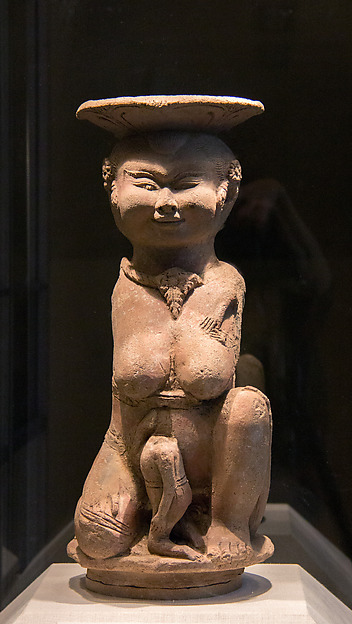
Indonesia (East Java, Trowulan), 14th–15th century. Terracotta; 48 cm. Metropolitan Museum of Art, 2009.321.
Look closer: Note the flat disc on her head and the small child at her knee: the same mother, in the terracotta workshops of East Java.
The Metropolitan Museum of Art, Gift of Jaap Polak, 2009. Open Access.
The same figure appears in island Southeast Asia. The Met holds a terracotta from Trowulan in East Java, fourteenth to fifteenth century, 48 centimetres high, titled The Mother Goddess Men Brajut (Hariti): a seated woman with a broad flat headdress and a small child at her knee.
The Met's record gives no description, so the photograph is the guide: the disc on her head is flat like a tray, and the child leans against her knee. The Museum's title joins a local name, Men Brajut, to the Indian one, and this page does not guess at why. Wikipedia adds that in Nepalese Vajrayana she is revered as a protection goddess, and On-Mark records a Tibetan form that holds a child to her breast with a mongoose, the nakula, and a dispenser of riches. It also mentions an Ajanta image in Cave 2, seated at ease above a frieze of naked children, and Javanese and Central Asian examples, without giving dates.
Ten daughters and the twenty-sixth chapter
Japanese worship of Kishimojin is bound to the Lotus Sutra. JAANUS says she and the ten female rasetsunyo, the ten rākṣasī women, were counted as protectors of the sutra and may be painted with it. On-Mark places her vow in the twenty-sixth chapter, the Dhāraṇī chapter, in which she and her daughters pledge to protect those who practise the sutra. Wikipedia says that Nichiren Buddhism calls her, in that chapter, the Mother of Devil Children, and notes that she is named as a protector in the Candragarbha Sūtra. The Japanese retelling in On-Mark says the ten were originally Hindu rākṣasīs who fed on the dead and became guardians when they joined Buddhism; it also admits that other accounts do not treat them as her daughters at all. Wikipedia says that in some variants they are her daughters or granddaughters, and that they take part in the abductions.
On-Mark's table of the ten, taken from the Digital Dictionary of Chinese Buddhism, gives the names in three languages. It is reproduced here with one change: the two entries for which the page gives no meaning say so. The list is useful because the ten are painted with her, and because the names read like a catalogue of a demoness's household, with crooked teeth, flowery teeth, black teeth and long tresses.
The Metropolitan Museum owns a Korean Lotus Sutra of about 1340, volume two of an accordion-fold manuscript in gold and silver on indigo-dyed mulberry paper, 22.9 by 11.4 centimetres for the image. The record gives no description beyond the medium and does not say which chapter the pages contain, so this page treats it only as the kind of book Kishimojin was believed to protect. In the photograph a cover with an ornate title label stands at the right, columns of gold script fill the left, and a small scene of figures among trees fills the centre.
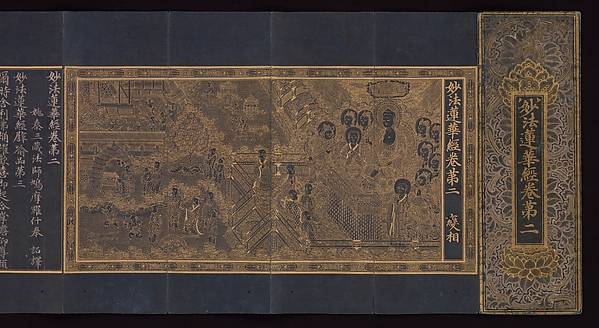
Unidentified artist, Korea, ca. 1340. Accordion-fold book; gold and silver on indigo-dyed mulberry paper; 22.9 x 11.4 cm. Metropolitan Museum of Art, 1994.207.
Look closer: Note the columns of gold script and the small scene among trees: the kind of Lotus Sutra volume that, in Japan, she and her ten daughters were believed to guard.
The Metropolitan Museum of Art, Purchase, Lila Acheson Wallace Gift, 1994. Open Access.
| Japanese | Sanskrit | Chinese | Meaning (On-Mark) |
|---|---|---|---|
| Ranba | Lambā | 藍婆 | Trapped or Ensnared |
| Biranba | Vilambā or Pralambā | 毘藍婆 | Not given |
| Kyōshi | Kūṭadantī or Mālākūṭadantī | 曲齒 | Crooked Teeth |
| Keshi | Puṣpadantī | 華齒 | Flowery Teeth |
| Kokushi | Makuṭa | 黑齒 | Black Teeth |
| Tahotsu | Keśinī | 多髮 | Many Tresses, Long Haired |
| Muensoku | Acalā | 無厭足 | Insatiable |
| Jiyōraku | Mālādhāri | 持瓔珞 | Necklace Holder |
| Kōtai | Kuntī | 皐帝 | Not given |
| Datsu Issai Shūjō Shōki | Sarvasattvojahārī | 奪一切衆生精氣 | Spirit Snatcher |
Kariteimo in the Japanese hall
JAANUS says monasteries worshipped her as a protector of the faith, and the general public as a protector of children. Together with the ten female rasetsunyo, she was considered a protector of the Lotus Sutra, and may be painted with them. Her iconography follows the Dai yakusha nyo kangimo narabi ni aishi jōjuhō. She is dressed in Song dynasty robes, holds a pomegranate in her right hand and may cradle a child in her left arm, with three, five, seven or nine children.
Wikipedia adds that in Japan she is regarded as an aspect of Kannon, with the epithets Bringer of Happiness and Giver of Children and Easy Delivery, and that she is revered as a deity of fertility and easy childbirth. In Nichiren Buddhism, it says, she is called the Mother of Devil Children in chapter 26 of the Lotus Sutra.
| Site | Image (JAANUS) |
|---|---|
| Daigoji, Kyoto | Late Heian painting |
| Onjōji (Miidera), Shiga Prefecture | Kamakura period sculpture |
| Tōdaiji, Nara | Late Heian to Kamakura period sculpture |
How the Japanese hall shows her
On-Mark gives several pictorial types that the single line in JAANUS does not. A seated sculpture sets her on a chair among naked or half-naked children, usually three, five, seven or nine. A standing one holds a lotus in the right hand, which the page calls an attribute of Kannon. A painting seats her under an octagonal canopy capped with a jewel, holding a fly-whisk, with two young girl attendants. It also names two sculptural styles made for Nichiren believers and priests, a 'demon style' and a 'celestial maiden style', and credits the modern examples it shows to a website, butsuzou.com, not to a museum.
The pomegranate is the constant. On-Mark says it is held in the right hand and signifies fertility because of its many seeds. In the legend of Wikipedia she vows to eat pomegranates in place of children, so the fruit is also the sign of her vow. The pomegranate is therefore both a symbol of children, in its seeds, and a sign of children spared, in the story. Look for it first when a figure is not labelled.
Kannon and Kishimojin overlap in another way. On-Mark says Koyasu Kannon, the form that gives children, was worshipped from the fourteenth century, possibly through Nichiren's influence, and repeats a tradition that an eighth-century Koyasu Kannon was modelled on Empress Kōmyō, who lived from 701 to 760 and became a nun in 749. The page gives that tradition without verification, and so does this page.
A standing goddess at Onjōji
Onjōji, also called Miidera, stands above Lake Biwa at Ōtsu in Shiga Prefecture. Its museum's page on the Gohō Zenshin standing statue gives the clearest account of a Japanese image of her. The statue is of the Heian period, twelfth century, 159.1 centimetres high, carved from a single piece of cypress in shallow relief and painted, and kept in the Gohō Zenshin shrine, a tutelary shrine of the temple. It shows a standing goddess in Tang-style clothing holding a pomegranate in her left hand, with a calm face and less elaborate drapery than many similar works. The museum treats the deity as equivalent to Kishimojin, also called Kariteimo. The present shrine building was rebuilt in 1727, the twelfth year of Kyōhō. The page's designation line reads Important Cultural Property, though its header lists the shrine as a Cultural Property of the City of Ōtsu, so the exact status is worth confirming with the temple.
On-Mark describes two Onjōji images and does not always agree with that museum page. It lists the Gohō Zenshin as Heian, twelfth century, wood with pigment, 159.1 centimetres, matching the museum. It also shows a smaller painted wooden Kariteimo of the Kamakura period, early thirteenth century, 43.9 centimetres high and designated an Important Cultural Property, holding a baby, and cites a 2002 book on hidden Buddhas of Japan as its source. JAANUS speaks of a Kamakura period sculpture at Onjōji, so these are different objects or different dating habits, and the sources do not say which.
A second disagreement concerns the hand. JAANUS says she holds a pomegranate in her right hand; the Onjōji museum says her left. It is a small point, but it shows how easily a standard description fails when a real figure is measured. The statue is a good reason to look before quoting a rule.
A thousand dumplings in May
The Onjōji museum records that the Sendango festival was established in 1363 to commemorate the rebuilding of the shrine by Ashikaga Takauji, the first shogun of the Muromachi shogunate, who lived from 1305 to 1358 and held office from 1338. A thousand sweet rice dumplings, sendango, are offered for the safe delivery of babies and the wellbeing of children. During the festival, in the rite called Hōjō-e at Hōjō Pond in front of the shrine, parents write their children's names on turtle shells and release the turtles into the water. The museum says the event has been a symbol of Ōtsu for more than six hundred years.
On-Mark gives the same festival as Kishibojin Mairi, the Festival of a Thousand Dumplings, held at Miidera from 16 to 18 May. It says pilgrims pray for the safe growth of children and that clay dolls called sukusuku ningyō are sold. It also gives a different reason for the dumplings, which it says honour the souls of the children she devoured. The museum's page says they are offered for safe birth and healthy children. The explanations may belong to different layers of the tradition, but they are not the same, and this page cannot say which is older.
The page adds a further tradition from the blog of Gabi Greve, which it cites: that Miidera held hot-water newborn-bathing ceremonies for three emperors in the eighth century. This page repeats it only as a claim made by a blog and has not checked it. On-Mark also says that Mii-dera declared independence from Enryakuji in the thirteenth century, and that Raigō, a Tendai monk of the eleventh century who lived from 1004 to 1084, is the origin of a tale about a thousand rats. These are interesting threads, but the page does not tie them to Kishimojin in a way that this chapter can verify.
Zōshigaya and its Edo-period halls

Utagawa Kuniyoshi, Japan, 1835–36. Woodblock print; ink and color on paper; 24.8 cm. Metropolitan Museum of Art, JP1422.
Look closer: Note the red-robed monk against the snow and the huts below the pine: Nichiren on Sado Island, the teacher through whom she became a protector of the Lotus Sutra.
The Metropolitan Museum of Art, Rogers Fund, 1922. Open Access.
The best-known Tokyo shrine to her stands at Zōshigaya, and On-Mark names it, with Meguro, as the best-known place of worship in the city. The Visiting Japan guide says the Zōshigaya Kishimojin-dō was founded in 1578 and that the present complex was built in the Edo period and is an Important Cultural Property. The main hall, the honden, was built in 1664, the hall of worship, the haiden, in 1700, and the Myōkendō, a hall to Myōken, the bodhisattva of the North Star, in 1788. Wooden ema decorated with pomegranates hang at the entrance, and two small stone Niō stand there. A torii once stood at the gate, and was removed in the late nineteenth century when the state separated Buddhism and Shinto.
The Tokyo Metropolitan Library's entry on a print from the Guide to Famous Spots of Edo gives a different founding. The guide, compiled by Saitō Chōshū and painted by Hasegawa Settan, was published between 1834 and 1836, Tempō 5 to 7, and its fourth volume shows the Zōshigaya Kishimojin-dō. According to the entry the temple began in 1561, the fourth year of Eiroku, when Yamamura Tan'emon dug up an image of Kishimojin from a well near present-day Mejirodai and enshrined it at Tōyōbō, a structure later joined to Hōmyōji. The entry adds that the temple drew many worshippers, as did Kishimojin in Iriya. The dates 1561 and 1578 do not agree, and neither source explains the gap.
The hall is managed by Hōmyōji, a Nichiren temple that Visiting Japan says is said to have been founded in 810. The temple did not survive the war, and the present buildings are a post-war reconstruction. The annual Oeshiki, held from 16 to 18 October, commemorates the death of Nichiren, whose connection to her is long. On-Mark says she was popularised in the Kamakura period by Nichiren, who lived from 1222 to 1282, and mentions two stories this chapter can only report: that a well-known image at Hokekyōji in Chiba is said to have been carved by Nichiren, and that a scroll of Kishimojin and the Ten Female Demons by Hasegawa Tōhaku, who lived from 1539 to 1610, was discovered at Myōdenji in Toyama Prefecture in 2003, according to a Japan Times report of January 2003 that the page cites.
Separating her from the neighbours
A standing or seated woman among children, with a pomegranate in one hand, is Kishimojin. The fruit and the children together are the test, and the Song-style robes JAANUS mentions are the dress. Children alone can mislead, for Koyasu Kannon is also shown with a child; the pomegranate points to Kishimojin, and the lotus in the right hand of a standing figure points, in On-Mark's account, towards Kannon. A woman with a wish-granting jewel in the left hand is Kichijōten, who has her own chapter, and a woman with a biwa is Benzaiten.
A second test is the company. If ten female figures stand with her, they are the rasetsunyo and the sutra is the Lotus. On-Mark's painted type has two young girl attendants beside her, and its sculpted type has the children around her chair, so count the company before naming the figure. A pomegranate carved on a wooden ema, as at Zōshigaya, tells a visitor which hall they are in even when the image is hidden.
On-Mark says that in Gandhāra she is sometimes shown as a bodhisattva with visible fangs. The Onjōji museum describes the Japanese statue as calm in appearance, and none of the Japanese descriptions read for this chapter mention fangs. The figure looks gentle because, in the story, the vow has already been made.
Ten small facts
- The Onjōji statue is 159.1 centimetres high and carved from a single piece of cypress (Onjōji museum).
- The Sendango festival was established in 1363 and offers a thousand sweet rice dumplings (Onjōji museum).
- Parents write their children's names on turtle shells and release the turtles into Hōjō Pond (Onjōji museum).
- The Zōshigaya main hall dates from 1664, the hall of worship from 1700 and the Myōkendō from 1788 (Visiting Japan).
- The Oeshiki at Zōshigaya runs from 16 to 18 October (Visiting Japan).
- The Sahri-Bahlol stele shows a four-armed Hārītī and is 122 centimetres high (Oregon thesis photographs).
- Wikipedia records a Tagalog form of her name, Haliti (Wikipedia).
- The Thai-Burmese story makes her a daughter of Mother Dhamma, born under the Buddha Vesabhu (Wikipedia).
- The Cleveland Tang ivory of Hariti is only 8.7 centimetres tall (Cleveland Museum of Art).
- The ten rasetsunyo include Crooked Teeth, Flowery Teeth and Black Teeth (On-Mark).
Across Asia
One mother, one lesson, in many scripts.
| Where | Form and name | What the record shows |
|---|---|---|
| Gandhāra | Hārītī; Pāñcika | Hārītī with children, with her husband Pāñcika, from the first century BCE (Wikipedia, Met). |
| China | Guizimu 鬼子母 | One of the Twenty-Four Protective Devas; the raising of the alms-bowl a stage and scroll motif (Wikipedia). |
| Korea | Gwijamoshin 귀자모신 | The Korean reading (Wikipedia). |
| Java | Men Brajut | A terracotta Hariti of the 14th to 15th century at Trowulan (Met). |
| Japan | Kishimojin 鬼子母神; Kariteimo 訶梨帝母 | Protector of children and of the Lotus Sutra (JAANUS). |
| South-East Asia | Hārītī, Haliti | A Thai-Burmese story of Mother Dhamma's daughter, and a Tagalog form of the name (Wikipedia). |
| Nepal and Tibet | Hārītī | A protection goddess in Nepalese Vajrayāna; in Tibet, a figure with a child and a mongoose (Wikipedia, On-Mark). |
| Tang China | Hariti Statuette | An 8.7-centimetre ivory in Cleveland, dated 618 to 907. |
A mother among the heavens
Kishimojin belongs to the Heavenly Beings, as a converted deity of Indian origin who guards both the faith and the household.
| Companion | Why they meet |
|---|---|
| The ten rasetsunyo | Female guardians of the Lotus Sutra, painted with her (JAANUS). |
| Kannon | She is regarded as an aspect of Kannon in Japan (Wikipedia). |
| Pāñcika | Her husband in the Indian record (JAANUS). |
Where to see her
| Place | What to look for |
|---|---|
| Daigoji, Kyoto | A late Heian painting (JAANUS). |
| Onjōji (Miidera), Shiga | A Kamakura period sculpture (JAANUS). |
| Tōdaiji, Nara | A sculpture of the late Heian to Kamakura period (JAANUS). |
| Metropolitan Museum of Art, New York | A Gandhāran silver rondel, a Javanese terracotta and a Chinese handscroll, in open access. |
| Onjōji (Miidera), Ōtsu, Shiga | The 159.1-centimetre Heian standing statue in the Gohō Zenshin shrine, and the Sendango festival each May (Onjōji museum). |
| Zōshigaya Kishimojin-dō, Tokyo | Edo-period halls of 1664, 1700 and 1788 under Hōmyōji (Visiting Japan). |
| Cleveland Museum of Art | A Tang ivory Hariti and a Rajasthan mother goddess, both in open access. |
| Peshawar Museum and British Museum | Gandhāran Hārītī images (Oregon thesis photographs). |
Two views in the Metropolitan Museum
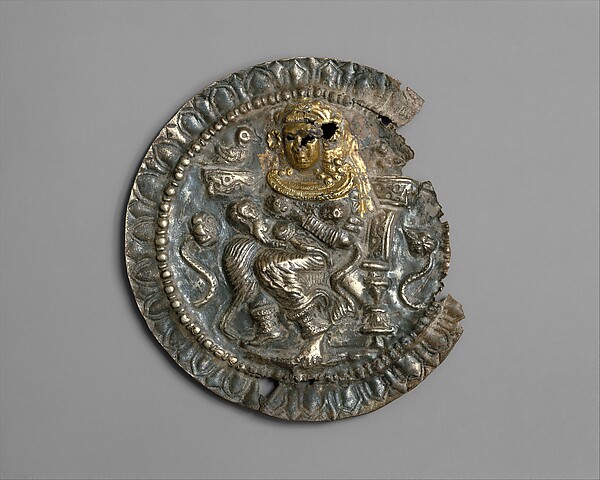
Pakistan (ancient region of Gandhara), ca. 1st century. Silver with gold foil; Diam. 8.9 cm. Metropolitan Museum of Art, 1981.460.2.
Look closer: Note the gilded face and the child held in her arms.
The Metropolitan Museum of Art, Gift of Steven Kossak, The Kronos Collections, 1981. Open Access.
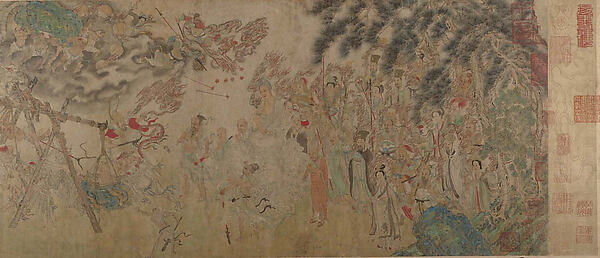
China, 17th to 18th century. Handscroll; ink, colour and gold on paper; 27.3 x 106 cm. Metropolitan Museum of Art, 27.24.
Look closer: Note the crowd gathered under the pines; the Met's title names the episode Wikipedia calls jiebo.
The Metropolitan Museum of Art, Rogers Fund, 1927. Open Access.
At the desk
No Kishimojin piece is on the shelves today. If one arrives it will appear here; meanwhile the concierge desk can look for a figure, scroll or print.
A short glossary
- Kishimojin (鬼子母神)
- 'Mother of demon children', the Japanese translated name of Hārītī.
- Kariteimo (訶梨帝母)
- The Shingon transliteration of Hārītī.
- Kangimo (歓喜母)
- 'The joyful mother', another translated name.
- Koyasu Kishibojin (子安鬼子母神)
- The form who gives children and an easy delivery.
- Jūrasetsunyo (十羅刹女)
- The ten rākṣasī women who guard the Lotus Sutra with her.
- Pāñcika (散脂迦)
- Her husband in the Indian story, a yaksha general; Sanshika in Japanese.
- Yakṣiṇī
- A female nature spirit of early India.
- Rākṣasī
- A female demon of Indian lore; Hārītī is called one in Wikipedia.
- Kubera
- The yaksha king of wealth, linked with Pāñcika.
- Hōkekyō (法華経)
- The Lotus Sutra, which she and her daughters swear to protect.
- Honden (本殿)
- The main hall of a shrine or temple, where the principal image stands.
- Haiden (拝殿)
- The hall of worship in front of the main hall.
- Hōjō-e (放生会)
- The rite at Onjōji, during the Sendango festival, in which turtles are released into the pond.
- Sendango (千団子)
- The thousand dumplings offered at Onjōji each May.
- Oeshiki (御会式)
- The Nichiren memorial rite held at Zōshigaya in October.
Answered plainly
Who is Kishimojin?
The Japanese form of Hārītī, a demoness who ate children until the Buddha converted her, and now protector of children (JAANUS).
How did the Buddha convert her?
He hid one of her children, so that she felt a parent's grief (JAANUS); Wikipedia names the child as Piṅgala, hidden under an alms bowl.
Why a pomegranate?
In the legend she vowed to eat pomegranates instead of children (Wikipedia); she holds one in her right hand (JAANUS).
Is she a Kannon?
Wikipedia says she is regarded in Japan as an aspect of Kannon.
Which sutra does she protect?
The Lotus Sutra, with the ten rasetsunyo (JAANUS).
Where are the oldest Japanese images?
A late Heian painting at Daigoji in Kyoto (JAANUS).
Why is Kishimojin called a mother of demons?
She was a rākṣasī or yakṣiṇī with hundreds of yaksha children before the Buddha converted her (Wikipedia, JAANUS).
What happens at the Sendango festival?
A thousand rice dumplings are offered at Onjōji for safe births and children's health, and parents release turtles marked with their children's names (Onjōji museum).
Which hand holds the pomegranate?
JAANUS says the right; the Onjōji museum says the left for its statue, so look at each image (JAANUS, Onjōji museum).
When was the Zōshigaya hall founded?
Visiting Japan gives 1578 and the Tokyo Metropolitan Library 1561; the sources disagree (Visiting Japan, Tokyo Metropolitan Library).
Who are the ten rasetsunyo?
Ten rākṣasī women, in some accounts her daughters, who vow with her to protect the Lotus Sutra (Wikipedia, On-Mark).
Where next
Sources and image credits
- JAANUS, Kariteimo 訶梨帝母 (Columbia University)
- Wikipedia, Hariti
- Metropolitan Museum of Art, Rondel with the Goddess Hariti (1981.460.2)
- Metropolitan Museum of Art, The Mother Goddess Men Brajut (Hariti) (2009.321)
- Metropolitan Museum of Art, Raising the Alms-Bowl (27.24)
- On-Mark Productions, Kariteimo
- Onjōji museum, Gohō Zenshin standing statue
- Visiting Japan, Zōshigaya Kishimojindō
- Tokyo Metropolitan Library, Zōshigaya Kishimojin-dō
- Hopp Ferenc Museum, Pancika and Hariti
- Rowan, Danger and Devotion (University of Oregon, 2002)
- Rowan, Images of Hariti (University of Oregon)
- Metropolitan Museum of Art, Fragment of a Mother Goddess (2000.284.21)
- Cleveland Museum of Art, Mother Goddess (1970.12)
- Cleveland Museum of Art, Hariti Statuette (1915.333)
- Metropolitan Museum of Art, Yakshi (33.50.1)
- Metropolitan Museum of Art, Plaque with Standing Yakshi (1999.203)
- Metropolitan Museum of Art, Kubera (Dhanada) (67.214)
- Metropolitan Museum of Art, Illustrated manuscript of the Lotus Sutra, Volume 2 (1994.207)
- Metropolitan Museum of Art, Concise Illustrated Biography of Monk Nichiren: In Snow at Tsukahara on Sado Island (JP1422)
Last reviewed 28 October 2026. Pictures are public-domain or openly licensed, each credited beneath it. Diagrams on this page are drawn by Japonista.
Looking for a Kishimojin figure, scroll or print? Tell the concierge desk what you have in mind and we will search Japan for it.
Private concierge
Looking for something in particular?
Describe the piece or the project you have in mind. A senior advisor in Tokyo reads every case file personally and replies within two business days, with fees set out in writing before any work begins.