
Japanese Painting Schools | Japonista
Craft and Ceremony Wing · Brush and Lineage
Japanese Painting Schools
日本画の流派
Japanese painting is best understood as a family of workshops. Each had a founder, a patron, a vocabulary of subjects and a signature way of laying down colour or ink. This chapter introduces the schools in order, using screens and scrolls that can be seen online.
Fact sheet
At a glance
- A family business. Wikipedia calls the Kanō school the dominant style from the late fifteenth century until the Meiji period, and notes it trained painters in a family workshop like Renaissance ateliers.
- Gold as a ground. Rinpa’s standard painting is a simple natural subject with the background filled in with gold leaf, a technique called gold ground.
- A modern word. Nihonga was coined in the Meiji period to distinguish Japanese-style painting from yōga, Western-style painting.
Two Ways to Paint a Landscape
Japanese painting was shaped by two currents. Wikipedia describes yamato-e, “Japanese pictures”, as inspired by Tang dynasty painting and fully developed by the late Heian period, the classical Japanese style. Its marks are many small figures, careful details of buildings, a high oblique view that shows interiors as if through a cutaway roof, stylised landscape, and the “floating cloud”, a band of colour that covers whatever the painter chooses not to show. From the Muromachi period the term was used to distinguish this work from kara-e, “Chinese pictures”, inspired by Song and Yuan ink wash painting.
The article on ink wash painting gives the second current. It emerged in Tang China and, it says, reached Japan through Zen Buddhist monks in the fourteenth century, where the goal was to capture the spirit of the subject rather than copy its appearance. Its materials are the same as those of calligraphy; the artist grinds the ink stick in water to vary the density and varies the ink load and pressure within a single stroke. The Met’s hanging scroll of a splashed-ink landscape, dated early sixteenth century and attributed to Bokushō Shūshō, shows what the technique could do with a handful of washes.

Bokushō Shūshō · early 16th century · Hanging scroll; ink on paper
Bokushō Shūshō, Splashed-Ink Landscape, early 16th century. The Metropolitan Museum of Art, Mary Griggs Burke Collection, Gift of the Mary and Jackson Burke Foundation, 2015 (accession 2015.300.55). Public domain, Met Open Access. Record
Most of what follows is the story of how these two currents were combined, quarrelled and were combined again. The picture below places the lives of the principal masters on one axis.

Dates as given in the cited Wikipedia articles
Look closer: read across to see who overlapped.
Diagram by Japonista. Drawn from the facts cited in this chapter; schematic, not to scale.
Sesshū and the Ink Landscape
Between the court scrolls of the Heian period and the gold screens of the warlords there is a quieter chapter, and it is painted in black. In the Muromachi period (1336 to 1573) ink painting, suibokuga, arrived from China through the Zen monasteries and became a way of seeing as much as a way of painting. Wikipedia’s article on ink wash painting describes the manner: a few tones of ground ink, brushwork that shows the hand, and empty paper left to stand for mist, water or sky. It is the opposite of the coloured, narrative handscroll, and for a century and more the two ran side by side.
The painter who stands for the whole movement is Sesshū Tōyō. Wikipedia gives his birth as about 1420 in Bitchū province and his death as 26 August 1506, adding that sources disagree on his age at death, between 85 and 87. He became a Rinzai Zen monk at Shōkoku-ji in Kyoto, where he studied under Tenshō Shūbun, and in 1467 he sailed to China, where he stayed for about three years and saw at first hand the landscapes that Japanese painters had known only from copies.
Two works are the usual anchors. The Haboku Sansui, a “splashed-ink landscape” scroll dated 1495 and kept in the Tokyo National Museum, is the picture most often chosen to show how far abbreviation could go. The Amanohashidate of about 1502 to 1505 does the opposite, laying out a real sandbar on the Sea of Japan with a map-maker’s patience. Between them they show a painter who could be loose or exact on demand. When Sesshū died, his pupil Shutoku inherited the Unkoku-an studio, and the line continued under that name.
A legend is attached to him that every guide repeats, and it is best told as a legend. As a boy at a temple, the story goes, Sesshū was tied to a pillar as a punishment for drawing when he should have studied, and he drew a mouse on the floor with the tear-wet tip of his toe. The mouse looked so alive that the priest, coming to untie him, saw it move and freed him. Nobody claims the tale is documented. What it records is how the later tradition wanted its first great ink painter to have begun: not by instruction, but by an uncontrollable gift for line.
Pictures catalogued under his name are not all by his hand, and the Metropolitan Museum is open about it. A hanging scroll titled Pavilion on Mountain Stream, held there under Sesshū’s name, is dated by the museum to the seventeenth century, a hundred years after the painter’s death. It shows what a Sesshū-style landscape looked like to the generations that copied him: a tall pine at the cliff’s edge, a small pavilion over water, a sharp pinnacle of rock beyond, and a pale wash of cloud between.

Sesshū Tōyō 雪舟等楊 · 17th century · Hanging scroll; ink on paper
Look closer: a pine leans from a cliff toward a small pavilion on the left, and a tall pinnacle of rock rises at the right behind a band of cloud.
Sesshū Tōyō 雪舟等楊, Pavilion on Mountain Stream, 17th century. The Metropolitan Museum of Art, H. O. Havemeyer Collection, Bequest of Mrs. H. O. Havemeyer, 1929 (accession 29.100.529). Public domain, Met Open Access. Record
Tosa and the Tale of Genji
Wikipedia describes the Tosa school as founded in the early Muromachi period and devoted to yamato-e, with “areas of flat opaque colour enclosed by simple outlines” and narrative subjects from Japanese literature and history. The earliest documentary evidence for a painter using the name is Fujiwara Yukihiro, active 1406 to 1434, known from an inscription on illustrated handscrolls of 1414 at Seiryōji; Tosa Mitsunobu formally founded the school and served as head of the imperial painting bureau, and the family held that post for three generations until 1569. Its fortunes then declined, the post passed to Kanō painters, and Mitsuoki won it back in 1654, reviving the school with elements of Chinese painting and a famous series of paintings of quail.
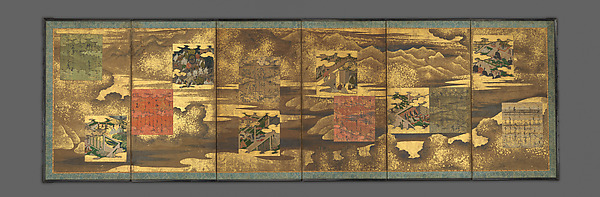
Tosa School · early 17th century · Pair of six-panel folding screens; ink, color, and gold on decorated-paper shikishi (poetry cards)
Tosa School, Scenes and Calligraphic Excerpts from The Tale of Genji, early 17th century. The Metropolitan Museum of Art, Mary and Cheney Cowles Collection, Gift of Mary and Cheney Cowles, 2019 (accession 2019.420.13.1, .2). Public domain, Met Open Access. Record
The subject that defines the Tosa tradition is the Tale of Genji. The Metropolitan Museum has a pair of six-panel screens of the early seventeenth century by the Tosa School in which scenes from the tale are set beside calligraphic excerpts on small cards. A hanging scroll of egrets and cotton roses by Tosa Mitsuoki, dated to the middle or late seventeenth century, shows the same fine line and brilliant colour applied to birds and flowers.
The school was also a bridge. Mitsunobu’s daughter, the article says, married Kanō Motonobu, so Kanō artists worked in a Tosa style when the occasion required, and the Tosa interest in everyday life influenced ukiyo-e, especially through Iwasa Matabei, regarded as one of its founders. That last connection returns in the Ukiyo-e Almanac.
Kanō and the Castle Screen
The Kanō school, according to the same encyclopaedia, was the dominant style of painting from the late fifteenth century until 1868, by which time it had divided into many branches. Founded by Kanō Masanobu (1434 to 1530), a court artist to the Muromachi government and contemporary of Sesshū, it began by reflecting renewed Chinese influence. His son Motonobu established the firmer line and stronger outlines that became its signature, and its painters were professional artists trained in a family workshop, working for nobility, shoguns and emperors. The article quotes the historian Robert Treat Paine on the improbability of another family producing so many men of genius.
The great invention was the castle. The article says the school was instrumental in developing new forms of painting for the castles of the daimyō who emerged in the civil wars of the Azuchi-Momoyama period, and that bold, vigorous styles of bright colour on a gold ground, applied to folding screens (byōbu) and sliding doors (fusuma), appealed to men who had risen by military skill. Many examples were lost to fires. The article adds a practical caveat that matters to anyone who collects: sliding doors were by convention not signed, and screens only rarely, which complicates attribution to painters able to work in several styles.

Kano Eitoku · late 16th century · Two panels of a folding screen, mounted as a hanging scroll; ink, color, gold, and gold leaf on paper
Kano Eitoku, Chinese Women in a Palace Garden, late 16th century. The Metropolitan Museum of Art, H. O. Havemeyer Collection, Bequest of Mrs. H. O. Havemeyer, 1929 (accession 29.100.495g, h). Public domain, Met Open Access. Record
The Met has Kanō work of every register. A six-panel Landscapes of the Four Seasons by Kanō Tan’yū, painted in the 1630s, is monochrome ink on paper, in the Chinese manner the school continued to practise. A pair of screens of 1630 by Kanō Sanraku shows Jinshan Island and West Lake in ink, colour and gold. A hanging scroll mounted from two panels of a screen, assigned to Kanō Eitoku in the late sixteenth century, shows Chinese women in a palace garden against a gold ground, the colourful side of the school. The article adds that from the seventeenth century the school became increasingly conservative and academic, and that it nearly monopolised the teaching of painting in the eighteenth.
Eitoku, Tōhaku and the Castle Rooms
The Kanō school and its rivals had a better feud than most painting schools can claim. Kanō Eitoku, born on 16 February 1543 and dead on 12 October 1590, was the grandson of the school’s founder and was hired by Oda Nobunaga at the age of 34 to decorate Azuchi Castle. Wikipedia describes his style as monumental, taiga, large figures and trees on a vast scale across sliding doors and screens. Most of what he made was destroyed, and the survivors are all the more precious for it.
Hasegawa Tōhaku, born in 1539 in Nanao on the Noto peninsula and dead on 19 March 1610, came to the capital as an outsider and set himself against Eitoku. The Wikipedia entry on him records a rivalry that was real enough to have shaped the careers of both men. His best-known work, the Shōrin-zu screen of about 1595, is a National Treasure: pines emerging from mist, painted in ink alone, so spare that the trees seem to be thinking. At Chishaku-in in Kyoto a series of maple and flower paintings dated 1593 shows the other side of him, a colourist who could rival Eitoku on his own gold ground.
Under both men sat the economics that made the art possible. A castle or a temple needed whole rooms covered at once, and only a workshop of assistants working to a master’s design could do that. This is what Wikipedia means in calling the Kanō school a family business trained like a Renaissance atelier. A man who could not manage a team of painters could not take a commission, which is why the schools had to be schools.
Rinpa, Sōtatsu to Hōitsu
Rinpa began in seventeenth-century Kyoto. Wikipedia says it was created by Hon’ami Kōetsu (1558 to 1637) and Tawaraya Sōtatsu (died about 1643) and consolidated about fifty years later by the brothers Ogata Kōrin (1658 to 1716) and Ogata Kenzan (1663 to 1743). The name is an abbreviation of Kōrin with the word for school, coined in the Meiji period; before that the style was called the Kōetsu school or the Sōtatsu-Kōrin school. Kōetsu founded an artistic community of craftsmen at Takagamine in northeastern Kyoto in 1615, supported by wealthy merchant patrons; Sōtatsu kept an atelier that produced fans and folding screens and decorated paper with gold or silver, to which Kōetsu added calligraphy.

Ogata Kōrin · after 1709 · Pair of six-panel folding screens; ink and color on gold leaf on paper
Look closer: no sky, no horizon: the gold is the whole world.
Ogata Kōrin, Irises at Yatsuhashi (Eight Bridges), after 1709. The Metropolitan Museum of Art, Purchase, Louisa Eldridge McBurney Gift, 1953 (accession 53.7.1, .2). Public domain, Met Open Access. Record
The article gives Rinpa’s standard picture: simple natural subjects, birds, plants and flowers, with the background filled in with gold leaf. Its formats were as various as screens, fans, hanging scrolls, printed books, lacquerware, ceramics and kimono textiles. The Met’s pair of six-panel screens of Irises at Yatsuhashi by Ogata Kōrin, dated after 1709, is the clearest demonstration, with blue iris and green leaves marching across gold beside a zigzag plank bridge. Its two-panel screen of rough waves, dated about 1704 to 1709, shows the same designer drawing water in gold, ink and colour. Sōtatsu’s pair of Moon and Autumn Grasses, mid to late seventeenth century, sets a black half moon above gold grasses.
Revival came in Edo. Sakai Hōitsu (1761 to 1828), a Kanō school artist from a family that had sponsored Kōrin, published a hundred woodcut prints based on Kōrin’s paintings, and painted Summer and Autumn Grasses on the back of Kōrin’s Wind and Thunder Gods screen. The article says Rinpa was incorporated into the Nihonga movement by Okakura Kakuzō in the late nineteenth century.
Maruyama Ōkyo and the Shijō Painters
The eighteenth century brought a different kind of painter, and a different kind of customer. Maruyama Ōkyo, born on 12 June 1733 in Ano-o and dead on 31 August 1795, did not come up through the old studios. Wikipedia says he trained in a toy shop and in megane-e, perspective pictures viewed through a lens, a background that gave him an unusual eye for depth. His Harbour View of 1767 shows the result, and his Pine Trees in Snow of 1773, made for the Mitsui family, became a model for the school that followed.
The idea he brought, drawing from the living subject, is easy to see in the herons the Met holds. In a scroll of 1769 three white herons sit in snow among a few reeds, and Ōkyo paints them by leaving the white paper untouched and darkening only the bills, the legs and the shadows between. The birds are not drawn at all; they are what is left when the dark is taken away. A pair of hanging scrolls of 1770 shows him at the other extreme, a tiger and a dragon, creatures nobody had seen, painted with the same close attention to fur and cloud.

Maruyama Ōkyo · 1770 · Pair of hanging scrolls: ink on silk (dragon), ink and color on silk (tiger)
Look closer: the tiger crouches with its head turned back over its shoulder; the dragon rises from banked grey cloud.
Maruyama Ōkyo, Dragon and Tiger, 1770. The Metropolitan Museum of Art, Mary and Cheney Cowles Collection, Gift of Mary and Cheney Cowles, 2023 (accession 2023.583.16a, b). Public domain, Met Open Access. Record
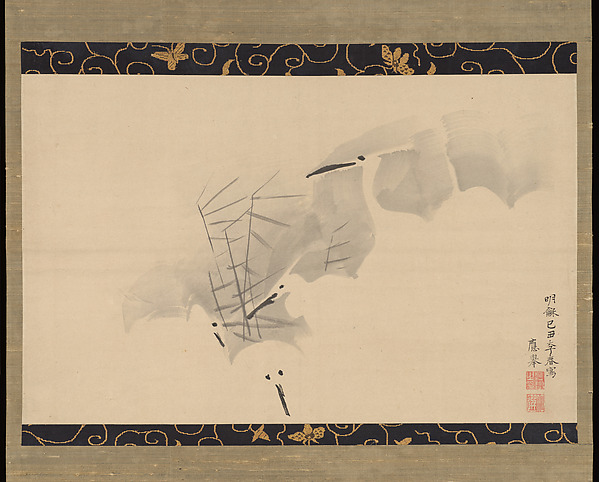
Maruyama Ōkyo 円山応挙 · 1769 · Hanging scroll; ink on paper
Look closer: the herons’ bills and legs are the only strong black; the bodies are paper, defined by pale grey wash around them.
Maruyama Ōkyo 円山応挙, White Herons, 1769. The Metropolitan Museum of Art, The Harry G. C. Packard Collection of Asian Art, Gift of Harry G. C. Packard, and Purchase, Fletcher, Rogers, Harris Brisbane Dick, and Louis V. Bell Funds, Joseph Pulitzer Bequest, and The Annenberg Fund Inc. Gift, 1975 (accession 1975.268.71). Public domain, Met Open Access. Record
His following gave the movement its name. Two of his students are the best known: Nagasawa Rosetsu, and Matsumura Goshun, who joined him in 1787 and who, with others, founded the Shijō school. Wikipedia notes that Shijō painters were supported by the merchants of Kyoto and Osaka, not by the shogunate or the temples, and that the school’s subjects were birds, flowers, landscapes and, in the hands of Mori Sosen, monkeys. A pair of six-panel screens by Goshun of about 1790 to 1795 in the Met shows the temperate side of this world: woodcutters and fishermen moving through low hills and pines in pale ink and light colour.
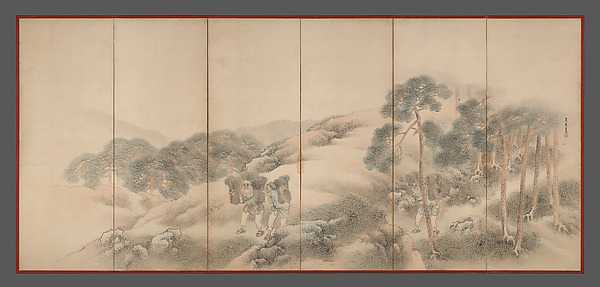
Matsumura Goshun · ca. 1790–95 · Pair of six-panel folding screens; ink and color on paper
Look closer: two men carrying bundles walk through the middle panels; tall pines stand at the right.
Matsumura Goshun, Woodcutters and Fishermen, ca. 1790–95. The Metropolitan Museum of Art, Mary Griggs Burke Collection, Gift of the Mary and Jackson Burke Foundation, 2015 (accession 2015.300.206.1, .2). Public domain, Met Open Access. Record
Jakuchū the Greengrocer
Itō Jakuchū belongs to no school, and that is how he is remembered. Wikipedia gives him a long life, from 2 March 1716 to 27 October 1800, and a day job as the owner of the Masuya, a greengrocer’s in the Nishiki market of Kyoto. About 1757 or 1758 he began the Dōshoku sai-e, a set of 30 hanging scrolls of birds, fish, flowers and insects in intense mineral colour, which he eventually gave to the temple of Shōkoku-ji; it is the work on which his modern fame rests.
Two Met scrolls show the range. White Plum Blossoms and Moon of 1755 is nearly abstract, a thicket of black boughs spangled with white blossom across the full height of the silk, with the moon as a pale disc behind. Hen and Rooster with Grapevine of 1792 is the opposite, a deliberate, almost heraldic portrait of two fowl, the rooster’s tail trailing in long white loops over a branch while the hen glances up from the vine below.

Itō Jakuchū · 1755 · Hanging scroll; ink and color on silk
Look closer: the boughs run dark and angular from bottom to top, and the white blossoms sit on them like frost.
Itō Jakuchū, White Plum Blossoms and Moon, 1755. The Metropolitan Museum of Art, Mary Griggs Burke Collection, Gift of the Mary and Jackson Burke Foundation, 2015 (accession 2015.300.213). Public domain, Met Open Access. Record

Itō Jakuchū · 1792 · Hanging scroll; ink and color on silk
Look closer: the rooster’s tail loops in long white curves down the left side; the hen looks up from the grape leaves at the lower right.
Itō Jakuchū, Hen and Rooster with Grapevine, 1792. The Metropolitan Museum of Art, The Harry G. C. Packard Collection of Asian Art, Gift of Harry G. C. Packard, and Purchase, Fletcher, Rogers, Harris Brisbane Dick, and Louis V. Bell Funds, Joseph Pulitzer Bequest, and The Annenberg Fund Inc. Gift, 1975 (accession 1975.268.69). Public domain, Met Open Access. Record
The reappraisal has been recent. Wikipedia lists a 2018 exhibition, Lineage of Eccentrics, at the Tokyo Metropolitan Art Museum, which set Jakuchū among the other painters of eighteenth-century Kyoto who did not fit the schools. The idea that these were eccentrics is itself a modern one, because in their own day they sold to the same merchants as everyone else.
Nanga, the Literati Tradition
A third strand of the eighteenth century looked back to China, and to the Chinese idea that a painter should be a scholar first. This is nanga, the “southern painting” of Japan, and it rests on a conviction that the best pictures are made by amateurs who paint for themselves and for their friends. Its early star, according to Wikipedia, was Kuwayama Gyokushū, who lived from 1746 to 1799; the article lists a long line of painters after him and notes that Tomioka Tessai, who lived from 1837 to 1924, is considered the last.
Two names stand out in the Met’s collection. Ike no Taiga’s Orchid Pavilion Gathering of 1765 imagines a famous meeting of poets in China, rendering rocks, pines and a river in dense small strokes of ink and light colour, with a column of inscription in the upper right. Yosa Buson, a poet as much as a painter, made a diptych of the early 1770s showing Hanshan and Shide, the two eccentric Chinese monks who were favourite subjects of Zen painters; the pair is drawn in loose, wet ink with a lively, almost caricatured line.
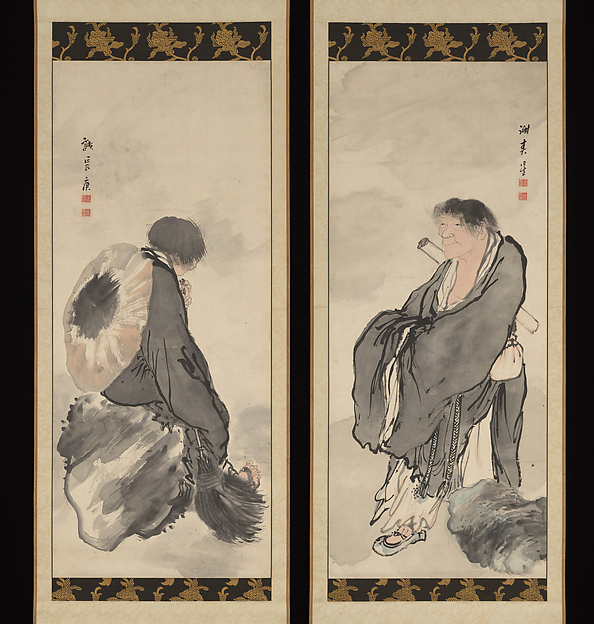
Yosa Buson · early 1770s · Diptych of hanging scrolls; ink and color on paper
Look closer: the left figure sits on a rock facing away with a broom, the right figure stands in long robes; both are drawn in grey wash.
Yosa Buson, Hanshan and Shide, early 1770s. The Metropolitan Museum of Art, Mary and Cheney Cowles Collection, Gift of Mary and Cheney Cowles, 2022 (accession 2022.432.16a, b). Public domain, Met Open Access. Record
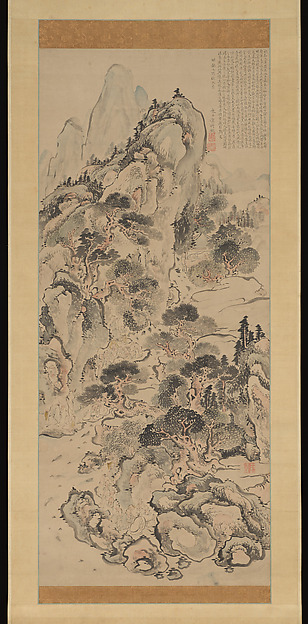
Ike no Taiga · 1765 · Hanging scroll: ink and color on paper
Look closer: pines cluster in the middle of the picture and a waterfall runs down the left; a pale peak rises behind.
Ike no Taiga, Orchid Pavilion Gathering, 1765. The Metropolitan Museum of Art, Mary and Cheney Cowles Collection, Gift of Mary and Cheney Cowles, 2024 (accession 2024.412.12). Public domain, Met Open Access. Record
Tessai’s Life of Reclusion in the Mountains of 1916 closes the story. The painter was almost eighty when he made it, and the picture still tumbles with detail: a waterfall at the top, a roofed house on stilts over a stream, trees in green and ochre, and a scatter of calligraphy in the corner. It is a scholar’s dream of retreat in the age of railways, and the date, 1916, is a reminder that this tradition outlived the shogunate that nourished it.
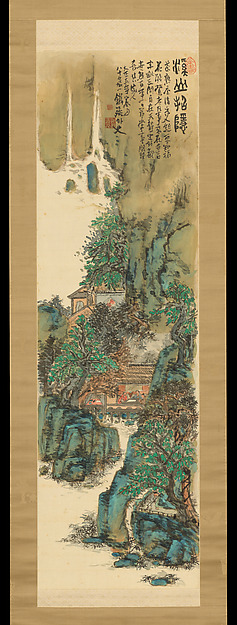
Tomioka Tessai · 1916 · Hanging scroll; ink and color on silk
Look closer: the roofed house sits over a stream in the centre, with blue-green rocks around it and a white waterfall at the top.
Tomioka Tessai, Life of Reclusion in the Mountains, 1916. The Metropolitan Museum of Art, Mary and Cheney Cowles Collection, Gift of Mary and Cheney Cowles, 2025 (accession 2025.981.57). Public domain, Met Open Access. Record
Nihonga and the Meiji Argument
Wikipedia states that the term Nihonga was coined in the Meiji period to differentiate Japanese-style painting from yōga, Western-style painting. Its pigments are typically mineral, occasionally with ink and other organic pigments, on silk or paper. The movement began when Okakura Tenshin and Ernest Fenollosa sought to revive traditional painting in response to the rise of Western-style painting, and Hashimoto Gahō, a Kanō painter, led the practical side, serving as the first professor at the Tokyo Fine Arts School and training Yokoyama Taikan, Shimomura Kanzan, Hishida Shunsō and Kawai Gyokudō. The article adds that before then paintings were classified by school: Kanō, Maruyama-Shijō, and Tosa.
Nihonga was not simply a continuation. The same article says stylistic and technical elements from Kanō, Rinpa and Maruyama Ōkyo were blended, and some Western techniques, perspective and shading, were adopted. For the materials, see the house essay on mineral pigments, shell white and gold leaf.
Yokoyama Taikan and the Hazy Style
Nihonga needed its heroes, and Yokoyama Taikan was the one the state chose. Wikipedia gives his dates as 2 November 1868 to 26 February 1958 and records the Order of Culture, Japan’s highest honour for the arts, awarded to him in 1937. His Metempsychosis of 1924, a long scroll that follows a drop of water from the mountains to the sea and on into the cycle of rebirth, is the work most often cited to explain what he wanted from Japanese-style painting: a philosophy as well as a picture.
He is also remembered for a technique that his critics gave a name. Mōrōtai, the “hazy style” or “vague style”, softened the outlines of Japanese painting in favour of atmosphere, a debt to Western ideas of light that, as Wikipedia notes, drew early ridicule. The next generation did not need to defend the term, because by then the blurred edge had become part of what Nihonga looked like.
The Schools Compared
The table is a summary of the accounts above and of the references listed below.
| School | Begun | Patron | Marks |
|---|---|---|---|
| Tosa | Early Muromachi period | Imperial court | Flat opaque colour, simple outlines, narrative subjects, Genji |
| Kanō | Late fifteenth century, Masanobu | Muromachi and Tokugawa governments, daimyō | Firm outline, gold-ground screens, ink landscape in Chinese manner |
| Rinpa | Kyoto, 1615 onward | Merchants and old aristocratic families | Gold ground, birds and flowers, design across media |
| Nihonga | Meiji period | Government and exhibitions | Mineral pigments; blends earlier schools with Western methods |
Dates from 1420 to 2026
Dates come from the articles cited at the foot of the page. Where a source gives a range, the table says so.
| Year | Event |
|---|---|
| c. 1420 | Sesshū Tōyō born in Bitchū province |
| 1467 | Sesshū sails to China, where he stays about three years |
| 1495 | Haboku Sansui scroll dated, now in the Tokyo National Museum |
| 1506 | Sesshū dies on 26 August |
| 1539 | Hasegawa Tōhaku born in Nanao |
| 1543 | Kanō Eitoku born on 16 February |
| c. 1577 | Eitoku, aged 34, hired by Oda Nobunaga for Azuchi Castle |
| 1590 | Eitoku dies on 12 October |
| c. 1595 | Tōhaku’s Shōrin-zu screen, later a National Treasure |
| 1610 | Tōhaku dies on 19 March |
| 1716 | Itō Jakuchū born on 2 March |
| 1733 | Maruyama Ōkyo born on 12 June |
| 1767 | Ōkyo paints Harbour View |
| 1795 | Ōkyo dies on 31 August |
| 1800 | Jakuchū dies on 27 October |
| 1868 | Yokoyama Taikan born on 2 November |
| 1924 | Taikan’s scroll Metempsychosis; Tessai dies the same year |
| 1937 | Taikan receives the Order of Culture |
| 1958 | Taikan dies on 26 February |
| 2018 | Lineage of Eccentrics at the Tokyo Metropolitan Art Museum |
| 2026 | Hosomi Collection show at the Kyushu National Museum, 21 April to 14 June |
Curiosities of the Studio
A painter’s workshop was a family. Wikipedia’s account of the Kanō school says it ran like a Renaissance atelier, with pupils adopted into the line and the name passed down. The school’s dominance lasted from the late fifteenth century to the Meiji period, and few other artistic institutions in the world have held a style for so long.
The Met’s records show how a school’s name travels. A scroll catalogued under Sesshū Tōyō is dated to a century after his death, and a woodblock-printed book of 1818 gathers copies of works by famous Japanese painters of Chinese subjects. In Japan, copying a master was how a painter learned, and the copies were often kept with respect.
Gold is a ground as well as a colour. Rinpa’s standard painting, says Wikipedia, is a simple natural subject with the background filled with gold leaf. Because the leaf catches the light from different angles, a screen can seem to change from morning to evening in the same room.
Terms Used on This Page
A short vocabulary, in the order a visitor is likely to meet the words.
| Term | Meaning |
|---|---|
| Yamato-e | “Japanese pictures”; the coloured native style of the court scroll |
| Kara-e | “Chinese pictures”; the older imported manner, set against yamato-e |
| Suibokuga | Ink wash painting, introduced from China and developed in Zen monasteries |
| Haboku | “Splashed ink”; a very free, abbreviated manner of landscape |
| Taiga | “Large painting”; the monumental scale of Eitoku and his heirs |
| Byōbu | A folding screen |
| Kakejiku | A hanging scroll |
| Fusuma | A sliding door, painted for castle and temple rooms |
| Rinpa | The decorative school using gold ground, associated with Kōetsu, Sōtatsu and Kōrin |
| Shijō | The school of Kyoto painters who followed Ōkyo and Goshun |
| Megane-e | A perspective picture viewed through a lens, part of Ōkyo’s training |
| Nanga | “Southern painting”; the scholar’s tradition drawing on Chinese models |
| Mōrōtai | The “hazy style” of blurred outlines associated with Taikan |
| Nihonga | “Japanese-style painting”, a Meiji-era term set against yōga |
| Yōga | Western-style painting |
What Is Showing Now
The year 2026 brought the Rinpa and Kyoto traditions to a southern audience. The Magnificent Hosomi Collection: Jakuchu, the Rimpa School, and the Fine Art of Kyoto ran at the Kyushu National Museum from 21 April to 14 June, with admission of 2,000 yen, and included work by Sakai Hōitsu and Suzuki Kiitsu. Hokusai’s Five Beauties was shown only from 19 May.
A modern angle came from Yokohama, where the Yokohama Museum of Art presented Imamura Shikō: A Revolutionary Innovator of Nihonga from 25 April to 28 June 2026. The show is a reminder that Nihonga is a living practice, not a closed period.
The Suntory Museum of Art also announced Kyosai’s World: The Israel Goldman Collection, devoted to the caricaturist Kawanabe Kyōsai; the sources read give conflicting dates, so check the museum before travelling.
Readers most often search for the difference between Kanō and Rinpa, the meaning of nihonga, whether the screens are signed, and where to see the paintings in Kyoto. The answers are in the questions below.
Screens and scrolls from the schools
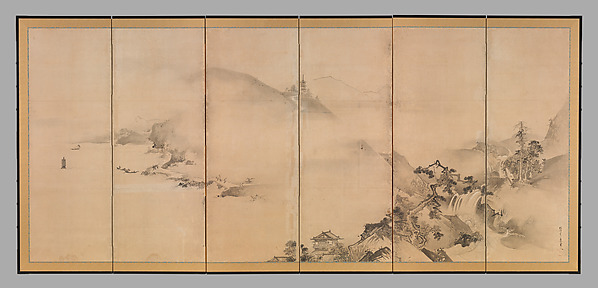
Kano Tan'yū · 1630s · Pair of six-panel folding screens; ink and color on paper
Kano Tan'yū, Landscapes of the Four Seasons, 1630s. The Metropolitan Museum of Art, Mary Griggs Burke Collection, Gift of the Mary and Jackson Burke Foundation, 2015 (accession 2015.300.77.1, .2). Public domain, Met Open Access. Record
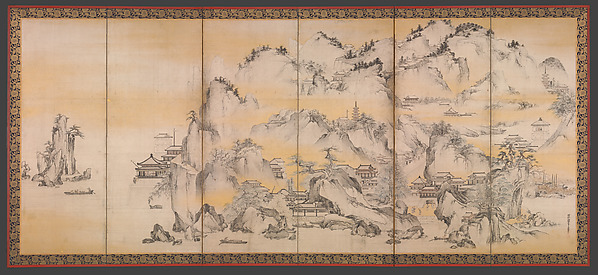
Kano Sanraku · 1630 · Pair of six-panel folding screens; ink, color, and gold on paper
Kano Sanraku, Jinshan Island and West Lake, 1630. The Metropolitan Museum of Art, Mary Griggs Burke Collection, Gift of the Mary and Jackson Burke Foundation, 2015 (accession 2015.300.74.1, .2). Public domain, Met Open Access. Record
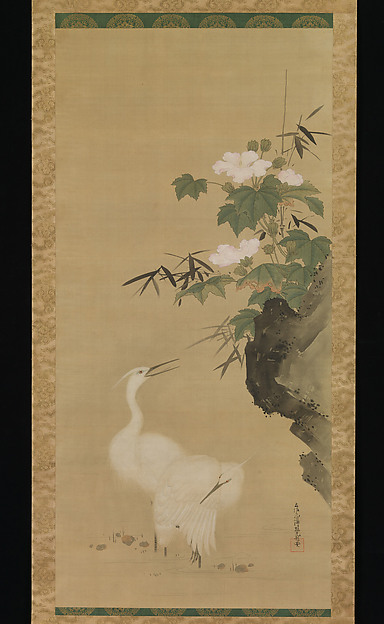
Tosa Mitsuoki · mid- to late 17th century · Hanging scroll; ink and color on silk
Tosa Mitsuoki, Egrets and Cotton Roses, mid- to late 17th century. The Metropolitan Museum of Art, Fishbein-Bender Collection, Gift of T. Richard Fishbein and Estelle P. Bender, 2014 (accession 2014.768.1). Public domain, Met Open Access. Record

Ogata Kōrin · ca. 1704–9 · Two-panel folding screen; ink, color, and gold leaf on paper
Ogata Kōrin, Rough Waves, ca. 1704–9. The Metropolitan Museum of Art, Fletcher Fund, 1926 (accession 26.117). Public domain, Met Open Access. Record
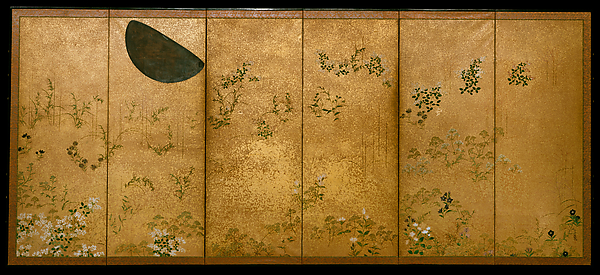
Tawaraya Sōtatsu · mid- to late 17th century · Pair of six-panel folding screens; ink, color, silver, and gold flecks on paper
Tawaraya Sōtatsu, Moon and Autumn Grasses, mid- to late 17th century. The Metropolitan Museum of Art, The Harry G. C. Packard Collection of Asian Art, Gift of Harry G. C. Packard, and Purchase, Fletcher, Rogers, Harris Brisbane Dick, and Louis V. Bell Funds, Joseph Pulitzer Bequest, and The Annenberg Fund Inc. Gift, 1975 (accession 1975.268.60, .61). Public domain, Met Open Access. Record
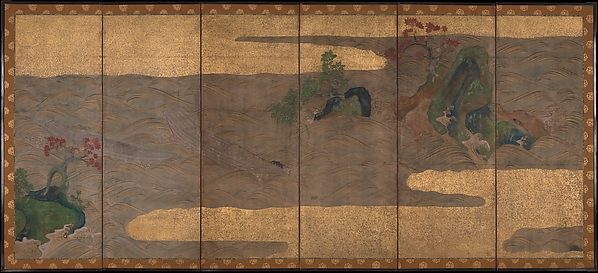
Tawaraya Sōtatsu · mid- to late 17th century · Six-panel folding screen; ink, color, and gold on paper
Tawaraya Sōtatsu, Boats upon Waves, mid- to late 17th century. The Metropolitan Museum of Art, H. O. Havemeyer Collection, Gift of Horace Havemeyer, 1949 (accession 49.35.3). Public domain, Met Open Access. Record
The Scrolls and Screens Shelf
Hanging scrolls, folding screens and related works are gathered on one shelf, each described with its mounting and condition.
Answered plainly
What is yamato-e?
The classical Japanese style of painting, developed by the late Heian period, as distinct from kara-e, Chinese-style pictures.
Which school made the castle screens?
The Kanō school, which developed bold colour-on-gold painting for folding screens and sliding doors in the Azuchi-Momoyama period.
What does Rinpa mean?
An abbreviation of Kōrin and the word for school, coined in the Meiji period.
What is Nihonga?
A Meiji-era term for Japanese-style painting, as against yōga or Western-style painting.
Why are screens so rarely signed?
Wikipedia’s Kanō article notes that sliding doors were by convention not signed and screens only rarely.
Who was Sesshū?
A Rinzai Zen monk and ink painter, born about 1420, who studied in China from 1467 and died in 1506. His Haboku Sansui scroll of 1495 is in the Tokyo National Museum.
What is suibokuga?
Ink wash painting, brought to Japan from China and developed in Zen monasteries during the Muromachi period, using ink alone in varied tones.
Who was Hasegawa Tōhaku?
A painter from Nanao, born in 1539 and dead in 1610, who rivalled Kanō Eitoku. His Shōrin-zu pine screen of about 1595 is a National Treasure.
What is the Shijō school?
A Kyoto school that grew from Maruyama Ōkyo’s teaching, co-founded by Matsumura Goshun and supported by merchants of Kyoto and Osaka.
Why was Itō Jakuchū unusual?
He ran a greengrocer’s in Kyoto, belonged to no school and made a set of 30 scrolls of birds and flowers that he gave to Shōkoku-ji.
What is nanga?
The “southern painting” of Japan, a scholar’s tradition of landscape and figure painting modelled on Chinese literati art. Tessai is considered its last great master.
Who was Yokoyama Taikan?
A Nihonga master, 1868 to 1958, honoured with the Order of Culture in 1937, known for Metempsychosis and the hazy style called mōrōtai.
What is mōrōtai?
The “hazy style”, a manner of softened outlines and atmosphere associated with Taikan and his circle.
Where can I see these paintings?
In Kyoto temples and the Kyoto and Tokyo national museums for the schools discussed here; the Metropolitan Museum of Art holds an open-access selection online, from which the images on this page come.
Where next
References and image credits
- Yamato-e, Wikipedia
- Tosa school, Wikipedia
- Kanō school, Wikipedia
- Rinpa school, Wikipedia
- Nihonga, Wikipedia
- Ink wash painting, Wikipedia
- Sesshū Tōyō, Wikipedia
- Maruyama Ōkyo, Wikipedia
- Shijō school, Wikipedia
- Hasegawa Tōhaku, Wikipedia
- Kanō Eitoku, Wikipedia
- Itō Jakuchū, Wikipedia
- Yokoyama Taikan, Wikipedia
- Metropolitan Museum of Art Open Access: Asian Art collection records (credited beneath each image)
Last reviewed 28 October 2026. Every photograph is public domain or openly licensed and credited beneath it; drawn diagrams are by Japonista.
Looking for a scroll or screen in a particular school? The concierge desk replies within one to three business days.
Private concierge
Looking for something in particular?
Describe the piece or the project you have in mind. A senior advisor in Tokyo reads every case file personally and replies within two business days, with fees set out in writing before any work begins.