
Idaten
The Swift Guardian
Idaten
韋駄天
A young general in Chinese armour who chased a thief to the summit of Mount Meru and came back with the Buddha's ashes, and who has since watched over monks and kitchens.
Identity card
Know the figure at a glance
- A general's helmet. He appears as a young man in the armour and headgear of a Chinese general (Wikipedia); the Met's gilt-brass Weituo wears a winged headdress.
- Chinese armour. JAANUS says the look may come from a famous Chinese general with whom he was conflated, hence the armour.
- Sword or baton. A sword or baton rests across the forearms (JAANUS). Wikipedia describes him leaning on a vajra staff; the diagram draws the vajra.
- Hands in gasshō. Hands joined in gasshō are the Japanese convention (JAANUS), matching the anjali of Chinese temples (Wikipedia).
- On the clouds. The cloud seat stands for his chase to the summit of Mount Meru (Wikipedia).
A war god turned guardian
Idaten begins as Skanda. The Japan Architecture and Art Net Users System (JAANUS) calls him the Indian deity Skanda, son of Shiva and general of Shiva's army, who became a protector of the Dharma in Buddhism. His other Japanese names are Sukanda, Shikenda, Kenda and Ida shōgun, 'General Ida'. Wikipedia lists the Chinese Weituo, the Korean Witaecheon, the Tibetan gdong drug, the Thai Phra Wet Phothisat and the Vietnamese Vi Đà Bồ Tát.
He is named in the Konkōmyōkyō, the Golden Light Sutra, and the Daihatsu nehankyō, though JAANUS notes that neither describes his appearance. Wikipedia adds that he is one of the twenty-four celestial guardian deities mentioned in the Golden Light Sutra and that, although he is a deva, he is often addressed as a bodhisattva.
The Japanese Wikipedia article on Idaten explains how the name was written. It says the word derives from the Sanskrit Skanda, transcribed in Chinese as 塞建陀 or 私建陀, with further forms such as 韋陀 and 韋天将軍. A shortened form, 建駄天, was in use, and the form 違駄天 arose, the article says, from a miscopying of 建駄天 in the Guishin chapter of the Chinese Golden Light Sutra. That spelling then merged with the cult of the Daoist General Wei, 韋将軍, and the result was 韋駄天. JAANUS records the same alternative writing 違駄天 and the variants Sukanda, Shikenda and Kenda, so the two sources agree on the names even where they tell the history of the spelling differently or not at all.
The Japanese article also gives him a place in the hierarchy of the heavens. It says he is one of the eight generals under Zōchōten (Virūḍhaka) and ranks first among the thirty-two generals under the Four Heavenly Kings; in the esoteric mandalas it makes him one of the twenty world-protecting deities, placed in the west. It adds that he is regarded as a deity who removes the illnesses of childhood. None of this appears in JAANUS or in the English Wikipedia article, so it should be read as the Japanese article's account of the tradition and not as a settled count.
Which sutra names him
The two scriptures that JAANUS names, the Konkōmyōkyō and the Daihatsu nehankyō, are the Golden Light Sutra and the Great Nirvana Sutra, and the Japanese Wikipedia article gives the chapters in which he is found. In the Chinese Golden Light Sutra, the Jinguang Ming Jing, the Guishin chapter, number 13, names him as 違駄天. In the longer Golden Light Sutra of Yijing, the Jinguang Ming Zuisheng Wang Jing, the chapter on the goddess Benzaiten, number 15, names him as 塞建陀天. And the later section of the Nirvana Sutra holds the relic story described above. The chapter numbers belong to those two Chinese versions, and they do not match the numbering of the thirty-one-chapter version described in English, so they are reported here as the Japanese article gives them.
The English Wikipedia article on the Golden Light Sutra supplies the setting. It calls the work an apotropaic and purificatory scripture that rulers used to seek supernatural protection for their realms, and says it calls itself the 'king of kings of sūtras'. Three Chinese translations survive in the canon: the Jin guangming jing of Dharmakṣema (385 to 433), a combined edition of about 597 by Baogui, and the Jin guangming zuisheng wang jing of Yijing (635 to 713), whose thirty-one chapters became the most popular edition in East Asia. In chapters six to eleven, deities vow to protect preachers and listeners, among them Sarasvatī, known in Japan as Benzaiten, and the earth goddess Pṛthivī. The article does not list Skanda among them, which is why this chapter relies on JAANUS and the Japanese article for his appearance in the text.
The sutra was also a state instrument in Japan. The article says that in 741 Emperor Shōmu founded provincial monasteries and nunneries whose official names included the Golden Light Sutra and the Four Heavenly Kings, and that twenty monks recited the sutra on a fixed schedule to protect the country. It further records that the Tiantai patriarch Zhiyi (538 to 597) created the Gongfo Zhaitian ceremony, which honours the Buddhas and twenty-four devas and is still performed on the ninth day of the first lunar month. The article does not name the twenty-four, so it does not show that Weituo is among them; the English article on Skanda is the source for that, and it gives no list either. A reader who wants the roll-call of the twenty-four will need a source that this chapter has not been able to open.
The thief on the mountain
JAANUS links him to the relics of the Buddha through a story in which he chased off a demon trying to steal the Buddha's ashes. Wikipedia tells it from the Golden Light Sutra: a demon stole the ashes, and Skanda pursued him to the summit of Mount Meru and recovered the relics after defeating the demons. The feat, Wikipedia says, links him with extraordinary speed.
The story fixes the character: a guardian who acts, young, armed and quick, whose task is to keep what is precious from being carried off. Wikipedia adds that he protects the Sangha and is associated with warding off fire and theft.
The relic story has more than one telling. The English Wikipedia article on the relics associated with the Buddha says the body was cremated at Kushinagar and that the Brahmin Drona settled a dispute among claimants by dividing the ashes into eight portions, among them the shares of Ajātasattu of Magadha, the Licchavis of Vesāli and the Sakyas of Kapilavastu. It says the Mahāvaṃsa and the Aśokāvadāna have Ashoka collect seven of the eight and distribute them among 84,000 stupas, and it names four eye teeth, one of which is the tooth at Kandy in Sri Lanka. The number of portions varies, since Buddhaghosa and the Mahāvaṃsa count ten in all.
Within that article is a single Japanese legend of a theft. It says a demon named Sokushikki, rendered 'demon fleet foot', stole a tooth from Drona's turban, that a faster divinity caught him, and that the tooth was given to Indra. The article does not name the divinity, so it cannot be said from this source that the pursuer was Idaten. The Japanese Wikipedia article makes the connection directly: it says the popular legend has a swift demon, 捷疾鬼, steal a Buddha relic and Idaten chase and recover it, and that this is the origin of his link with speed and protection against theft. It calls the story a folk tale and says it probably derives from the later section of the Nirvana Sutra, where Indra recovered two canine teeth from the cremation site and two swift rākṣasas took one of them.
The English article tells the chase differently, as a pursuit of a demon who had stolen the ashes to the top of Mount Meru. The Buddhist Sumeru, according to the Wikipedia article on the mountain, stands at the centre of the world, is given as 80,000 yojanas in height and width by the Abhidharmakośabhāṣya and 84,000 yojanas in height by the Long Āgama Sutra, and carries Trāyastriṃśa, the heaven of Śakra, on its peak. A guardian who must climb that mountain after a thief is a guardian who can run, which is the one quality that every telling shares.
The six-faced youth of India
The general who guards Japanese kitchens began as a war god of the Indian subcontinent, and the Wikipedia article on Kartikeya, also called Skanda and Murugan, sets out how old he is. It lists 108 names in Hindu literature, among them Skanda, glossed as 'to leap or attack', Kumara, 'youthful', Subrahmanya and Shanmukha, 'six-faced'. Kartikeya means 'of the Krittikas', the women who raised him. The article says that Murugan was a hill deity in the Tamil Sangam literature and that the Tamil and Vedic figures merged over time. It places mentions of Skanda in Pāṇini of the fifth century BCE and in Kautilya's Arthashastra of the third to second century BCE, and cites the Tirumurukarruppatai, dated second to fourth century CE, for a god with six faces and twelve arms.
Evidence from the ground is firmer than evidence from the page. The article says that Yaudheya and Kushan coins of the first to second century CE show him with one head or six, the one-headed type being the more common, and that Gandhāra and Mathura images show him with one head, armour, a spear in the right hand and a rooster on the left. It dates the conquest of the Yaudheyas by Samudragupta to the fourth century CE and says that the six-faced figure on a peacock became standard only after the sixth century. Early images, it adds, show an elephant mount. This is the young soldier who, by the time he reaches Japan, has lost his peacock, his spare faces and his spear and acquired a Chinese helmet.
His birth is told in more than one way. In the Mahābhārata, the article says, he is the son of Shiva in the Shalya and Anushasana books and the son of Agni and Svāhā, born among the reeds of the Ganges, in the Vana Parva; in the Skanda Purāṇa, six sparks from Shiva became six boys raised by the Krittikas and later fused by Pārvatī into one six-headed child. He is made commander of the gods and given an army of thirty thousand, with nine sub-commanders under Virabahu, and he kills the demon Tārakāsura with his spear, the vel. In the final battle against Surapadma, who has taken the shape of a mango tree, he splits the tree in two, and the halves become his peacock and his rooster banner. Not one of these details survives in the Japanese Idaten, which is a reminder of how selective the transmission of a god can be.
The English article on the Buddhist Skanda says that the Mahāparinirvāṇa Sutra lists Kumara among eighty gods, and that the commentary of Yi Xing calls him the son of Īśvara. The Japanese article repeats the inheritance in its own words: it says that the Idaten of the Japanese hall is drawn from Skanda as a youthful deity with six faces and twelve arms riding a peacock, the six faces said to come from his having been raised by six nurses, and that he is the second son of Daijizai-ten, which is Shiva. The relationship between the war god of India and the guardian of the kitchen is therefore stated in the Japanese tradition's own source, even though the guardian has long since stopped looking like the god.
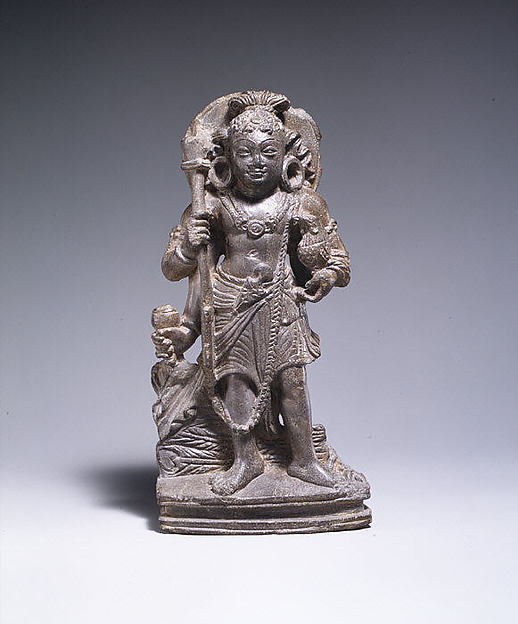
Pakistan (ancient region of Gandhara), 6th–7th century. Stone; 15.7 cm. Metropolitan Museum of Art, 1988.260.
Look closer: Note the youthful face, the halo and the tall staff held upright: the war god as the Gandhāran sculptors shaped him, long before he was a guardian of monks.
The Metropolitan Museum of Art, Purchase, Anonymous Gift, 1988. Open Access.
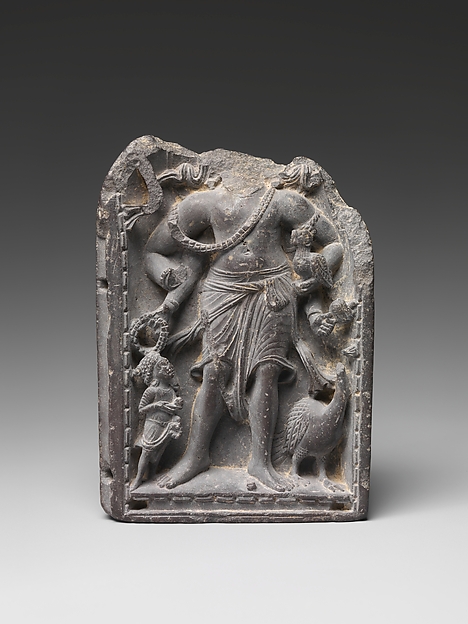
Pakistan (ancient region of Gandhara), 6th century. Schist; 9.8 cm. Metropolitan Museum of Art, 1987.142.211.
Look closer: Note the peacock standing at his feet and the small bird at his hand: the mount and the attributes that Chinese and Japanese guardians no longer carry.
The Metropolitan Museum of Art, Samuel Eilenberg Collection, Gift of Samuel Eilenberg, 1987. Open Access.
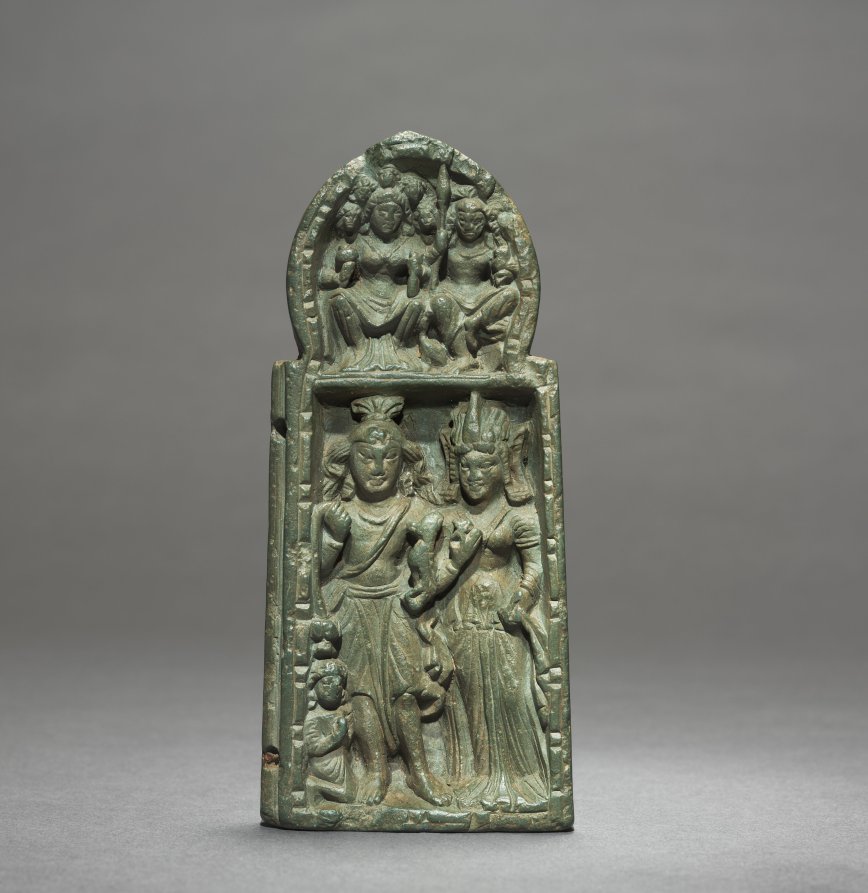
Pakistan, Gandhara, Kushan period, 100s CE. Gray schist; 14.6 x 6 cm. Cleveland Museum of Art, 1973.76.
Look closer: Note the two registers: below, a form of Skanda holding a bird and a flower beside a yakshi; above, the six-headed Shashthi seated beside the spear.
Cleveland Museum of Art, John L. Severance Fund. Open Access (CC0).
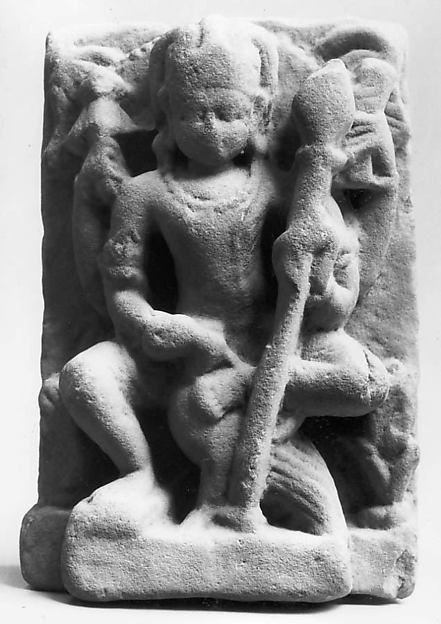
India (Mathura?), 9th–10th century. Sandstone; 19.7 cm. Metropolitan Museum of Art, 33.65.3.
Look closer: Note the staff held upright and the worn but youthful face: Karttikeya in the sandstone tradition of Mathura.
The Metropolitan Museum of Art, Gift of George D. Pratt, 1933. Open Access.
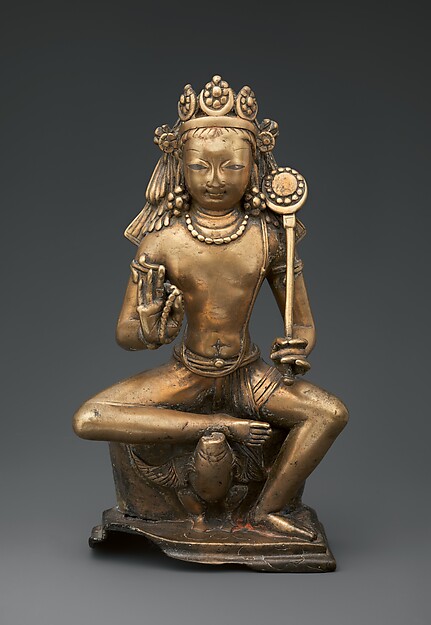
India (Jammu and Kashmir, ancient kingdom of Kashmir), 8th century. Brass with silver inlay; 26.7 × 15.9 × 7.6 cm. Metropolitan Museum of Art, 2015.500.4.5.
Look closer: Note the jewelled crown, the raised hand and the staff: a Kashmir bronze with silver inlay, made centuries after the Gandhāran stones.
The Metropolitan Museum of Art, Gift of Florence and Herbert Irving, 2015. Open Access.

Nepal (Kathmandu Valley), 11th–12th century. Gilt-copper alloy; 15 cm. Metropolitan Museum of Art, 1984.494.3.
Look closer: Note the tail fanned out as a halo behind the rider: the peacock mount that the six-faced image made standard.
The Metropolitan Museum of Art, Gift of Dr. and Mrs. Roger Stoll, 1984. Open Access.
Son beside father and mother
In India the child is usually shown with his parents, and the Metropolitan Museum owns a fine bronze of the arrangement. The Somāskandamūrti of the early eleventh century, 53 centimetres high and 55.6 centimetres wide, shows Shiva and Pārvatī seated side by side with their small son Skanda standing between them. The Met's record gives no description, and in the photograph the god sits at the left with four arms, the goddess at the right with one leg drawn up, and the child stands on the plinth between their knees. The group is the family of the war god before the war; it is the starting point from which the Chinese and Japanese Skanda diverge most sharply, since no East Asian image shows him as a child or beside his parents.
The English Wikipedia article on Kartikeya says the Sanskrit tradition gives him the consort Devasena, the Tamil tradition Devayanai and Valli, and the northern and eastern traditions make him a celibate bachelor. It names Ganesha as the elder brother in the Shaiva Purāṇas. The Japanese article calls him the second son of Daijizai-ten. The English article on the Buddhist Skanda also reports the tradition that identifies Weituo with Kartikeya, while some scholars link him to Vajrapāṇi because both carry vajras, have flaming haloes and protect Buddhism. The Buddhist guardian is accordingly one figure with two possible ancestors, and the sources do not decide between them.

India (Tamil Nadu), early 11th century. Copper alloy; 53 cm. Metropolitan Museum of Art, 1982.220.10.
Look closer: Note the small child standing between the seated parents: Skanda in the family group that Indian bronze-casters called the Somaskanda.
The Metropolitan Museum of Art, Purchase, Lita Annenberg Hazen Charitable Trust Gift, in honor of Cynthia Hazen and Leon B. Polsky, 1982. Open Access.
Theravāda shrines and a Sri Lankan god
The Chinese Weituo has a cousin in the Theravāda world. The Wikipedia article on Kataragama deviyo, the Sri Lankan form of Skanda Kumara, calls him a guardian deity of the island and says that among Sinhalese Buddhists he is a divine patron of the Buddhist teaching there. The article on Kartikeya adds that the Nikāyasaṅgraha counts him with Upulvan, Saman and Vibhisana among the guardians of Sri Lanka, and that a sixteenth-century Thai chronicle, the Jinakalamali, lists him as a guardian. The English article on Weituo gives the Thai form of the name as Phra Wet Phothisat.
The Kataragama devale, in Monaragala District, is said by tradition to have been built by King Dutugemunu around 160 BC after he vowed to honour the god before his campaign against the Chola invader Elara. The article says the building is simple, with two apartments and carvings of peacocks and elephants on the outer walls, and that thousands of devotees of many religions visit daily. Its main festival is the Esala, held in July or August, with a night procession, fire-walking and a water-cutting ceremony in the Menik Ganga on the morning after the full-moon night. One account the article reports credits the Buddha himself with asking the deity to stay in Sri Lanka and help people, after teaching the local people to stop animal sacrifices. That is a devotional tradition and should be read as such; the article attributes it to a particular monk's reading of astrological records and gives no earlier source.
The comparison clarifies what happened in East Asia. The Sri Lankan god kept his name, his consorts, his shrine and his festival, and became a patron of a Buddhist land; the Chinese and Japanese god lost nearly all of that and became a guardian of a Buddhist house. Both are ways of keeping a powerful ally once the ally's own cult has been set aside.
Weituo in the Chinese hall
In China, JAANUS says, he was seen as a protector of monasteries and monks, especially in Zen. Wikipedia describes the usual arrangement in Chinese temples: he may face the Buddha's statue with his hands in añjali, or stand at the far right holding a weapon, with Qielan, Guan Yu, on the left. His image often appears at the end of Chinese sutras as a reminder of his vow to protect the teachings, and his birthday is the third day of the sixth lunar month.
The Ming novel Fengshen Yanyi is one proposed source of his features, but Wikipedia notes that illustrated images of him predate the Ming; a portrait by Zhao Mengfu dates to the Yuan dynasty (1271 to 1368). Some writers identify Weituo with the Hindu war god Kartikeya, while others suggest a link to the bodhisattva Vajrapāṇi, since both wield vajras, have flaming halos and protect Buddhism (Wikipedia).
Wikipedia records two Chinese legends that give the general a human past. In the first, from the Ming-dynasty Xiangshan Baojuan, the 'Precious Scroll of Fragrant Mountain', Guanyin was reborn as the princess Miao Shan, and Weituo was one of her cruel father's generals. He loved her but saw that she was pure and could not be his partner, and he stayed devoted. They escaped together, he helped her build a temple and a kingdom, and the king later killed them both. Through his devotion he became a bodhisattva and vowed to protect Guanyin, and his general's appearance, the article says, comes from this story. In the second version Miao Shan's grandmother forces her to leap into the sea; a loyal soldier, Luo Ping, pretends to throw her in, and later a fish demon sends a disloyal soldier to kill her. Weituo is killed in the fight by the soldier's son, and Miao Shan, now Guanyin, makes him a guardian bodhisattva because he had cared for her as a sister.
The Japanese Wikipedia article describes the arrangement of a Chinese Chan temple differently from the English one. It says he is placed at the mountain gate or in front of the main hall, often with the Four Heavenly Kings and the laughing figure of Budai. The English article puts him inside the main hall, either facing the Buddha with hands in añjali or at the far right with a weapon, opposite Qielan, who is personified as the historical general Guan Yu. These are two descriptions of two kinds of hall, not a contradiction, but a visitor should expect to find him in different places in different temples.
Zhao Mengfu, whose Yuan-dynasty depiction of Weituo the English article illustrates, lived from 1254 to 1322 according to the Wikipedia article on the painter, which does not itself mention a Weituo picture. The attribution therefore rests on the English article's own caption, and the same article says only that illustrated images of the guardian predate the Ming dynasty.
Two Chinese guardians at the Met
The Metropolitan Museum owns two Chinese images of Skanda. The first is a gilt brass Skanda (Chinese Weituo) of the early seventeenth century, 32.4 centimetres high, cast by the lost-wax method: a seated young general in scale-patterned armour and a winged headdress, one hand held before his chest. The second is a Bodhisattva Skanda of the sixteenth or seventeenth century in lacquered and gilded wood, 22.9 centimetres high, standing in a flared tunic with ribbon-like sleeves that sweep out from the shoulders.
Both are the same figure the Japanese temples inherited, and both show how much of him is clothing: the helmet, the scales, the streaming ribbons. The Met's titles, notably, call him a bodhisattva, which matches Wikipedia's remark that devas of his kind are often addressed that way.
From Song China to Sennyūji
JAANUS records the oldest known Japanese image: a Song dynasty sculpture beside a sharihōtō, a relic pagoda, in the shariden at Sennyūji in Kyoto. Tankai brought it from China in 1255 together with relics from Taishan and Bailiansi. A Kamakura period sculpture survives at Osshinji in Gifu Prefecture, and a Kamakura painting is held at Sennyūji.
At Manpukuji in Kyoto, JAANUS says, there is a sculpture possibly made by the Chinese artist Fan Daosheng, known in Japanese as Han Dōsei (1637 to 1670), who was active there. In Japan he was enshrined in the living quarters and kitchens of Zen monasteries, the same places where Daikokuten was set, and his place beside a relic pagoda at Sennyūji shows the protector doing his oldest job.
The temple at the centre of this record is worth a paragraph of its own. The English Wikipedia article on Sennyūji calls it a Shingon temple in Higashiyama-ku, Kyoto, and says that one tradition has it founded in 855 as Senyū-ji at the former mountain villa of Fujiwara no Otsugu, while another says it was a reconstruction of Hōrin-ji, founded by Kōbō Daishi in the Tenchō era, 824 to 834. The monk Shunjō, who had studied in Song China, rebuilt and enlarged the main buildings in the early thirteenth century, with an enlargement dated 1218, and built them in the Song Chinese style. The temple became a mausoleum for the imperial house, with the tombs of Emperor Shijō and many later emperors, and it keeps a nehan-zu, a painting of the Buddha's death, that measures 8 by 16 metres and is described as the largest in Japan, shown last in 2003 for three days.
The dates need to be set side by side. JAANUS has Tankai, a monk the article on the temple does not mention, bring the Song sculpture of Idaten and the relics to Kyoto in 1255, which is some decades after the 1218 enlargement. The Wikipedia article says nothing of the shariden or of Idaten, so no source read for this chapter connects the temple's Song-style buildings to the Idaten image.
| Site | Image (JAANUS) |
|---|---|
| Sennyūji, Kyoto | Song sculpture beside the sharihōtō, brought by Tankai in 1255; also a Kamakura painting |
| Osshinji, Gifu Prefecture | Kamakura period sculpture |
| Manpukuji, Kyoto | Sculpture possibly by Fan Daosheng (Han Dōsei, 1637 to 1670) |
A guardian of hot water and fire
The best evidence for his work in Japan comes from the Zen monasteries themselves. A teaching handout from the Sōtō Zen temple Sanshin-ji describes Idaten as 'the God of the Kitchen and Protector of Monasteries and Monks'. It says that the dedication, the eko, calls him the envoy who oversees the meals in the kitchen, the god in charge of hot water and fire, and asks for the prevention of fire and theft and for the support of donors and practitioners. The chant for him, the Idaten fugin, is done directly after the morning service and led by the doan, the ino's assistant, who directs the movements of the assembly with instruments. The Heart Sutra and the Disaster-Preventing Dharani are recited and the merit is dedicated to him.
The handout is careful about what it does not say. It does not link Idaten to the tenzo, the monk in charge of the kitchen, whose own chanting is dedicated to the 'kitchen god of this temple', and it does not describe a shrine or an altar. The Wikipedia article on the tenzo, which does not mention Idaten either, explains the office: the tenzo is one of six office-holders who guide a monastery, is responsible for the community's meals, is described in the Pure Standards of the Chan Monastery as the one who makes offerings with reverence to the monks, and must cook nourishing food from what is donated through takuhatsu, the alms round. Put together, the guardian and the cook have the same work from two sides, and the sources do not say that any monastery ever joined them in a single rite.
The prayer has an obvious logic. Hot water and fire, the two things the eko names, are the two things a kitchen cannot do without and the two it may lose, and theft is the risk of every storeroom. JAANUS says the god was enshrined in Zen living quarters and kitchens; the Japanese Wikipedia article says he guarded the kitchen and the monks' quarters. A guardian whose first legend is the recovery of something stolen, and whose second function is the prevention of fire, has been put where the stores and the stoves are.
At Manpukuji, the head temple of the Ōbaku school, the Chinese inheritance is immediate. The Wikipedia article says the Chinese monk Yinyuan Longqi, in Japanese Ingen, founded the temple in 1661 and that it opened formally in 1663, that its buildings follow the Ming style and that Ingen died there on 21 May 1673. It says nothing of Idaten, but JAANUS records that the temple has a sculpture of him possibly by the Chinese artist Fan Daosheng, in Japanese Han Dōsei, who worked there. The two sources describe the same place from different angles, and a visitor who wants to see him in an Ōbaku setting will find the strongest textual claim there.
A demon chased across the clouds
The Met's seventeenth-century inrō, a small lacquer case 6.5 centimetres high, carries the legend in miniature. Titled Case with Design of Bishamon (or Idaten) Pursuing an Oni (Demon) on Clouds, it shows an armoured figure in dark relief on one side and a snarling demon scrambling through gold clouds on the other, in gold and silver hiramakie with applied metal.
The hedge in the museum's title is instructive: the Met leaves open whether the armoured pursuer is Bishamon or Idaten, since both are armoured guardians who drive off demons.
A pursuer on a sword guard

Japan, 19th century. Iron, copper, gold, copper-gold alloy (shakudō); 7.3 cm. Metropolitan Museum of Art, 91.1.812.
Look closer: Note the helmeted figure at the right in gold-patterned armour and the small horned creature below him: the pursuer and the pursued in a few centimetres of inlaid metal.
The Metropolitan Museum of Art, Edward C. Moore Collection, Bequest of Edward C. Moore, 1891. Open Access.
The Metropolitan Museum has a Japanese sword guard of the nineteenth century titled, in English and Japanese, Sword guard (Tsuba) Depicting Skanda (韋駄天図鐔). It is made of iron with copper, gold and shakudō, a copper and gold alloy, and measures 7.3 centimetres high and 6.5 wide. The record gives no description of the scene. In the photograph, a bearded, helmeted figure in gold-patterned armour strides across the right of the plate, and below him a small horned figure crouches in a darker metal at the left. The Met's title names only the god, not the creature, but the composition is the chase in miniature: the general above and the thing he has caught or is catching below.
A sword guard was something a man carried, and the choice of subject is worth noticing. A warrior's fitting was likely to show a guardian who is fast and who keeps what is precious from being taken. The Met's record does not say who commissioned this piece or what it was for, so that reading is an inference from the subject and not a statement of the museum. The inrō in the gallery below, with its armoured pursuer and its scrambling demon on clouds, belongs to the same family of images, and the Met itself hesitates over whether to call the pursuer Bishamon or Idaten.
Is it Idaten or Bishamonten
A young armoured figure with a sword or baton across the forearms and hands joined is Idaten (JAANUS). An armoured king with a pagoda in one hand is Bishamonten. The lacquer pursuer is the proof that the two can be confused; context, such as a relic pagoda or a Zen kitchen, usually decides.
A short sequence of tests helps in the museum or at the bench. First, the hands: JAANUS says the Japanese convention is hands joined in gasshō with a sword or baton resting across the forearms. A figure that holds a pagoda is Bishamonten. Second, the clothing: Chinese general's armour, a helmet with a crest or wings, and ribbons at the shoulders belong to the Chinese tradition he inherited. Third, the setting: a kitchen, a refectory or a relic hall points to Idaten, and a temple gate points elsewhere.
The Indian youth with the peacock, spear and six faces is a different object and a different chapter of the story. A Gandhāran or Nepalese Karttikeya like those in the Met's collection is an Indian god, and nothing in the sources suggests that a Japanese temple ever took one for Idaten. A figure described as Idaten that has a peacock, a rooster banner or six heads is unlikely to be a Japanese guardian, and one without any of them, in a general's armour, with the hands joined, is the figure this chapter describes. The Met's own records for these objects carry no description, so the identification of the figures rests on their titles, the photographs and the sources cited here, and the curator's captions say so.
Ten small facts
- The Chinese Golden Light Sutra of Yijing (635 to 713) has thirty-one chapters and became the most popular edition in East Asia (Wikipedia, Golden Light Sutra).
- Emperor Shōmu's provincial monasteries of 741 carried the sutra's name in their official titles (Wikipedia, Golden Light Sutra).
- Kartikeya is credited with 108 names in Hindu literature (Wikipedia, Kartikeya).
- Yaudheya and Kushan coins of the first to second century CE show Skanda with one head or six (Wikipedia, Kartikeya).
- According to Kartikeya's legend he commands an army of 30,000 with nine sub-commanders (Wikipedia, Kartikeya).
- His birthday in the Chinese tradition falls on the third day of the sixth lunar month (Wikipedia, Skanda).
- Sennyūji keeps a painting of the Buddha's death measuring 8 by 16 metres, last shown in 2003 for three days (Wikipedia, Sennyūji).
- Manpukuji was founded in 1661 and opened in 1663; Ingen died there on 21 May 1673 (Wikipedia, Manpuku-ji).
- The Japanese article counts him first among the thirty-two generals under the Four Heavenly Kings (Japanese Wikipedia, 韋駄天).
- The Sōtō Zen chant for Idaten is led by the doan directly after the morning service (Sanshin-ji handout).
Across Asia
The same young general carries a different name in every country he reached.
| Where | Form and name | What the record shows |
|---|---|---|
| India | Skanda; Kartikeya | A war god, son of Shiva and general of his army; some identify Weituo with Kartikeya (JAANUS, Wikipedia). |
| China | Weituo (韋駱天) | Guardian of monasteries and sutras; birthday on the 3rd day of the 6th lunar month (Wikipedia). |
| Korea | Witaecheon | The Korean reading of the same name (Wikipedia). |
| Japan | Idaten (韋駄天) | Zen kitchen and monastery guardian; the Sennyūji image of 1255 (JAANUS). |
| Sri Lanka | Kataragama deviyo | Skanda Kumara as a guardian of the island and of the Buddhist teaching (Wikipedia). |
| Thailand | Phra Wet Phothisat | Listed as a guardian in the sixteenth-century Jinakalamali (Wikipedia). |
| Tibet | gdong drug | The Tibetan name, 'six faces' (Wikipedia). |
A deva of the household
Idaten belongs to the Heavenly Beings. He is a guardian deva of Indian origin, one of the twenty-four celestial guardians of the Golden Light Sutra, and is often addressed as a bodhisattva.
| Companion | Why they meet |
|---|---|
| Qielan (Guan Yu) | Stands opposite him in the Chinese hall (Wikipedia). |
| Bishamonten | A fellow armoured guardian; the Met's inrō cannot decide which of the two it shows. |
| Daikokuten | Another guardian enshrined in Zen kitchens (JAANUS). |
Where to see him
| Place | What to look for |
|---|---|
| Sennyūji, Kyoto | The oldest known image, a Song sculpture beside a relic pagoda, with a Kamakura painting (JAANUS). |
| Osshinji, Gifu Prefecture | A Kamakura period sculpture (JAANUS). |
| Manpukuji, Kyoto | A sculpture possibly by Fan Daosheng (JAANUS). |
| Zen monastery kitchens, Japan | Where JAANUS says he was enshrined. |
| Metropolitan Museum of Art, New York | Two Chinese Skanda figures, a lacquer inrō, a Japanese sword guard of Skanda, Gandhāran and Indian Karttikeya figures and a Somāskanda bronze, all in open access. |
| Kataragama devale, Sri Lanka | The island's Skanda Kumara, honoured by Buddhists and others (Wikipedia). |
| Cleveland Museum of Art | A Kushan-period portable shrine section with a form of Skanda and the goddess Shashthi, in open access. |
Three views in the Metropolitan Museum
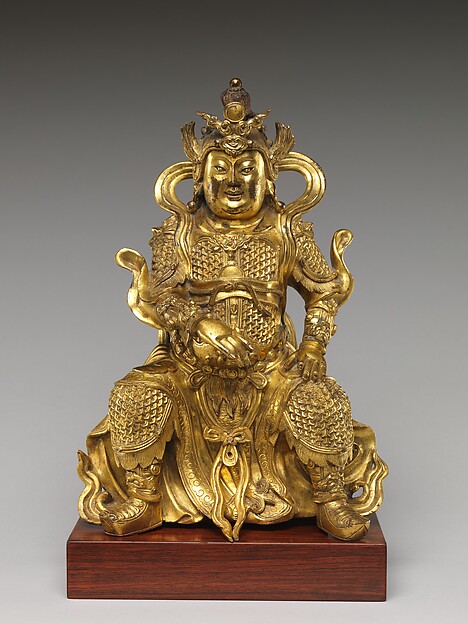
China, early 17th century. Gilt brass, lost-wax cast; H. 32.4 cm. Metropolitan Museum of Art, 2002.254.
Look closer: Note the winged headdress and the scale pattern across the knees.
The Metropolitan Museum of Art, Purchase, The Vincent Astor Foundation Gift, 2002. Open Access.
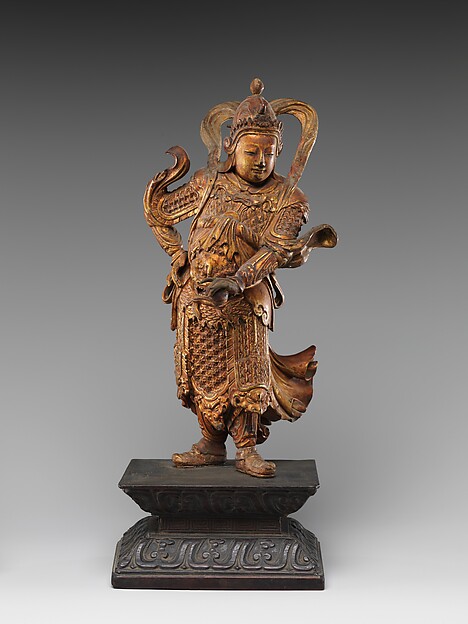
China, 16th to 17th century. Lacquered and gilded wood; H. 22.9 cm. Metropolitan Museum of Art, 47.74.
Look closer: Note the sleeves sweeping out like flames and the flared hem of the tunic.
The Metropolitan Museum of Art, Gift of Frank M. Michaelian, 1947. Open Access.

Japan, 17th century. Lacquer, roiro, rubbed fundame, gold and silver hiramakie, applied metal; H. 6.5 cm. Metropolitan Museum of Art, 91.1.695.
Look closer: Note how the cloud scrolls carry both figures across the two faces of the case.
The Metropolitan Museum of Art, Edward C. Moore Collection, Bequest of Edward C. Moore, 1891. Open Access.
At the desk
No Idaten piece is on the shelves today. If one arrives it will appear here; meanwhile the concierge desk can look for a figure, scroll or print.
A short glossary
- Idaten (韋駄天)
- The Japanese name of the Buddhist Skanda.
- Skanda
- The Sanskrit name; the Indian war god Kartikeya, also Murugan and Kumara.
- Weituo (韋駱)
- The Chinese name, also 'Bodhisattva Weituo'.
- Konkōmyōkyō (金光明経)
- The Golden Light Sutra, in which he is named.
- Daihatsu nehankyō (大般涅槃経)
- The Great Nirvana Sutra, the possible source of the relic story.
- Shari (舎利)
- Relics of the Buddha, cremation remains.
- Sharihōtō (舎利宝塔)
- A relic pagoda, the reliquary beside which the Sennyūji Idaten stands.
- Gasshō (合掌)
- Palms joined in prayer; his usual gesture in Japan.
- Añjali
- The Sanskrit term for the same joined-hands gesture.
- Eko (回向)
- The dedication of merit chanted after a service.
- Doan (堂行)
- The ino's assistant, who leads the chant for Idaten in Sōtō practice.
- Tenzo (典座)
- The monk in charge of the monastery kitchen.
- Takuhatsu (托鉢)
- The alms round that supplies much of the kitchen's food.
- Qielan
- The Chinese hall guardian personified as Guan Yu, who stands opposite Weituo.
- Tsuba (鐔)
- The guard of a Japanese sword.
- Inrō (印籠)
- A small lacquer case worn at the sash.
Answered plainly
Who is Idaten?
The Japanese form of Skanda, a guardian of the Dharma, and in Zen a protector of monasteries, monks and kitchens (JAANUS).
Why is he shown as a young general?
JAANUS says he was apparently conflated with a famous Chinese general; Wikipedia describes a young man in a general's armour.
What did he do for the Buddha?
He chased off a demon trying to steal the Buddha's ashes (JAANUS) and recovered the relics from the summit of Mount Meru (Wikipedia).
Where is the oldest Japanese image?
At Sennyūji in Kyoto, a Song dynasty sculpture brought from China by Tankai in 1255 (JAANUS).
Is he a bodhisattva?
He is a deva, but often addressed as a bodhisattva, as the Met's title does (Wikipedia).
Is he the same as Bishamonten?
No, but the two can look alike; the Met's inro cannot decide which of them it shows.
What does the name Idaten mean?
It is the Japanese form of Skanda, written 韋駄天; the Japanese Wikipedia article says the form 違駄天 came from a miscopying and merged with the cult of the Daoist General Wei.
Is Idaten the same as the Hindu god Kartikeya?
He derives from Skanda, the Indian war god also called Kartikeya, and some writers identify them; others link Weituo to Vajrapāṇi (Wikipedia).
Why is he in Zen kitchens?
JAANUS and the Japanese Wikipedia article say he was enshrined there, and the Sōtō chant calls him the god in charge of hot water and fire (Sanshin-ji handout).
How can I tell him from Bishamonten?
Idaten has hands joined with a sword or baton across the forearms (JAANUS); Bishamonten holds a pagoda.
What did the Chinese hall look like?
He may face the Buddha with hands joined or stand at the far right with a weapon, opposite Qielan (Wikipedia).
Where next
Sources and image credits
- JAANUS, Idaten 韋駄天 (Columbia University)
- Wikipedia, Skanda (Buddhism)
- Metropolitan Museum of Art, Skanda (Chinese Weituo) (2002.254)
- Metropolitan Museum of Art, Bodhisattva Skanda (47.74)
- Metropolitan Museum of Art, Inro with Bishamon (or Idaten) (91.1.695)
- Wikipedia, Kartikeya
- Wikipedia, Kataragama deviyo
- Wikipedia, Golden Light Sutra
- Wikipedia, Relics associated with Buddha
- Wikipedia, Mount Meru
- Wikipedia, Sennyū-ji
- Wikipedia, Manpuku-ji
- Wikipedia, Tenzo
- Wikipedia, Zhao Mengfu
- Japanese Wikipedia, 韋駄天
- Sanshin-ji, Stewardship: tenzo and ino handout
- Metropolitan Museum of Art, Sword guard (Tsuba) Depicting Skanda (韋駄天図鐔) (91.1.812)
- Metropolitan Museum of Art, Karttikeya, the God of War (1988.260)
- Metropolitan Museum of Art, Panel of a Portable Shrine with Karttikeya, the God of War (1987.142.211)
- Cleveland Museum of Art, Section from a Portable Shrine (1973.76)
- Metropolitan Museum of Art, Karttikeya (33.65.3)
- Metropolitan Museum of Art, Karttikeya, the God of War (2015.500.4.5)
- Metropolitan Museum of Art, Kumara Riding a Peacock (1984.494.3)
- Metropolitan Museum of Art, Shiva, Parvati, and Their Son Skanda (Somaskandamurti) (1982.220.10)
Last reviewed 28 October 2026. Pictures are public-domain or openly licensed, each credited beneath it. Diagrams on this page are drawn by Japonista.
Looking for an Idaten figure, scroll or print? Tell the concierge desk what you have in mind and we will search Japan for it.
Private concierge
Looking for something in particular?
Describe the piece or the project you have in mind. A senior advisor in Tokyo reads every case file personally and replies within two business days, with fees set out in writing before any work begins.