
Hakuin Ekaku, the Reviver of Rinzai Zen
Suruga · Edo period
Hakuin Ekaku, the Reviver of Rinzai Zen
白隠慧鶴
Zen in Japan was not always a living thing. In the usual telling, Rinzai had fallen into a long stagnation by the eighteenth century, and the man credited with waking it up was a village priest who lived and died within sight of Mount Fuji.1 Hakuin Ekaku set a riddle that is now known across the world, the sound of one hand, wrote advice on health that is still in print, and at close to sixty took up the brush and painted Daruma, Kannon and the Seven Lucky Gods for people who could not read.134 His own pupils, and theirs, shaped the koan training of every Rinzai monastery today.1 This chapter follows the life, the riddle, the paintings and the village, and shows where the biographies disagree, beginning with the year of his birth.
Fact sheet
Five things to notice
- The riddle. He made the sound of one hand the koan for beginners, saying it worked better than the older Mu koan.14
- The illness. Over-training left him unwell for nearly two years, and a hermit's breathing and visualisation cured him.13
- The village. He turned down the great Kyoto monasteries and taught for about forty years at Shōin-ji in his home village.1
- The brush. He began painting seriously at almost sixty, and dozens of his Daruma portraits survive from his last decades.15
- The heirs. Tōrei Enji and Gasan Jitō carried his teaching on, and the later koan curriculum grew from Gasan's line.1
Born Under Mount Fuji
First lookHakuin was born in the village of Hara at the foot of Mount Fuji, the youngest of five children of a commoner family, and was known in boyhood as Iwajirō.129 His mother was a devout Nichiren Buddhist, and as a child he heard a Nichiren monk preach on the Eight Hot Hells. The sermon left him with a fear of hell that, by his own account, drove him into the monkhood.1

Hakuin Ekaku. Hanging scroll, ink on paper, Minneapolis Institute of Art
Look closer: Mount Fuji is drawn in one pale, unbroken line, with an eggplant and a hawk's feather below it. These are the three lucky things of the New Year proverb, ichi Fuji, ni taka, san nasubi, first Fuji, second hawk, third eggplant, for a first dream of the year; Hakuin's Fuji is the mountain he saw from his own village.12
Photograph: Hakuin Ekaku. Public domain. Source: Wikimedia Commons. File record

At fifteen he obtained his parents' consent and was ordained at Shōin-ji, the temple in Hara, by the resident priest Tanrei Soden, and then served as a novice at the neighbouring Daishō-ji for three or four years.19 He found the Lotus Sutra disappointing, calling it simple tales of cause and effect, and at eighteen moved to Zensō-ji near Hara. At nineteen he read of the Chinese Chan master Yantou Quanhuo, murdered by bandits, and despaired, and for a time gave up the aim of becoming an enlightened monk.1
The despair did not last. Travelling with twelve other monks to Zuiun-ji, where the scholar Baō Rōjin taught, he took a Ming-dynasty collection of Zen stories from a pile of books and resolved to practise Zen after all.1 The next fourteen years or so were a pilgrimage: the biography says he trained at as many as sixteen monasteries, from Shinano and Echigo in the north-west to Shikoku in the south.2 The city newsletter lists Wakasa, Iyo, Shinano and Mount Iwataki in Mino among the places, and says he went home to Hara when his sick father asked him to.9
His adopted name explains the landscape he lived in. Hakuin means concealed in white, and the Wikipedia article reads it as a reference to Mount Fuji hidden in cloud and snow.1 A local saying, recorded in the biography, has it that Suruga has two marvels, Mount Fuji and Hakuin from Hara.2
Shōju Rōjin and the Broom
First lookThe first awakening came at about twenty-four, when he shut himself in a shrine for seven days and woke, the biography says, on hearing the temple bell at dawn.12 His master at the time did not acknowledge it, and Hakuin left.1 The Terebess biography dates the bell to 1707, which for a man born in 1686 would make him twenty-one, not twenty-four.2 The bell is firmly in the record, but its exact year is not.

Hakuin Ekaku. Hanging scroll, ink on paper, 117.5 x 54 cm
Look closer: Follow the single black sweep of the robe from the lower left up and around the shoulder, then look at the eyes: they are round, ringed in white and fixed on you. The short inscription at upper left reads, in the Met's transcription, 'no matter how you see', and the three seals are his names.5
The Metropolitan Museum of Art, New York, Gift of Florence and Herbert Irving, 2015, accession 2015.500.9.3. Public domain, Met Open Access. Museum record
He then spent eight months with Shōju Rōjin, also called Etan (1642 to 1721; the first part of his name is spelled Dōkyō in the Terebess biography and Dokyū in Wikipedia), at the Shōju hermitage in Iiyama in Shinano.12 Shōju was harsh, hurling insults and blows. When Hakuin said he had become a monk out of fear of hell, Shōju is quoted as replying that he was a self-centred rascal.1 The Terebess biography adds that a second awakening came when an old woman chased him away with a broom.2 He had three isolated experiences of satori in those months, but by his own account understood their meaning only about eighteen years later.1
The long delay matters. Hakuin's whole teaching rests on the claim that an early flash of insight is only a beginning, and that one must keep working for decades. At twenty-six he read that unenlightened monks who lack the mind of enlightenment fall into hell, and the line planted what he called a great doubt in him.1 The decisive moment came at forty-one, while reading the parables chapter of the Lotus Sutra, and he understood the mind of enlightenment as work for all living beings; in his autobiography he says that at forty-two he finally grasped the warning that had troubled him since his mid-twenties.1 A man who had called the Lotus Sutra dull as a boy was won over by it in middle age.
Soft Butter and the Night Boat
First lookHakuin's training nearly broke him. He fell ill for almost two years with what Wikipedia compares to a nervous breakdown and Zen tradition calls Zen sickness, zenbyō.13 Katō Shōshun dates it to his late twenties.1 He credited his cure to Hakuyū, a Taoist cave-dwelling hermit who, in the Terebess account, is described as about two hundred years old.23
Hakuyū gave him two remedies. In the first, the soft butter method, the practitioner imagines a lump of soft butter on the top of the head. It melts slowly and spreads down through the body, relaxing it as it goes, and Hakuyū linked the image to a method in an Āgama text that uses butter.3 In the second, naikan, the practitioner lies on his back and gathers breath and energy in the lower belly, the tanden or hara, through four contemplations, in which the belly is called the original face, the native place, the Pure Land of one's own mind and the Amida Buddha of one's own self.3 The Amida wording is worth noticing, since Hakuin kept a wary respect for Pure Land practice; the chapter on Ippen shows another Kamakura answer to the same name.
Hakuin told the story many times, and it became the book Yasenkanna, Idle Talk on a Night Boat, which a note in Wikipedia dates to 1757 and which the Terebess biography also dates to 1757.12 The preface is attributed to a disciple called Hunger and Cold, the Master of Poverty Hermitage.3 The book has stayed in print since it was published, and Norman Waddell argues that this reflects its popularity in secular circles.3 Hakuin himself warned that long life is not the aim of Buddhism, and should not be set beside the bodhisattva vows.3
A Numazu city notice also says that he recovered from the illness through abdominal breathing and later wrote about it in Yasenkanna and popularised the practice.9
The Sound of One Hand
The deep endHakuin's best-known invention is a question: what is the sound of one hand? In Japanese it is sekishu no onjō, and Takase's philological note gives the standard headword as 隻手の音声, with Hakuin's own prose using 隻手の聲 and his last verse the four characters 隻手音聲.4 The Buddhist reading onjō is required, not onsei.4
He devised it, he says, to replace the older Mu koan. In his tract of 1753, Yabukōji, he says he devised it five or six years earlier, and claims that Mu had brought only some dozens of students through in forty-five years, while the single hand raises doubt easily in anyone.4 Takase notes that this tract is the only source in which the author dates the koan, and the Terebess biography also places the koan in Yabukōji of 1753.24 Wikipedia reports Hakuin saying the two koans differ like cloud and mud.1 The koan has two parts, to hear the sound of one hand, and to put a stop to all sounds, so that the eye which sees one's nature opens.14
The famous English phrase has a history of its own. The Japanese says one hand, and it is raised, since two hands are needed to clap.4 The earliest English versions, those of Lloyd in 1904 and 1905 and Saunders in 1922, say the sound of one hand or a single hand, and one hand clapping first appears in print in 1935.4 Salinger's epigraph of 1953 popularised the clapping version, and the Princeton Dictionary of Buddhism brackets the word clapping as an editorial addition.4 A faithful rendering keeps the hand raised, and keeps the fact that the question is put to a student, who must answer it in person.4
Hakuin's other test of doubt was the question who is the host of seeing and hearing.1 He also warned, in a mill-song, against settling into the sound once it was found, and in a letter he demonstrates it by clapping and then raising one palm.4 The koan was for beginners, meant to turn the student away from conceptual thought; later Zen teachers built a ladder of harder koans above it.14
| Class | Meaning | Place in the list |
|---|---|---|
| Hosshin | Dharma-body koans | First in the list1 |
| Kikan | Dynamic action koans | Second1 |
| Gonsen | Word-explication koans | Third1 |
| Hachi nanto | Eight difficult-to-pass koans | Fourth; some sources give ten1 |
| Goi jūjūkin | The Five Ranks of Tōzan and the ten grave precepts | Fifth1 |
Hara and Shōin-ji
First lookHakuin came home to Shōin-ji at thirty-one. Wikipedia says he was installed as head priest in 1718 with the title Dai-ichiza, First Monk, which it calls largely a matter of paying a fee and registering as incumbent, and he held the post for about half a century.1 The temple was in poor repair and heavily in debt, and the biography says it took about twenty years of work to restore, finishing around 1737.2

Hakuin Ekaku. Hanging scroll, ink on paper, Minneapolis Institute of Art
Look closer: A round-faced, laughing Budai, whom Japan calls Hotei and counts among the Seven Lucky Gods, hauls open an enormous sack with brushed characters on its side. Pictures like this were the kind of sermon a village could take home and hang on the wall.10
Photograph: Hakuin Ekaku. Public domain. Source: Wikimedia Commons. File record

Hara was the thirteenth post station on the Tōkaidō, with travellers always passing. The biography gives the figures of the 1728 village records: 190 landowning families, 119 tenant farmers, a population of 1,665 and 262 servants.2 He did not run away from this world. He relied on parishioners and lay students, who became known as the Kokurin disciples, after the temple's mountain title.2 Wikipedia says that students from across the country came, that a monastic community formed in Hara, and that he turned down offers to lead the great Kyoto monasteries in order to remain at Shōin-ji.1
His ethics were a mixture, drawing on Confucianism, old Japanese tradition and Buddhism, and in his last fifteen years he wrote often, much of it in the vernacular and in popular poetic forms.1 The number of his pupils is uncertain. Wikipedia says that he certified more than eighty successors, and that his students numbered in the hundreds.1 The Terebess biography gives no count but says his pupils came to fill most of the important posts in Rinzai monasteries.2
One story about the village shows his temper. Wikipedia says a girl falsely named Hakuin as the father of her child, he raised the child, and when the truth came out a year later he yielded the child willingly.1
Painting for Everyone
The connoisseur's eyeHakuin took up painting seriously at almost sixty, and wrote and painted for ordinary people, many of them unable to read.1 Wikipedia calls his pictures visual sermons.1 The Japan Times, reviewing a Shizuoka exhibition of drawings he made in his late sixties, says they promoted the teachings of Bodhidharma, the worship of Kannon and the Seven Lucky Gods, and filial piety.10 How many works exist is not agreed: the Terebess biography says thousands of Zen paintings, plus about ten self-portraits after his seventies, and the Numazu city notice says about ten thousand drawings and poems.29
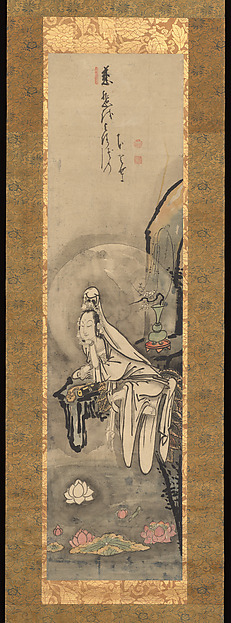
Hakuin Ekaku. Hanging scroll, ink and colour on paper
Look closer: The white robes are left bare and the outlines do the work: trace the heavy line down the sleeve to the red lacquer stand with its willow branch. The huge pale moon behind the head acts as the halo, and the inscription at upper right reads, in Carpenter's translation, that compassion should be the root of all things.7
The Metropolitan Museum of Art, New York, Purchase, Jane and Raphael Bernstein Gift, 2025, accession 2025.91. Public domain, Met Open Access. Museum record
The Metropolitan Museum holds several of the works, four of them shown here, and its catalogue notes are a short course in how to read them. The Bodhidharma shown earlier in this chapter belongs to a set: the Met says dozens of half-length portraits of Bodhidharma, Daruma, date from the last few decades of his life, and that the most common inscription is four Chinese characters meaning look inside yourself to become a buddha, while this scroll carries the same message in a looser form.5
The seals are the clearest signature of his late work. The Met lists three on the Daruma: an oval intaglio seal reading Kokan'i, and two square seals, Hakuin and Ekaku.5 Kokan'i is a three-character koan of the Chan master Yunmen Wenyan (864 to 949), which the Met glosses as look, reflect on it, ah.67 The same three seals, with Kokan'i in the upper left or right, appear on all four of the Met scrolls shown on this page.5678
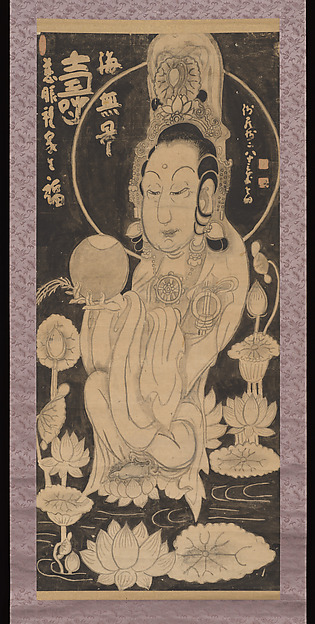
Hakuin Ekaku. Hanging scroll, ink on paper, signed at eighty-three
Look closer: Here the background is inked in black and the white-robed figure is left in reserve, with the lotuses, halo and inscription standing out against it. The Met calls such inked-ground versions rare and notes that the usual rocky ledge has been left out, so her foot rests on a lotus that seems to float on the water.6
The Metropolitan Museum of Art, New York, Purchase, Miriam and Ira D. Wallach Foundation and Jane and Raphael Bernstein Gifts, 2025, accession 2025.92. Public domain, Met Open Access. Museum record

Hakuin Ekaku. Hanging scroll, ink on paper, 106 x 52 cm
Look closer: One enormous character, toku, virtue, fills the sheet, with its thick strokes pressed almost to the edges, while a small column of text above states the moral: piling up money or books for your heirs will not help them, but hidden virtue will serve them for a long time.8
The Metropolitan Museum of Art, New York, Fishbein-Bender Collection, Gift of T. Richard Fishbein and Estelle P. Bender, 2014, accession 2014.768.2. Public domain, Met Open Access. Museum record
A Library in Plain Language
The connoisseur's eyeThe writings come in two forms. The collected Dharma works run to fourteen volumes and the works in classical Chinese to four, according to Wikipedia, and an eight-volume edition of his collected works was published in 1934 and 1935, with a fifteen-volume edition of his spoken Dharma talks compiled by Yoshizawa.12 Much of it is in the vernacular.1
The best known are Orategama, the Embossed Tea Kettle, a collection of letters, and Itsumadegusa, Wild Ivy, his spiritual autobiography, which uses a chapter of Yasenkanna almost word for word.1 The meaning of the title Orategama is disputed, since Hakuin's titles often carry double meanings.2 English readers have Norman Waddell's translations of Wild Ivy (2010) and of the Precious Mirror Cave (2009), Philip Yampolsky's selection of 1971, Thomas Cleary's Secrets of the Blue Cliff Record, and Albert Low's book on kensho.3
- 1749 and 1751Orategama written in 1749 and published in 1751.2
- 1753Yabukōji, the tract in which the sound of one hand is dated.24
- 1754Hebi-ichigo written, though it could not be published at the time and was printed only in 1862.2
- 1757Yasenkanna published.12
- 1758Keisō dokuzui published, his collected sayings.2
- 1771Hebi-ichigo appears in a catalogue of banned titles.2
Tōrei, Gasan and the Koan Curriculum
The deep endTōrei Enji (1721 to 1792) was the closest pupil and received Hakuin's robe.1 He wrote Shūmon mujintō ron.2 Gasan Jitō (1727 to 1797) connects all present Rinzai lineages to Hakuin, and he was followed by Inzan Ien (1751 to 1814) and Takuju Kosen (1760 to 1833).1 Wikipedia says Hakuin's own line came to dominate Rinzai institutions in the Meiji era.1
Hakuin opposed what Wikipedia calls do-nothing Zen and was especially critical of the followers of Bankei.1 The Ōbaku school posed a different challenge through its communal discipline; Terebess says that he criticised Ōbaku but used its popularity as a catalyst for Rinzai reform, and Wikipedia says his followers answered it by reviving Rinzai roots and by concentrating on koan collections.12 He also accepted the Pure Land nenbutsu if it was understood as a metaphor for the original mind, but saw it as a threat otherwise.2 The wider story is told in Rinzai, Sōtō and Ōbaku, and the older Kamakura beginnings in the chapters on Eisai and Dōgen.
Western views of Zen were shaped by his emphasis on kensho, the first glimpse of one's nature, which D. T. Suzuki and Yasutani's Sanbō Kyōdan carried abroad.1
The Death Poem
The connoisseur's eyeAt eighty-three, as the signature on the Met's Kannon of 1767 shows, he was still painting, and signed it as the old monk of eighty-three years beneath the sala tree.6 Shortly before he died he wrote a verse thanking the sound of one hand for another year.1
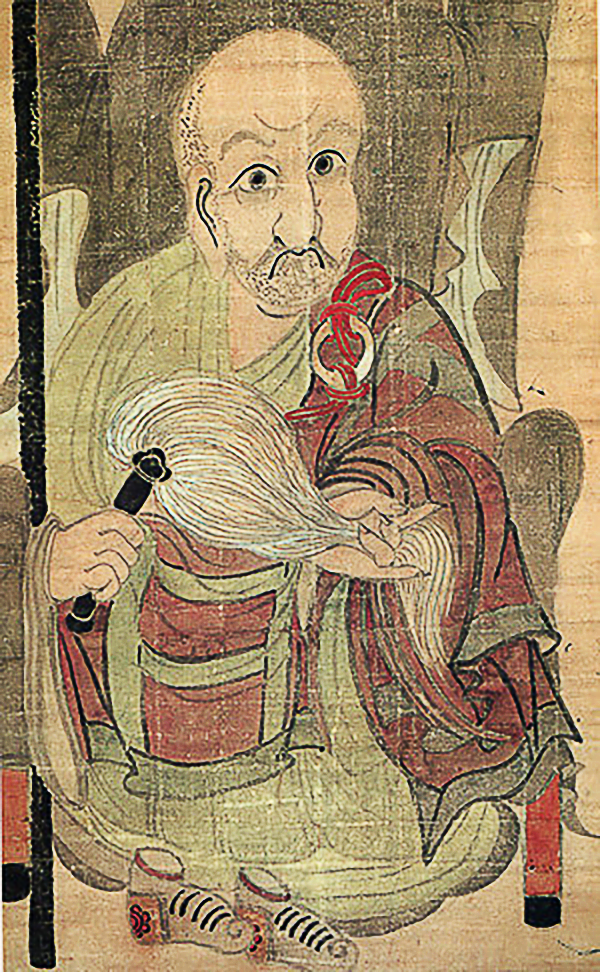
Hakuin Ekaku, 1767, two years before his death
Look closer: The old master sits in green and red robes with a fly whisk across his lap, eyes wide and mouth turned down, and his slippers placed neatly below him. The crop shows the figure alone, so the inscription is not visible here; the Terebess biography calls the verse on the 1767 self-portrait harsh and self-mocking, which is a fair description of the face.2
Photograph: Hakuin Ekaku (self-portrait). Public domain. Source: Wikimedia Commons. File record

His death poem was written over the character for death. It urges young people to die now, since having died once they will not die again.1 His tomb tower stands in the grounds of Shōin-ji.9
Walking Hara
First lookThe Numazu city newsletter of October 2014 lists the places linked to him.9 Shōin-ji holds his tomb tower and a seated statue. In Hara, Sainenji Temple and the Temmangu Shrine are where the boy Iwajirō prayed. At Yanagisawa, the Akeno Kannon-dō is where he trained, and Hachijō-ishi Park, twenty minutes by car from Numazu Station, has the rock he is said to have sat on to study as a child: about three metres high and fifty square metres on top, made of andesite, which fell in a flood in 1635.9
The notice is twelve years old, so its details should be checked with the city before travelling, and no opening hours or admission fees for the temple were found in the sources read for this chapter. The same newsletter reported a free exhibition of his Zen paintings and ink calligraphy in the Numazu Imperial Villa Park in November 2014, and a forum on deciphering his calligraphy at Hanazono University's invitation.9
His work travels too. The Japan Times reported an exhibition of drawings and texts he made in his late sixties at the Shizuoka City Museum of Art, and an earlier piece described Hakuin: The Hidden Messages of Zen Art at Bunkamura, The Museum, in Tokyo.1011 Both shows have closed, but they show that his work still travels.
Doubt, Breath and the Other Roads
The deep endHakuin's method rests on doubt, the great doubt, which he treated as the engine of training.1 He taught rural commoners in the vernacular and in popular poetry.1 The Sōtō school of Dōgen, as that chapter explains, puts sitting itself at the centre. Hakuin's Rinzai school kept the riddle, and gave it the sound of one hand as the entrance.
He was a near contemporary of Bach and Handel, who were both born in 1685, the year some sources give for his own birth. A closer comparison is within Japan: the wandering Pure Land priest Ippen had also used paper, rhythm and popular speech to give people a path that needed no learning. The difference is that Hakuin's path asked for years of effort, and his Zen sickness shows what it could cost.13
What a Collector May Meet
The connoisseur's eyeHakuin's paintings are displayed in several major museums, and the commonest subjects are the ones in this chapter: Daruma half-length, Kannon beside a lotus pond, the Seven Lucky Gods, and single large characters of calligraphy.156810 The Met's catalogue notes show what a serious cataloguer looks for: the medium, the inscription and its source, the seals, and the date in the signature where there is one.5678
The three seals, Kokan'i, Hakuin and Ekaku, appear together on the Met's four scrolls, so any scroll offered under his name can be compared with them, though a matching seal is not proof. Because a great many works of his late years exist, with counts in the thousands, a careful buyer asks for documentation, a record of previous owners and an expert opinion on the brushwork, and does not treat a seal or a famous name as proof.259
The house keeps a changing shelf of Buddhist objects, and the concierge desk can search Japan for a specific piece, with condition and provenance reported honestly.
Words Worth Knowing
The terms below recur on this page and across the almanac.
| Term | Reading | Meaning |
|---|---|---|
| Kōan | kōan | A paradoxical question or case used to provoke doubt in Zen training.1 |
| Sekishu no onjō | sekishu no onjō | The sound of one hand, Hakuin's koan for beginners.4 |
| Daigi | daigi | The great doubt, which Hakuin made the engine of training.1 |
| Naikan | naikan | Introspective breathing in the lower belly taught to Hakuin by Hakuyū.3 |
| Tanden | tanden | The lower belly, the centre of the breath, also called the hara.3 |
| Zenbyō | zenbyō | Zen sickness, the illness from over-training.3 |
| Daruma | daruma | Bodhidharma, painted by Hakuin in dozens of half-length portraits.5 |
Related Pieces
The house keeps a changing shelf of Buddhist sculpture, scrolls and ritual objects from Japan. The shelf below fills with pieces on the day you read this, and the collection page lists them all.
Pieces in the house now
- Buddhist statues and sacred artSculpture, scrolls and ritual objects
Answered plainly
Who was Hakuin Ekaku?
Hakuin (1685 or 1686 to 1768 or 1769) was an Edo-period Rinzai Zen master of Hara, near Mount Fuji, credited with reviving the Rinzai school and known for the sound of one hand, his health writings and his paintings.19
What is the sound of one hand?
It is a koan Hakuin devised, dated by himself to about five or six years before his tract of 1753, as an entrance for beginners: the student must hear the sound of one raised hand and put a stop to all sounds.14
Is it one hand clapping?
Not in Japanese. The word is one hand, raised, and clapping was added in English, first in print in 1935 and popularised by a Salinger epigraph in 1953.4
What is the soft butter method?
It is a visualisation, taught to Hakuin by the hermit Hakuyū, in which a lump of soft butter on the head melts and relaxes the body. It sits beside naikan, a breathing practice in the lower belly, in his book Yasenkanna.3
When was he born and when did he die?
Most references say 19 January 1686 and 18 January 1769, while the Numazu city newsletter and others say 1685 and 1768. Both follow from the calendar used.149
Why do people call him the reviver of Rinzai?
Because his pupils' lines supply every modern Rinzai lineage and his koan method became the standard training, though one scholar says the revival is partly a matter of perception.1
Where next
Sources and image credits
- Wikipedia, Hakuin Ekaku Life, awakenings, teaching, writings, lineage, disagreements.
- Biography of Hakuin (Terebess Asia Online) Dates, Hara and Shōin-ji, writings, local figures.
- Wikipedia, Yasenkanna Hakuyū, soft butter, naikan, translations.
- Takase, Sekishu no onjō (the sound of one hand) Wording, date, translation history.
- The Metropolitan Museum of Art, Portrait of Bodhidharma, 2015.500.9.3 Inscription, seals, catalogue note.
- The Metropolitan Museum of Art, Kannon in a Lotus Pond, 2025.92 Signature at eighty-three, verse, technique.
- The Metropolitan Museum of Art, Kannon by a Lotus Pond (1750s) Inscription, seals, iconography.
- The Metropolitan Museum of Art, Virtue, 2014.768.2 Calligraphy, quotation of Sima Guang.
- City of Numazu, English newsletter, October 2014 Hara sites, events, numbers.
- The Japan Times, Hakuin in Suruga Exhibition at Shizuoka City Museum of Art.
- The Japan Times, Hakuin: the sight of one hand clapping Bunkamura exhibition, January 2013.
- JAANUS, ichi Fuji, ni taka, san nasubi The New Year proverb of the lucky dream.
Last reviewed 28 October 2026. Dates in this chapter follow the cited pages; where the sources disagree, the chapter says so. Every picture is public-domain or openly licensed, and its credit and licence stand beneath it.
If this subject has drawn you to an object, the concierge desk can search Japan for it.
Private concierge
Looking for something in particular?
Describe the piece or the project you have in mind. A senior advisor in Tokyo reads every case file personally and replies within two business days, with fees set out in writing before any work begins.