
The Diamond Sutra, Blade of Wisdom
Kongō-kyō · Prajñāpāramitā scripture
The Diamond Sutra, Blade of Wisdom
金剛般若経
A sutra that cuts through ideas the way a thunderbolt cuts through stone is also the sutra that, in a cave on the Silk Road, gave the world its oldest dated printed book. The Diamond Sutra is short enough to be recited in an hour, and so slippery that its central move is to say a thing and then take it back. In Japan it lives in three places at once: in the Zen hall, where one of its lines is brushed on scrolls; in the chanting of the Perfection of Wisdom family; and in the long argument about whether a book can carry what a book cannot hold.1
Fact sheet
Five things to notice
- The method. The sutra states a thing, denies it, then restores it as a convention. Everything, including the Buddha, passes through that three-step.1
- The six similes. Conditioned things are to be seen as a dream, an illusion, a bubble, a shadow, dew and lightning.1
- The date. The 868 scroll carries its own date in the colophon, to the day.13
- The gift. The colophon says it was made for universal free distribution, in the names of two parents.13
- The verse. Eight Chinese characters, "abiding nowhere, the awakened mind arises", are brushed again and again by Zen masters.6
What the Name Cuts
First lookThe Sanskrit title, Vajracchedikā Prajñāpāramitā, may be rendered roughly as the Perfection of Wisdom that Cuts like a Thunderbolt, or the Vajra Cutter. A vajra is both diamond and thunderbolt: the hardest substance and the most violent weapon. The title uses that double image as a metaphor for a kind of wisdom that shatters illusion to reach what is actually the case.1 In Japanese the sutra is Kongō Hannya Haramitta-kyō, and the short form Kongō-kyō, written 金剛経, is what priests and collectors say. The same two characters, 金剛, name the vajra and the Kongōrikishi gate guardians, so a reader who has met the vajra elsewhere in the almanac will feel at home.

Woodblock print, Tang China, 11 May 868, now in the British Library (Or. 8210/P.2)
Look closer: The frontispiece at the right shows the Buddha preaching to his disciples. The columns of text beside it run top to bottom and are read from right to left.
Image: The British Library (Or. 8210/P.2), photographed for the Library. CC0. Source: Wikimedia Commons. File record

The sutra belongs to the great Perfection of Wisdom family, of which the Heart Sutra is the shortest and most chanted member.1 Where the Heart Sutra is a compressed statement, the Diamond Sutra is a conversation. The Buddha has finished his walk through Śrāvastī to gather offerings of food, and sits down to rest. The elder Subhūti rises and asks how someone who has set out on the bodhisattva path should stand, proceed and control the mind.1 Almost the whole of the sutra is the answer.
The answer is unlike a sermon. The Buddha says that he will bring all living beings to final nirvana, and that after this no living being has been brought to nirvana, because a bodhisattva does not see beings through ideas of a person, a soul or a self.1 That is the shape of the book. A claim is made, undone, and left standing only as a way of speaking. The scholar Hajime Nakamura called this the logic of not; the translator and commentator David Kalupahana read it as an attempt to avoid extreme uses of language while keeping their practical value.1 It is the best-known place in all Buddhism where an argument is performed instead of stated.
A Conversation That Unmakes Itself
The connoisseur's eyeThe themes the sutra returns to are not-self, the emptiness of all phenomena, the liberation of beings without attachment, and the merit of spreading the sutra itself.1 The Chinese teacher Hsing Yun summed up the four main points as giving without attachment to self, liberating beings without notions of self and other, living without attachment, and cultivating without attainment.1 The word shūnyatā, emptiness, does not actually appear in the text; the argument is made by negation instead.1
A typical turn runs in three steps. The Buddha says that all things are without a thing-nature. He then says that this is why they are called things. In Kalupahana's reading the first statement is the mistake of treating a word as a substance, the second is the critique, and the third rebuilds the word as a convention that arises from conditions and still does useful work. A concept is a substitute for a human experience that has many causes, and so it has practical meaning without being absolute.1 Paul Harrison put the same point more bluntly: all things lack a self or essence and appear to exist separately only through the power of conventional language.1
Several passages make the point personal. A saint who thinks that he has attained a state, or that he will bring beings to nirvana, has not understood: such thoughts are a seizing upon a self.1 Because language makes concepts solid, the Buddha's habit of negation is a kind of therapy. Subhūti is being helped to unlearn the limited notions of reality he came with.1
The most quoted moment is the closing verse of the Chinese version, which names six images for conditioned things: a dream, an illusion, a bubble, a shadow, dew and a flash of lightning. Different translators order and expand the list, and the Sanskrit includes a shooting star, a clouding of the sight and a lamp, but the sense is steady. One is to look at the world as one looks at a thing that is vivid and has no hold.1
| Image | What it says about experience | How a reader might meet it |
|---|---|---|
| Dream | Vivid, convincing and without a waking basis1 | The sleeper believes it until morning |
| Illusion | Produced by causes and conditions, not by a hidden substance1 | A conjuror's trick still works when the trick is known |
| Bubble | Takes shape, shines and breaks1 | Rain on a pond |
| Shadow | Depends on something else to exist1 | A figure on a paper screen |
| Dew | Present at dawn and gone by noon1 | Morning in a temple garden |
| Lightning | Sudden, complete and over1 | A flash over the mountains |
Seven Translators and a Hundred Readers
The connoisseur's eyeNo one knows exactly when the Sanskrit text was composed. Arguments have been made for the second century and for the fifth; what is certain is that by the early fifth century the sutra had been translated into Chinese, and that the fourth- or fifth-century masters Asaṅga and Vasubandhu had already written commentaries on it.1 It was a text for scholars from the start.
The version Japan reads is the one made in about 401 by Kumārajīva, the prolific translator. His style prefers a flowing sense to a literal word-for-word rendering, and the result has been admired for centuries. It is the text on the Dunhuang scroll of 868 and the most widely chanted Chinese version.1 Later translators went back to the Sanskrit and made their own versions, including the pilgrim Xuanzang, who translated it twice, and Yijing, whose rendering is dated 703.1 A Japanese reader who consults a modern annotated edition will usually find these earlier translations compared line by line.
The weight of commentary is striking. By the end of the Tang dynasty in 907 more than eighty commentaries had been written, of which thirty-two survive. They include works by Sengzhao, Xie Lingyun, Zhiyi, Jizang, Kuiji and Zongmi, and the Exegesis by Huineng, the Sixth Patriarch of Chan.1 Copying and recitation of the sutra became a common devotion, and stories attributing miraculous powers to those acts are recorded in Chinese, Japanese, Tibetan and Mongolian sources.1
| Translator | Date | Note |
|---|---|---|
| Kumārajīva | About 401 | The most admired and most chanted Chinese text1 |
| Bodhiruci (north India) | 509 | First of the retranslations1 |
| Paramārtha | 558 | A Sanskrit-based version1 |
| Dharmagupta | 590 and 605 to 616 | Translated twice1 |
| Xuanzang | 648 and 660 to 663 | Translated twice1 |
| Bodhiruci (south India) | 693 | A second translator of the same name1 |
| Yijing | 703 | The last of the early retranslations1 |
A Scroll from the Sealed Cave
The connoisseur's eyeIn 1900 the Taoist priest Wang Yuanlu, who apparently appointed himself guardian of the Mogao Caves near Dunhuang, found a sealed doorway during restoration work. It opened onto Cave 17, a small library stuffed with about forty thousand scrolls that had been walled up around the year 1000.23 In 1907 the archaeologist Aurel Stein, Hungarian-born and working from England, bought a large number of them from Wang, among them a roll of the Diamond Sutra.12

Gansu, China; the library cave sealed about 1000 was opened in 1900
Look closer: The cliff face is honeycombed with chambers cut by monks along about a mile of soft rock. The sutra was found inside one small chamber behind a walled-up door.
Photograph: Flickr user: eviltomthai. CC BY 2.0, with attribution. Source: Wikimedia Commons. CC BY 2.0 File record

The roll is a single scroll of about five metres, made of seven sheets of paper glued end to end. The frontispiece, printed on a sheet of its own, was pasted to six sheets bearing the text; the whole is woodblock printed.23 The frontispiece shows the Buddha among his disciples with the elder Subhūti sitting on a prayer mat at the lower left, listening.3 The characters run in vertical columns and are read right to left, so the picture is the first thing the reader meets.
At the left end is the colophon: made for universal free distribution by Wang Jie on behalf of his two parents, on the fifteenth day of the fourth month of the ninth year of Xiantong, which is 11 May 868.13 It makes the scroll the earliest complete printed book that carries a date. The dry desert air kept the paper, and the yellow dye used on Buddhist sutra paper helped, since it had an insecticidal effect.3
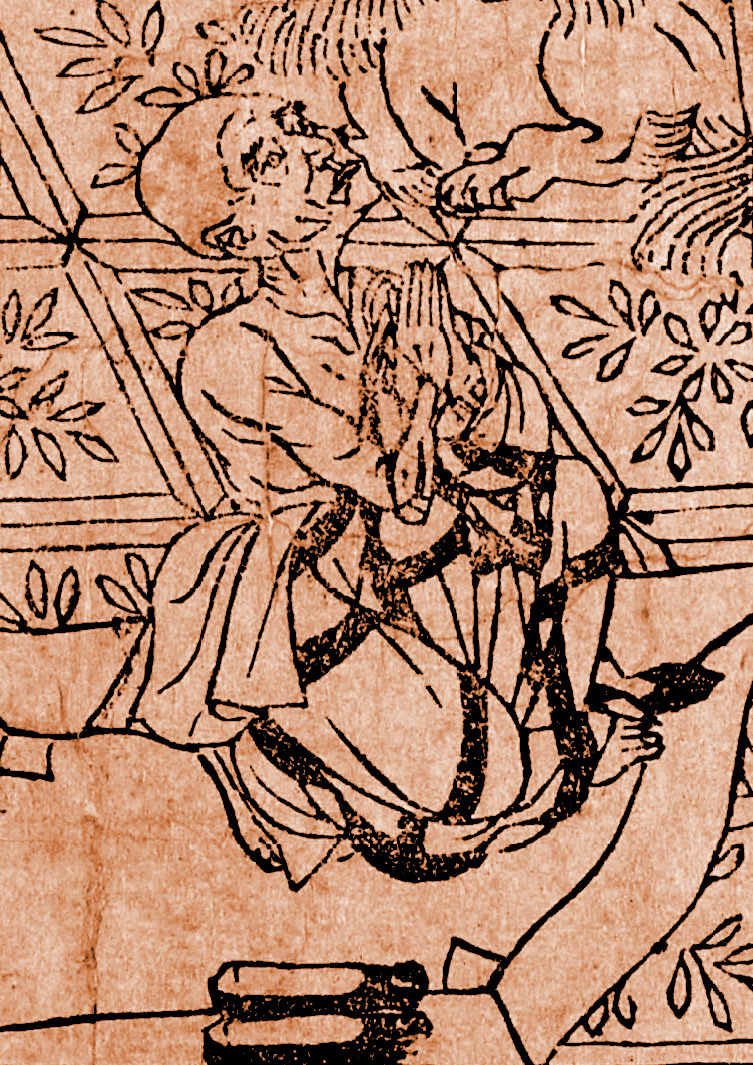
Detail of the 868 frontispiece
Look closer: Subhūti is the disciple who asks the question. He sits on his mat in the lower left corner of the scene, a listener rather than a speaker.
Image: Tang dynasty printer, 868 (retouched by Tengu800). Public domain. Source: Wikimedia Commons. File record

Eight Characters on a Scroll
The connoisseur's eyeThe sutra gave Japanese Zen one of its best-loved sentences. The eight characters 應無所住而生其心, abiding nowhere, the awakened mind arises, are a verse from the Diamond Sutra, and the Metropolitan Museum owns a hanging scroll in which the master Musō Soseki, who lived from 1275 to 1351, brushed them in a forceful cursive hand. The museum describes the message as a basic Zen one: awakening is reached by moving beyond every aspect of the material and transitory world.6 Musō was spiritual adviser to the emperor and to the shogun Ashikaga Takauji, so the scroll is not an obscure exercise but a statement from the centre of Muromachi culture.6
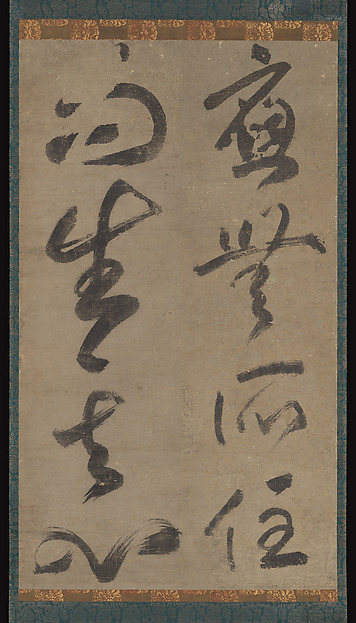
Japan · Kamakura (1185–1333) or Nanbokuchō (1336–92) period · early to mid-14th century · Hanging scroll; ink on paper
Look closer: The brush is moving so fast that streaks of bare paper show through the strokes. That technique is called hihaku, flying white, and it makes the line of the verse look like something in motion.
The Metropolitan Museum of Art, New York, Mary and Cheney Cowles Collection, Gift of Mary and Cheney Cowles, 2018, accession 2018.853.2. Public domain, Met Open Access. Museum record
The scholarship of the Edo period shows how seriously the sutra was studied. A recent article in Religions traces the transmission of a verse commentary on the sutra, the Chuanlao Song by the Southern Song Chan monk Daochuan, through Korea and Edo Japan. It discusses two Japanese works, a set of lecture notes first printed in 1636 and a commentary of 1641 by the Rinzai abbot Ryūkei Shōsen written entirely in Chinese, and it concludes that the text was studied across sectarian lines.7 The author also notes that Japanese interpretations often show the influence of the Lotus Sutra, while Korean editions more often connect it with the Flower Garland Sutra.7
Recitation is a different relationship with the same words. Scholar Erez Joskovich, writing on the Rinzai tradition, points out that classical Chan rhetoric often rejects scriptural authority, yet in monasteries sutra recitation and dhāraṇī invocation have taken up more of the monks' time than almost any other activity. The eighteenth-century Rinzai monk Tōrei Enji argued that recitation benefits body and mind, and that texts function as ritual objects.8 That is a neat answer to the paradox of the Diamond Sutra, a text that teaches that no text can be held, and is nonetheless held, copied and chanted every day.

Japan · Heian period (794–1185) · ca. 1175 · Handscroll; gold and silver on indigo-dyed paper
Look closer: The text is written in gold and silver on indigo-dyed paper, so the characters glow against a dark ground. The same family of texts was copied in this luxurious form in the twelfth century.
The Metropolitan Museum of Art, New York, Dr. and Mrs. Roger G. Gerry Collection, Bequest of Dr. and Mrs. Roger G. Gerry, 2000, accession 2002.447.1. Public domain, Met Open Access. Museum record

Japan · Nanbokuchō period (1336–92) · 1383, sixth month (Eitoku 3) · Woodblock printed book (orihon, accordion-style); ink on paper
Look closer: This is an accordion-folded book (orihon), woodblock printed in 1383, so every page opens in sequence from one long folded strip. The museum catalogues it as volume 157 of the Great Wisdom Sutra.
The Metropolitan Museum of Art, New York, Purchase, Mary and James G. Wallach Foundation Gift, 2013, accession 2013.740. Public domain, Met Open Access. Museum record
A Woodcutter, a Printer and a Priest
The connoisseur's eyeThe best-known story belongs to the Sixth Patriarch. In the first chapter of the Platform Sutra, the biography of Huineng, the young woodcutter overhears the recitation of the Diamond Sutra. Hearing it is said to have awakened him, and he left his work to become a monk.1 A sutra that teaches that attainment is a delusion is thus the sutra that opens the path for the founder of the southern school. Every later Zen master who brushes the verse of the eight characters is, in a sense, repeating that scene.
The second story is the printer's. Almost nothing is known about Wang Jie beyond the colophon, which says he made the scroll on behalf of his two parents and offered it to everyone freely. The word the colophon uses for the offering means universal free distribution, and the scroll has been called the first known creative work with an explicit public-domain dedication.1 A sentence written in the ninth century has outlived the paper that carries it, and it is the sentence of a person who wanted the merit to go to others.
The third story is the discoverer's, and it is not a comfortable one. Wang Yuanlu discovered the cave and sold much of its contents to foreign buyers; Stein removed a great deal of material from China. Historians hold mixed views, and Chinese historians have mixed feelings about Wang, who both found the site and sold its contents abroad.2 The Diamond Sutra's present home in London is part of that history, and a visitor should know it.
- About 401Kumārajīva translates the sutra into Chinese.1
- 764 to 770The Hyakumantō Darani is printed in Japan, an earlier dated printed charm.45
- 11 May 868Wang Jie has the Dunhuang scroll printed.13
- About 1000Cave 17 at Mogao is sealed.2
- 1900Wang Yuanlu opens the sealed cave.23
- 1907Aurel Stein buys the scroll and others.12
- 2010The British Library restores its copy.1
- 2023The 1,155th anniversary of the printing is marked.2
Fun Facts and Small Surprises
First lookA short sutra gathers odd facts the way a river gathers stones. These are the ones that readers most often repeat.
- The sutra's opening scene is deliberately ordinary: a walk for alms, a rest, a question from an elder.1
- The sutra's original Sanskrit does not use the word for emptiness, even though emptiness is its subject.1
- A birchbark manuscript of the sutra in Sanskrit, written in Gupta script, was found at the Bamiyan site in Afghanistan; it also contains the Medicine Buddha Sutra and is now in the Schøyen Collection.1
- The text has been translated into Tibetan, Tangut, Old Uyghur, Mongolian and Korean, among other languages.1
- A project has even encoded the sutra in synthetic DNA, a modern twist on the old idea that the text should be copied for merit.1
- The 868 printing is a charity: the colophon makes it a gift for two parents and for everybody.3
In the Library, on the Screen and in the Hall
The connoisseur's eyeThe scroll is now a designated treasure of the British Library, and the library has put the whole of it online in twelve sections, with commentary.2 In 2010 the library's Chinese section head Frances Wood, the conservator Mark Barnard and the chemist Ken Seddon of Queen's University Belfast took part in the restoration of its copy.1 In 2023 the 1,155th anniversary of the colophon date was marked by libraries and historians around the world.2
The scroll is not the only way to meet the sutra today. A hand copy on a temple table, the scroll in the Zen hall and a page on a phone may all carry the same text. For readers in Japan the practical entrance is shakyō, the hand-copying of a sutra for merit, which the almanac treats in the Heart Sutra chapter; a Diamond Sutra copy, being longer, is a more patient exercise.1
The sutra is also in constant conversation with Japanese museums. The Metropolitan Museum holds not only Musō Soseki's calligraphy but a Chinese woodblock-printed Diamond Sutra with hand-painted sections, and Japanese fragments of the Perfection of Wisdom family from the twelfth and fourteenth centuries.6910
Korea, Tibet and the Silk Road
The deep endIn Korea the sutra is known as the Geumgang-gyeong, and Korean editions of its verse commentary more often tie it to the Flower Garland Sutra, while Japanese ones lean towards the Lotus.7 In China it is closely tied to Chan, and the Huineng story is its best-known legend.1 In Tibet, translations of the text and commentaries on it were made from the Sanskrit tradition.1
Along the Silk Road the translations are the proof of its reach: Old Uyghur, Tangut, Mongolian, and the Sanskrit birchbark pages at Bamiyan.1 That is why the Dunhuang scroll is so significant. It is not a freak survival but a single object from a vast, multilingual culture of copying.
In Japan the wider Perfection of Wisdom family was copied on a grand scale. The Metropolitan's twelfth-century sheet belongs to the Chūsonji Sutras, and its 1383 printed fragment is catalogued as volume 157 of the Great Wisdom Sutra.10
Reading a Sutra as an Object
The deep endA collector who meets a Diamond Sutra copy should ask four questions. What is the format, a scroll, an accordion-folded book or loose leaves? How is the text produced, by hand or by woodblock? What is the colophon, if any, and does it give a date or a donor? And what is the paper, since dyed paper such as the yellow stock of the Tang or the indigo of twelfth-century Japanese sutras tells its own story?310
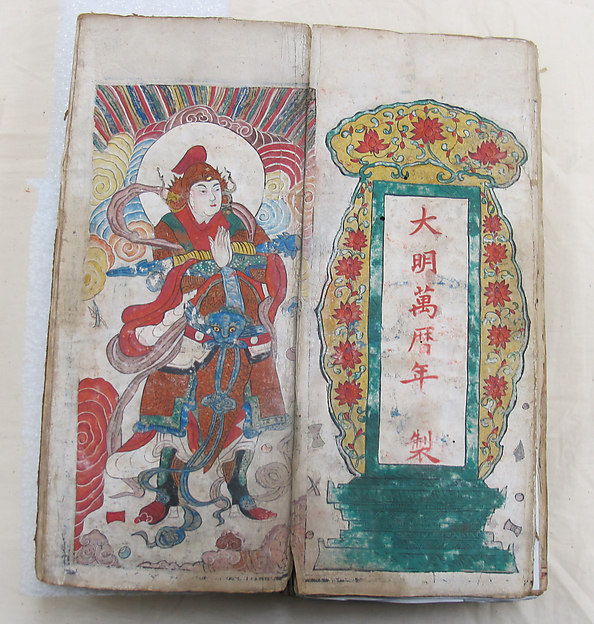
China · Ming dynasty (1368–1644), Wanli period (1573–1620) · Woodblock printed book with handwritten and hand-painted sections
Look closer: The museum describes this as a woodblock printed book with handwritten and hand-painted sections. Look for the passages that differ from the printed text in hand and colour.
The Metropolitan Museum of Art, New York, Anonymous Gift, 1947, accession 47.136.4. Public domain, Met Open Access. Museum record
The Metropolitan's printed Diamond Sutra is a modest book, 31.8 by 14 centimetres, printed from woodblocks with sections added by hand.9 The Japanese Perfection of Wisdom fragment of 1383 is a printed accordion book of about 26 by 9.5 centimetres, and the earlier Chūsonji sheet of about 1175 is written in gold and silver on indigo.10 Those three objects show a spectrum: printed, printed and painted, and written in precious metal. A buyer who understands the spectrum is in a position to read the price.
The house keeps a changing shelf of Buddhist sculpture, scrolls and ritual objects. Sutra copies, calligraphy of the great verses and sutra boxes appear from time to time, and the concierge desk can search Japan for a particular text or brushwork.
Words Worth Knowing
The terms below recur on this page and across the almanac.
| Term | Reading | Meaning |
|---|---|---|
| Kongō-kyō | Kongō-kyō | The Diamond Sutra.1 |
| Hannya haramitta | hannya haramitta | Perfection of wisdom, prajñāpāramitā.1 |
| Colophon | okugaki | The note at the end of a text naming maker, date and purpose.3 |
| Orihon | orihon | An accordion-folded book.10 |
| Hihaku | hihaku | Flying white, the streaks left when a brush moves fast.6 |
| Shakyō | shakyō | The hand-copying of a sutra as a devotion.1 |
Related Pieces
The house keeps a changing shelf of Buddhist sculpture, scrolls and ritual objects from Japan. The shelf below fills with pieces on the day you read this, and the collection page lists them all.
Pieces in the house now
- Buddhist statues and sacred artSculpture, scrolls and ritual objects
Answered plainly
What is the Diamond Sutra about?
It is a dialogue between the Buddha and his disciple Subhūti on how a bodhisattva should live. Its main themes are not-self, the emptiness of things, and acting without attachment, taught through a repeated pattern of statement, denial and restoration.1
Why is it called the Diamond Sutra?
The Sanskrit name means the Perfection of Wisdom that Cuts like a Thunderbolt, and vajra means both diamond and thunderbolt. The image is of wisdom that cuts through illusion.1
Is it the oldest printed book?
The 868 Dunhuang scroll is the oldest complete printed book that carries a date, but earlier printed material exists, including the Japanese Hyakumantō Darani of 764 to 770.145
Where can I see the 868 scroll?
It belongs to the British Library as Or. 8210/P.2 and is available online in twelve sections.23
How does the Diamond Sutra relate to the Heart Sutra?
Both belong to the Perfection of Wisdom family. The Heart Sutra is a few lines long and chanted constantly; the Diamond Sutra is a conversation and is more often studied and brushed.1
Which Japanese schools use it?
It was studied across sectarian lines in Edo Japan, and it has a prominent place in Zen. A Rinzai scholar notes that recitation takes up more monastic time than almost anything else.78
What does "abiding nowhere, the awakened mind arises" mean?
It is an eight-character verse from the sutra. The Metropolitan Museum glosses it as the Zen message that awakening comes by going beyond the material and transitory.6
Where next
Sources and image credits
- Wikipedia, Diamond Sutra Title, contents, translations, Dunhuang scroll, commentaries, Bamiyan manuscript.
- Linda Hall Library, The Diamond Sutra (11 May 2023) Discovery, scroll format, printing, anniversary, Stein.
- Cabinet, University of Oxford, The world's earliest dated printed book: The Diamond Sutra, 868 CE Frontispiece, colophon, discovery, conservation.
- Library of Congress, The History of Printing in Asia (part 1) Hyakumantō Darani, 764 to 770.
- Beinecke Library, Yale: 1300-year-old Japanese scroll Hyakumantō Darani and its patron.
- The Metropolitan Museum of Art, Musō Soseki, "Abiding nowhere, the awakened mind arises" The eight-character verse and flying-white brushwork.
- Mingjia Li, Religions 16(11), 1456 (2025) Transmission of the Chuanlao Song to Korea and Edo Japan.
- Erez Hekigan Joskovich, Relying on Words and Letters, Japanese Journal of Religious Studies 46/1 Scripture recitation in the Rinzai tradition.
- The Metropolitan Museum of Art, The Diamond Sutra (47.136.4) Woodblock printed book with hand-painted sections.
- The Metropolitan Museum of Art, Perfection of Wisdom fragments (2002.447.1, 2013.740) Chūsonji sheet of about 1175 and the printed fragment of 1383.
Last reviewed 28 October 2026. Dates in this chapter follow the cited pages; where the sources disagree, the chapter says so. Every picture is public-domain or openly licensed, and its credit and licence stand beneath it.
If this subject has drawn you to an object, the concierge desk can search Japan for it.
Private concierge
Looking for something in particular?
Describe the piece or the project you have in mind. A senior advisor in Tokyo reads every case file personally and replies within two business days, with fees set out in writing before any work begins.