
Bizen Ware: The Unglazed Kiln
Pottery Almanac · Regions
Bizen Ware: The Unglazed Kiln
Most Japanese kilns reached for glaze. Bizen, at the village of Imbe in Okayama, refused it, and let wood, ash and flame write the surface instead. The result is the oldest of the Six Ancient Kilns and one of the few that thrived on having nothing applied.
Fact sheet
At a glance
- No glaze, by necessity. The sticky, fine, iron-rich clay of Imbe shrinks strongly, so an applied glaze would peel in the firing. Bizen's unglazed look began as a response to its clay.
- The kiln writes the surface. Placement, fuel and flame decide every piece. Potters call the effects yohen, kiln effects, and no two pots leave the kiln alike.
- A slow firing. A single firing lasts ten to fourteen days and happens only once or twice a year, fed with red pine.
- Made for tea. From the middle of the sixteenth century Bizen potters made tea vessels, and the ware was among the first Japanese ceramics thought suitable for the tea ceremony.
- Six named effects. JAANUS lists six firing types, from the straw scorch of hidasuki to the sesame ash of goma.
A Pot Without a Skin
Pick up a piece of Bizen and the first surprise is the surface. There is no shine, no painted line, no coloured glaze. Wikipedia describes the ware by four traits: significant hardness from high-temperature firing, an earthen reddish-brown colour, the absence of glaze, though traces of molten ash may resemble one, and markings left by the wood fire.

Double Gourd Vessel, 18th century, Stoneware with natural ash glaze (Bizen ware). The Metropolitan Museum of Art, Gift of Samuel and Gabrielle Lurie, 2019, accession 2019.570.1.
Look closer: the body is the red-brown of iron-rich clay, and the paler orange patches on its shoulders and belly are marks left by the fire. Nothing here was painted or glazed on; the museum records only a natural ash glaze.
Image: The Metropolitan Museum of Art, Open Access (CC0)
The absence is a consequence, not a choice of taste. The clay found at Imbe is sticky and fine, high in iron and, traditionally, rich in organic matter that does not accept glaze. It shrinks a great deal, and it has low resistance to sudden heat. For that reason, Wikipedia explains, most Bizen is left uncoated: any applied glaze would peel away in the firing. The same clay is plastic, and its strength lets a pot keep its shape and stay tough without any coat.
So the Bizen potter works with what the kiln will give. The decoration, if one can call it that, is the record of a ten-day fire.
From Sue to Imbe
JAANUS, the Japanese Architecture and Art Net Users System, calls Bizen the oldest of Japan's six old kilns and describes it as a continuation of the Sue stoneware tradition. Wikipedia agrees that the ware has ties to Sue pottery. Towards the end of the Heian period, JAANUS says, potters moved from the Sue kilns to Imbe, drawn by better clay and by fuel for the kilns.
In the Kamakura period more kilns were built and the wares began to show colours from red to chocolate brown. By the Muromachi period production had concentrated in fewer, larger kilns, and the Inland Sea ports gave Bizen a route to markets in central Japan. By the end of that period, JAANUS records, three large kilns stood to the north, south and west of Imbe. The ware that left them was mostly utilitarian: jars, wide-mouthed vessels and grinding bowls of the kind described in the chapter on The Six Ancient Kilns: A Map of Japanese Clay.
That frame explains why Bizen, though now prized as art, began as the pottery of the everyday. Its fortunes turned in the sixteenth century, when the tea room discovered what a farm jar could be.
The Tea Century
JAANUS dates the addition of tea-related vessels to the mid-sixteenth century. Potters began to make freshwater jars, flower vases and sake flasks alongside their daily wares, and Bizen became one of the first Japanese ceramics thought suitable for the tea ceremony. Wikipedia places the ware's peak in the Momoyama period and attributes its popularity in tea to its rustic quality. Early work is grouped as Ko-Bizen, old Bizen.

Tea jar, ca. 1775, Pottery (Ko Bizen ware). The Metropolitan Museum of Art, Fletcher Fund, 1925, accession 25.215.26.
Look closer: the surface is dark and speckled, finely pitted where ash and charcoal touched it. The museum catalogues it as Ko-Bizen ware, old Bizen, even though this example is dated to around 1775.
Image: The Metropolitan Museum of Art, Open Access (CC0)
The Metropolitan Museum holds a small tea jar catalogued as Ko-Bizen of about 1775, a Bizen water pot of about 1625 and an eighteenth-century tea jar, and together they show what the tea world valued: weight, an unforced shape, and a surface that looks accidental because it partly was. The water pot is especially instructive. Its waist is pinched, its wheel rings catch the light, its streaks run from rust to brown, and above it all sits the black lacquer lid that turns a rough jar into an object of the tea room.
The vessels themselves are examined in their own chapters on Mizusashi, Kensui and Hishaku and Chaire and Natsume Tea Caddies. The point for the collector is that Bizen entered the tea tradition on its own terms. It was not made to look like Chinese porcelain or a Korean bowl. It was chosen, in a century that prized wabi taste, precisely because it did not try to impress.
The Ikeda Lords and the Edo Kiln
In the Edo period the Ikeda lords of Okayama continued to support the kilns and gave special privileges to certain families, among them the Kimura, Mori, Kaneshige, Oae, Tongu and Terami, whose names still turn up in the signatures of Bizen potters. JAANUS adds that the local clan protected and encouraged the Imbe potters, and that the output now included bottles, water jars, mortars and seed jars, as well as vessels for the court and the shogunate.

Figure of Hitomaru, God of Poetry, 18th century, Stoneware (Bizen ware). The Metropolitan Museum of Art, Purchase by subscription, 1879, accession 79.2.851.
Look closer: the god reclines on one elbow with a scroll in hand, his long beard and robe modelled in the same grey-brown stoneware as a jar. The pose is a classic one for the poet-god, and the detail is that of a modeller, not a thrower.
Image: The Metropolitan Museum of Art, Open Access (CC0)
A new type of climbing kiln, JAANUS notes, was in wide use by the nineteenth century, and it made possible flower vases, tea wares and sake cups and bottles. This is the context for the small figures that Western museums collected. Among the Met's Bizen holdings are a reclining figure of Hitomaru, the god of poetry, a figure of Hotei and a sparrow perched on a roof tile that serves as an incense burner. Their clay is the same, but the potter has turned from vessel to modelling.
The Met catalogues several of these figures as lightly glazed or covered with a thin glaze, which is a reminder that Bizen is a tendency rather than a law. The unglazed fire-marked pot is the heart of the tradition, and the figures stand at its edge.
Reading the Kiln
Wikipedia stresses that the surface of Bizen ware depends entirely on yohen, kiln effects. The place of each piece in the kiln exposes it to different conditions, so that one clay and one kind of firing yield a wide variety. The finish is decided by how the potter controls the fire, and both the flames and the flying charcoal ash are crucial. The ash melts in the heat and becomes something like a glaze. It also leaves yellow sprinkles known as goma, sesame seeds.
Most firing, Wikipedia says, takes place in traditional climbing kilns of several chambers, noborigama, or in a tunnel kiln, anagama. Red pine is the fuel, because its resin helps to reach a high temperature, and thousands of logs may go into a single firing. The potter feeds wood into the firebox every twenty minutes, day and night. The temperature begins near 600 degrees Celsius and is raised gradually to avoid cracking; by the eighth day it approaches its peak of 1,200 or even 1,300 degrees. A last throw of charcoal reduces the oxygen and leaves dark patterns, and several days later the fires are put out and the kiln is opened.
JAANUS names six firing types that connoisseurs learn to recognise, and the table gives them in its own words, lightly adapted. Learn these and the surface stops looking random. It begins to read like handwriting.
| Term | What happened in the kiln |
|---|---|
| Hidasuki | Straw is wound around the piece and leaves a scorch mark where it burned. |
| Goma | Ash spotting forms a sesame-like glaze. |
| Zangiri | The piece is buried in ash near the stoke hole during firing and turns grey. |
| Botamochi | A red mark appears where another vessel covered the piece. |
| Fuseyaki | The piece is fired face down so the inside is not speckled with ash. |
| Ao-bizen | Carbon flames produce a dark blue colour. |
Revival and Living Makers
After modernisation began in the Meiji era, Bizen, like many traditional crafts, nearly disappeared. Wikipedia credits the artist Kaneshige Toyo (1896 to 1967) with preserving it in the early Showa years, the 1930s, by reviving the Momoyama style. For this he was named a Living National Treasure. The same article lists Fujiwara Kei and Yamamoto Toshu among the Living National Treasures from Bizen, and a longer roll of artists honoured as Intangible Cultural Property by Okayama Prefecture, among them Kaneshige Sozan, Kaneshige Michiaki, Fujiwara Ken and Isezaki Yozan.
In 1982 the government designated Bizen ware a traditional Japanese craft. A Bizen ware festival is held every year around Imbe Station, near which stand the Bizen Ware Traditional Industry Hall, with works by contemporary potters and a small collection of old Bizen, and the Okayama Prefectural Bizen Ceramics Museum, whose collection exceeds 500 pieces.
For the living makers in the wider field, the house keeps a directory of Living National Treasures in ceramics, linked below.
Bizen in the Tea Room and the Study
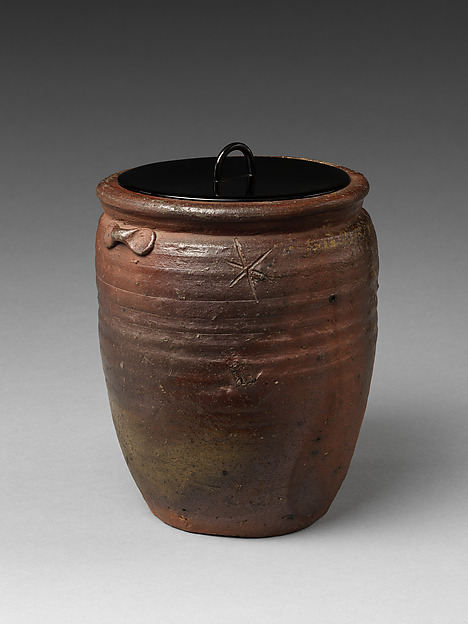
Freshwater Jar (Mizusashi) in the Shape of a Seed Jar (Tane-tsubo), late 16th century, Stoneware with natural ash glaze (Bizen ware, Ko-Bizen type); black-lacquered wooden lid. The Metropolitan Museum of Art, Mary Livingston Griggs and Mary Griggs Burke Foundation Fund, 2023, accession 2023.326a–c.
Look closer: the pinched wheel-thrown body wears the red and brown of the fire; the black lacquer lid with a ring handle is the tea master's addition.
Image: The Metropolitan Museum of Art, Open Access (CC0)

Tea jar, 18th century, Pottery (Bizen ware). The Metropolitan Museum of Art, Fletcher Fund, 1925, accession 25.215.13a, b.
Look closer: the squared body and mottled olive-grey surface carry the marks of ash and flame. The pale lid with a small knob is not part of the pot but a fitted cover, as is usual in the tea room.
Image: The Metropolitan Museum of Art, Open Access (CC0)
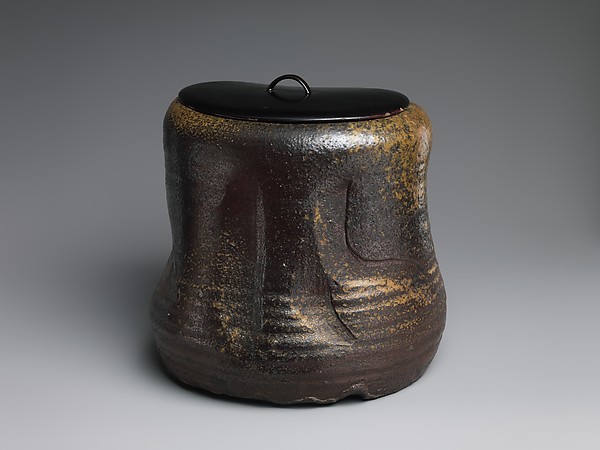
Water pot, ca. 1625, Bizen pottery; lacquer cover. The Metropolitan Museum of Art, Fletcher Fund, 1925, accession 25.215.47a, b.
Look closer: the horizontal wheel rings and the streaks of orange and rust show the throwing and the firing together, and the lid carries a ring handle.
Image: The Metropolitan Museum of Art, Open Access (CC0)

Censer in the Form of Sparrow on a Roof Tile, 1650, Lightly glazed stoneware (Bizen ware). The Metropolitan Museum of Art, Gift of Charles Stewart Smith, 1893, accession 93.3.163a, b.
Look closer: a small bird sits on a round-ended roof tile, the censer proper being the tile body beneath it. A reminder that Bizen potters modelled as well as threw.
Image: The Metropolitan Museum of Art, Open Access (CC0)
Ceramics From Japan
The house keeps a shelf of Japanese porcelain and ceramics. It is a shelf of the whole subject, and the concierge desk can say whether a Bizen piece or any other particular ware is available.
Answered plainly
Is Bizen ware glazed?
Mostly not. The clay shrinks so much that an applied glaze would peel in firing. Bizen potters rely on ash that melts on the surface and on the movement of the flame.
How long is a Bizen firing?
Wikipedia gives ten to fourteen days, once or twice a year, in a climbing kiln or tunnel kiln fed with red pine.
What does goma mean on Bizen?
Goma means sesame seeds. It names the yellow sprinkles formed when flying charcoal ash melts on the surface of the piece.
Who revived Bizen in the twentieth century?
Kaneshige Toyo (1896 to 1967), who revived the Momoyama style in the 1930s and was named a Living National Treasure.
Where next
Sources and image credits
- Bizen ware, Wikipedia
- Six Ancient Kilns, Wikipedia
- Bizen'yaki, JAANUS (Japanese Architecture and Art Net Users System)
- Object record, Double Gourd Vessel, The Metropolitan Museum of Art
- Object record, Tea jar, The Metropolitan Museum of Art
- Object record, Figure of Hitomaru, God of Poetry, The Metropolitan Museum of Art
- Object record, Freshwater Jar (Mizusashi) in the Shape of a Seed Jar (Tane-tsubo), The Metropolitan Museum of Art
- Object record, Tea jar, The Metropolitan Museum of Art
- Object record, Water pot, The Metropolitan Museum of Art
- Object record, Censer in the Form of Sparrow on a Roof Tile, The Metropolitan Museum of Art
Last reviewed 28 October 2026. Pictures, where shown, are public-domain or open-access and credited beneath each one.
Looking for a particular kiln, maker or form? The concierge desk replies within one to three business days.
Browse Japanese porcelain and ceramics · Make a private request
Private concierge
Looking for something in particular?
Describe the piece or the project you have in mind. A senior advisor in Tokyo reads every case file personally and replies within two business days, with fees set out in writing before any work begins.