
Bonsai Styles and History | Japonista
Craft and Ceremony Wing · Living Miniature
Bonsai Styles and History
盆栽
A bonsai is a tree that has been taught to look old and to stay small, and the Japanese tradition of doing so has a documented past of more than a thousand years. This chapter gives the history in plain order, then the vocabulary of styles by which every specimen is described.
Fact sheet
At a glance
- Older than it looks. Wikipedia lists a scroll of 1195 as the earliest known to depict dwarfed potted trees in Japan.
- The name is recent. The term bonsai did not come into broad use for nearly a century after scholars adopted it in the early nineteenth century.
- Styles are a shorthand. The named styles describe a tree and guide a designer, but even prized specimens rarely meet every rule of their style.
A Tree in a Bowl
Look at the three prints below. Each was made in Edo and each shows a potted tree placed on a table, a stand or a bench as a prized possession. In a privately published print by Ryūryūkyo Shinsai, dated 1806 in the Metropolitan Museum’s catalogue, a flowering plum grows from a blue pot with white dots, beside a compass and a pocket sundial. A print by Kubo Shunman, dated 1796, places a bonsai plum on a bench next to a lidded box. A print of the Edo period by Sunayama Gosei shows a pine in a deep bowl, a drum on a stand and a box of herbs. All three are surimono, privately published prints, and the care with which the pots and stands are drawn shows that the container and the tree were already read together.

Ryūryūkyo Shinsai · 1806 · Privately published woodblock prints (surimono) mounted in an album; ink and color on paper
Look closer: the pot and its stand are drawn with the same care as the tree.
Ryūryūkyo Shinsai, Bonsai Plum, Compass, and Pocket Sundial with Design of Calendar, from Spring Rain Surimono Album (Harusame surimono-jō, vol. 3), 1806. The Metropolitan Museum of Art, H. O. Havemeyer Collection, Bequest of Mrs. H. O. Havemeyer, 1929 (accession JP2295). Public domain, Met Open Access. Record
The Wikipedia article on bonsai gives the definition that matters. Bonsai is the Japanese art of growing and shaping miniature trees in containers, and in the narrowest sense the term refers to trees that follow Japanese bonsai tradition and principles. The purposes, it says, are the contemplation of the viewer and the exercise of effort and ingenuity by the grower. The trees are not grown for food or medicine.
Two clarifications from the same article keep the subject honest. Bonsai is not dwarfing: it does not need genetically dwarfed plants, but grows small trees from ordinary stock by pruning, root reduction, potting, defoliation and grafting. And in the Japanese tradition there is no indoor bonsai; trees shown at exhibitions or in catalogues have been grown outdoors for their entire lives.
From Penjing to Kokufu-ten
According to Wikipedia, the art originated in the Chinese practice of penjing. From the sixth century onward imperial embassy personnel and Buddhist students visited China and returned with many Chinese goods and ideas, including container plantings. Medieval handscrolls show what happened next. The article names the Saigyō Monogatari Emaki of 1195 as the earliest known to depict dwarfed potted trees in Japan, and says that recognisable bonsai appear in the Ippen Shōnin Eden of 1299, that the Kasuga Gongen Genki E of 1309 shows tray-like pots with dwarf landscapes on shelves, and that the Boki Ekotoba of 1351 shows dwarf trees displayed on short poles.
Zen gave the art its temper. The article describes Chinese Chan monks teaching in Japanese monasteries and introducing political leaders to miniature landscapes as accomplishments of men of taste. At first the pots carried miniature figurines in the Chinese fashion; Japanese artists gradually adopted a simpler style, removing the figures and ornaments, using smaller, plainer pots and focusing on the tree. Around the fourteenth century the term was “the bowl’s tree”, hachi no ki, which indicated a deep pot; the later word bonsai denoted a shallow one. The popular drama of that name was later depicted in woodblock prints by several artists.
By the seventeenth century the standard was high. The article reports that bonsai dating to that century survive and that a five-needle pine called Sandai Shōgun, in the Tokyo Imperial Palace collection, is documented as cared for by Tokugawa Iemitsu and was trained as a bonsai by 1610. In the Tenmei era (1781 to 1788), it adds, an annual exhibit of dwarf potted pines began in Kyoto, where connoisseurs from five provinces brought plants to be ranked. After 1800 the art moved from the practice of a few specialists to a popular pursuit. Scholars of Chinese art gathered in Itami in the early nineteenth century and drew many terms from the Mustard Seed Garden manual, and the older name for potted trees was replaced by bonsai.
The twentieth century turned a national pastime into an international one. Wikipedia records that steel tools made specifically for bonsai were first produced in the 1920s and 1930s by the toolsmith Masakuni I, including a concave cutter that leaves a shallow indentation which heals over, and that wire replaced string, rope and burlap for shaping from about 1910. The first national annual show was held in Tokyo’s Hibiya Park in 1914. After the war, English-language books such as Yuji Yoshimura’s The Art of Bonsai of 1957 reached readers abroad; the article calls it the classic Japanese bonsai bible for westerners, with over thirty printings. In 1967 the first group of Westerners studied at a nursery in Ōmiya, and in 1980 the first World Bonsai Convention was held in Osaka. The article’s survey is worth keeping in mind when you meet a Japanese pot in a foreign collection: the art has been travelling for a long time.
The modern institutions followed the Meiji restoration. The Meiji Emperor moved to Tokyo on 13 October 1868; bonsai were displayed inside and outside the palace, and the grand setting called for large trees. An Artistic Bonsai Concours was held in Tokyo in 1892, the monthly magazine Bonsai Gaho began in 1906, and the Kokufu-ten exhibitions began in Ueno Park in 1934. After the war they resumed in 1947, and the article says they are held by invitation each February.
Trays, Mountains and Stones
Before there was a Japanese word for the art there was a Chinese one. Wikipedia’s article on penjing gives it as 盆景, literally “tray scenery”, also called penzai, “tray cultivation”, and notes that the Tang-era term was rendered punsai. The tray itself is older than any tree in it: the article traces the pen container to the Neolithic Yangshao culture, where it was a shallow earthenware dish with a foot. It adds that Daoist mysticism recreated magical sites in miniature from at least the first century AD, and that Han incense burners of the second century BC had lids shaped like sacred mountains such as Penglai, the mythical island of the immortals.
The earliest known picture of the practice, the article says, is a wall mural of 706 in a corridor leading to the tomb of Prince Zhang Huai at the Qianling Mausoleum, excavated in 1972. It shows two maidservants carrying miniature rockeries and fruit trees. By about 1276, the same source reports, a tree guild at Suzhou was supplying dwarf trees to restaurants, and shops at Longhua near Shanghai have grown miniature trees since at least the sixteenth century. The Chinese art has three categories: shumu, the tree; shanshui, the landscape with rocks, usually in water; and shuihan, which joins water and land.
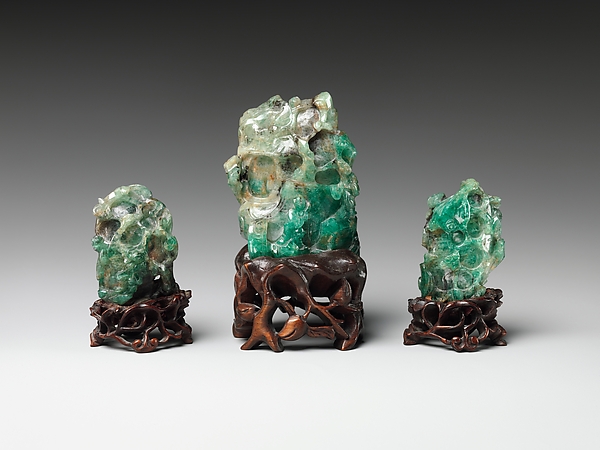
18th century · Emerald
Look closer: each peak is pitted and ridged like a rock in a tray landscape; the three together read as islands.
Miniature mountains representing the mythical realm Penglai, 18th century. The Metropolitan Museum of Art, Gift of Florence and Herbert Irving, 2015 (accession 2015.500.5.20a–c). Public domain, Met Open Access. Record
The Japanese art kept the idea and changed the manner. Wikipedia’s penjing article says penjing allows a wider range of tree shapes and uses bright, creatively shaped pots, while bonsai is simpler, with proportionally larger trunks, in low, plain, muted containers. It records the oldest known Japanese picture of a dwarfed tray landscape in the fifth of the twenty scrolls of the Kasuga-gongen-genki, dated 1309, which the previous section also names. Read together, the two accounts describe an art that was received, edited and then, in Japan, quietened.
Stones came along with the trees. Wikipedia’s article on suiseki, the Japanese art of the viewing stone, dates the Chinese appreciation of scholar’s rocks, gongshi, to the Han dynasty (206 BC to 220 AD), and cites the Huntington Library for the stones’ arrival in Japan about 600 AD, carried partly by Buddhist monks and scholars. In the Muromachi period (1336 to 1573) Zen and the aesthetics of the tea ceremony favoured subtle, suggestive forms, and stone appreciation belonged to the ruling elite, Zen monks and tea masters. By the nineteenth century it was formalised, with named categories. The word suiseki, 水石, “water stone”, is only about 150 years old according to Bonsai Clubs International, as the article quotes it.
Two differences are worth carrying away. The same article says that a suiseki may not be carved, polished or reshaped, and that alteration is limited to what stable display requires, such as fitting a base, the daiza. And Japanese practice favours the horizontal orientation of a stone where Chinese practice favours the vertical, with Japanese stands restrained and Chinese ones more elaborately carved. In a tokonoma, it adds, a suiseki may be paired with a hanging scroll and a seasonal accent such as a bonsai, which is why the tea-room alcove keeps appearing in this chapter.

probably 17th century · White Taihu limestone; wood stand
Look closer: the stone is pierced with holes and hollows; the stand beneath it is the carved part.
Scholar’s rock, probably 17th century. The Metropolitan Museum of Art, Rosenblum Family Collection, Gift of Anna Rosenblum Palmer, 2011 (accession 2011.575.9a, b). Public domain, Met Open Access. Record
Saikei, the Planted Landscape
Not every miniature landscape is a bonsai, and one man made a point of saying so. Wikipedia’s article on saikei describes Toshio Kawamoto, born in 1917, the eldest child of the bonsai master Tokichi Kawamoto, who trained in bonsai and ran the family nursery, Meiju-En, from 1960 after his father’s death. He developed the rules of saikei in postwar Japan, at a time, the article says, when bonsai was at a low point and many bonsai had died during the war. He published Bonsai-Saikei and Saikei: Living Landscapes in Miniature (1967), and helped to found the Nippon Bonsai-Saikei Institute and the Nippon Saikei Association. According to the article he insisted that saikei was not bonsai.
The word, 栽景, means “planted landscape”. Saikei combines miniature living trees with soil, rocks, water and ground cover in one tray, and it evokes a place through its topography, ground materials and plant species. A typical saikei uses a large, low-sided ceramic tray, and some span two or more containers that form one landscape when placed together. Its trees are usually young, thin-trunked and less elaborately shaped, generally no more than about four to six inches tall. Rocks are mandatory, the skeleton of the landscape; in bonsai they are rare and subordinate to the tree.
The table sets the differences side by side, as the article gives them. Neighbouring arts sit beside saikei in the same account: bonseki, simple landscapes of sand and stones on flat trays without living plants, and bonkei, where hills are formed in sand or gravel from rock and sculptable materials, again without living plants. The Vietnamese hòn non bộ, stylised miniature islands with trees projecting from water, is the related art outside Japan and China.
| Feature | Bonsai | Saikei | Penjing |
|---|---|---|---|
| Focus | The single tree, or a planting that dominates | The landscape; trees decorate it | Individual trees and detailed landscapes |
| Rocks | Rare and subordinate | Mandatory; the skeleton of the scene | Used, especially in shanshui and shuihan |
| Trees | Often old stock, carefully shaped | Young, thin-trunked, about four to six inches | Wide range of shapes; often over 100 years old |
| Other plants | Moss as a rule | Flowers, grasses and several species allowed | Not covered in the sources read |
| Ornaments | The tree, with moss and natural-looking rocks only | No figurines or buildings | Figurines, buildings and objects often included |
| Pot or tray | Low, plain, muted | Large, low-sided ceramic tray | Bright, creatively shaped pots |
Naming a Tree
Every serious description of a bonsai begins with a style. Wikipedia explains that the Japanese tradition describes tree designs by commonly understood names, which serve as shorthand in catalogues and competitions, assist teaching, and help a designer plan the development of a young tree. The styles are grouped by the orientation of the trunk, the character of trunk and bark, the placement of roots and rocks, and the number of trunks. They are not mutually exclusive; where a tree belongs to several, convention names the most striking, so that an informal upright tree with large areas of missing bark is called sharimiki rather than moyogi.

Schematic outlines, not to scale
Look closer: compare how the trunk leaves the pot and where the apex ends.
Diagram by Japonista. Drawn from the facts cited in this chapter; schematic, not to scale.
A second vocabulary names size. Wikipedia’s article says that Japanese exhibitions and catalogues refer to specimens by size class, and that the class implies the height and weight of the tree in its container; not all sources agree on the exact sizes or names, but the concept is well established. At the largest end the practice is to call trees “two-handed”, “four-handed” and so on, after the number of men required to move the tree and pot, and the very largest size, called “imperial”, is named after the great potted trees of the Imperial Palace. At the other end, the smallest common sizes, mame and shito, have techniques and styles of their own.
| Style | Japanese | What defines it |
|---|---|---|
| Formal upright | Chokkan | Straight, upright, tapering trunk; branches run from the thickest and broadest at the bottom to the finest and shortest at the top |
| Informal upright | Moyogi | Visible curves in trunk and branches, but the apex stands directly above the point where the trunk enters the soil |
| Slant | Shakan | A straight trunk that leaves the soil at an angle; the apex sits left or right of the root base |
| Semi-cascade and cascade | Han-kengai, kengai | Modelled on trees over water or down mountainsides; the apex reaches the lip of the pot in the first and falls below the base of the pot in the second |
| Raft | Ikadabuki | Imitates a fallen tree whose upper branches grow on as a group of new trunks |
| Broom | Hokidachi | Straight trunk branching out about a third of the way up into a ball-shaped crown, suited to fine-branched trees such as elms |
| Windswept | Fukinagashi | A tree that appears shaped by constant wind from one direction |
| Forest or group | Yose-ue | Several or many trees of one species, typically an odd number, in one pot |
Five Principles of Restraint
The same article lists the principles that guide the eye. Miniaturisation, by definition: the tree is small enough for a container yet has a mature appearance. Proportion: leaves and needles should be small and a thin trunk should not carry thick branches, since the aim is to mimic a full-grown tree. Asymmetry: strict radial or bilateral symmetry in branches and roots is discouraged. No trace of the artist: scars from removed branches are concealed and wiring is removed or hidden when the tree is shown. And poignancy, because many of the formal rules serve to express wabi-sabi or an aspect of mono no aware.
The principle that most surprises a newcomer is the fourth. A bonsai is the work of years of intervention that must not show. In a print, we see the finished tree; the labour is invisible by design. That is why a curator reading a bonsai, or a print of one, looks at the taper of the trunk, the balance of the crown and the fit of the pot, not at technique. Chapter two of this almanac turns to the pot, the tools, the soil and the display.
For the wider room, see Bonsai in Japan: A Short History, Bonsai Styles, Bonsai Size Classes and the glossary of bonsai and suiseki terms, and the hub The Bonsai Almanac.
The article also explains where the tree comes from, which surprises many readers. Bonsai growing is an unusual form of cultivation in that seed is rarely the source: to show the aged appearance of a bonsai within a reasonable time, the source plant is often mature or partly grown when work begins. Trees collected in the wild and replanted, called yamadori, are often the most expensive and prized of all. The Japanese tradition, it adds, does not include indoor bonsai: specimens at Japanese exhibitions and in catalogues have been grown outdoors for their entire lives, and temperate-climate trees kept in a home weaken and die.
Trees with Histories
The most famous tree in this art has a date and a story that museum people repeat with care. The Yamaki Pine, a Japanese white pine (Pinus parviflora ‘Miyajima’), is established in 1625 according to Wikipedia’s article, and is known as the “Hiroshima Survivor” and the “Peace Tree”. Officials of the Potomac Bonsai Association report, the article says, that a garden wall sheltered it in its original growing place. In 1976 the bonsai master Masaru Yamaki donated it to the United States, one of 53 bonsai that Japan gave for the American bicentennial. It stands today in the Japanese Pavilion of the National Bonsai and Penjing Museum in Washington. The same article cites an NPR report of 19 May 2025, “Washington honors an ancient tree that survived Hiroshima”, which marks how the tree’s story is still told.
The gift itself was an institution in the making. The museum’s article says the 53 trees were selected by the Nippon Bonsai Association with financial help from the Japan Foundation, dedicated on 19 July 1976, and accepted by Secretary of State Henry Kissinger on behalf of the government. The National Bonsai Foundation followed in 1982 and the collection was renamed the National Bonsai and Penjing Museum in 1988. Its Japanese collection began with the 53 trees and now has 63, shown in the Japanese Pavilion from April to October; its Chinese collection is housed in a pavilion funded by Dr Yee-sun Wu; and its viewing stones, 105 in all, began with six suiseki that came with the original trees.
Japan’s own centre of the art has a founding story too. Wikipedia’s article on Ōmiya Bonsai Village says professional bonsai gardeners settled there in 1925. They had lived around Dangō-zaka in Hongō, Tokyo, and the Great Kantō earthquake of 1923 caused serious damage there, so they moved to the Toro and Hongō settlements of Ōsato village. The village merged into Ōmiya city in 1940; the name Bonsai-chō was made official in 1957; Ōmiya merged into Saitama City in 2001, and Bonsai-chō was placed in Kita ward in 2003. The article reports about ten privately owned bonsai gardens, and as of 2007 a site of about 330,000 square metres with hundreds of thousands of trees.
Edo had its own versions of the trade, and the prints keep it. A woodblock print of about 1738 by Nishimura Shigenobu shows an actor in the role of an itinerant flower vendor, carrying on a pole two tiered racks of potted flowering plants, chrysanthemums on one side and a blossoming tree in a jar on the other. A century and a half later, in the 1870s, a studio photograph coloured by hand shows a florist’s display of potted pines and plants, with a woman in a green kimono standing beside the shelves. Between those two dates the plant in a pot passed from the street to the parlour and into the poetry circle, where it turns up in surimono, the privately published prints made for the New Year and for poems.

Nishimura Shigenobu · ca. 1738 · Woodblock print; ink and color on paper
Look closer: the racks of pots hang at either end of a pole; the jar on the right holds a small tree in blossom.
Nishimura Shigenobu, The Actor Ogino Isaburō as an Itinerant Flower Vendor, ca. 1738. The Metropolitan Museum of Art, The Howard Mansfield Collection, Purchase, Rogers Fund, 1936 (accession JP2658). Public domain, Met Open Access. Record

Suzuki Shin'ichi · 1870s · Albumen silver print from glass negative with applied color
Look closer: the pot of pines on a stand at the upper left is the only large tree; the rest are small plants on shelves.
Suzuki Shin'ichi, Florist, 1870s. The Metropolitan Museum of Art, Gilman Collection, Museum Purchase, 2005 (accession 2005.100.505.1 (24b)). Public domain, Met Open Access. Record
Surimono are the best place to see what a potted tree meant to its owner. In one print by Ryūryūkyo Shinsai, a flowering plum in a footed pot stands beside a book and a red cord, with a verse above; in another, by Katsukawa Shuntei, about 1815, a courtesan in a patterned robe bends toward a child attendant who tends a small potted plum on the floor. A third, of the eighteenth or nineteenth century, sets young pines on a little stand beside a ceremonial crown with long beaded hangings. A fourth, by Shinsai about 1820, is titled First Tea Gathering of the New Year: a dwarf pine on a low tray stands among the tea things, with a teapot and a bowl. None of these prints is a manual. Each shows a tree as one of the beautiful things a household had on hand at the start of the year.

Unidentified artist · 18th–19th century · Woodblock print (surimono); ink and color on paper
Look closer: the pine is cut as small sprigs on a stand; the cords trail through the foreground.
Unidentified artist, Young Pine Trees on a Stand and a Ceremonial Crown with Long Hangings, 18th–19th century. The Metropolitan Museum of Art, H. O. Havemeyer Collection, Bequest of Mrs. H. O. Havemeyer, 1929 (accession JP2190). Public domain, Met Open Access. Record

Ryūryūkyo Shinsai · 19th century · Woodblock print (surimono); ink and color on paper
Look closer: the pot has three feet and a decorated rim; the verse above names the poets.
Ryūryūkyo Shinsai, Potted Plum Tree in Blossom and Books, 19th century. The Metropolitan Museum of Art, H. O. Havemeyer Collection, Bequest of Mrs. H. O. Havemeyer, 1929 (accession JP2207). Public domain, Met Open Access. Record

Katsukawa Shuntei · ca. 1815 · Part of an album of woodblock prints (surimono); ink and color on paper
Look closer: the plum sits in a white tub on the floor between the two figures.
Katsukawa Shuntei, Courtesan and her Child Attendant with a Potted Plum Tree, ca. 1815. The Metropolitan Museum of Art, H. O. Havemeyer Collection, Bequest of Mrs. H. O. Havemeyer, 1929 (accession JP2336). Public domain, Met Open Access. Record

Ryūryūkyo Shinsai · ca. 1820 · Woodblock print (surimono); ink and color on paper
Look closer: the pine stands on a low tray at the left, and the tea things are grouped around it.
Ryūryūkyo Shinsai, First Tea Gathering of the New Year, ca. 1820. The Metropolitan Museum of Art, H. O. Havemeyer Collection, Bequest of Mrs. H. O. Havemeyer, 1929 (accession JP2375). Public domain, Met Open Access. Record
Dates from 706 to 2026
Dates come from the articles cited at the foot of the page. Where an account gives a century and not a year, the table says so.
| Year | Event |
|---|---|
| 706 | Tang wall mural at the tomb of Prince Zhang Huai shows maidservants carrying miniature rockeries and fruit trees |
| 1195 | Saigyō Monogatari Emaki, earliest known Japanese scroll to show dwarfed potted trees |
| 1299 | Ippen Shōnin Eden shows recognisable bonsai |
| 1309 | Kasuga Gongen Genki E shows tray-like pots with dwarf landscapes |
| 1351 | Boki Ekotoba shows dwarf trees displayed on short poles |
| 1610 | Sandai Shōgun already trained as a bonsai, by one account |
| 1625 | Yamaki Pine established |
| 1781 to 1788 | Tenmei era: annual exhibit of dwarf potted pines begins in Kyoto |
| 1868 | The Meiji Emperor moves to Tokyo on 13 October; bonsai displayed in the palace |
| 1892 | Artistic Bonsai Concours in Tokyo |
| 1906 | Bonsai Gaho, first monthly magazine on the subject |
| 1910 | Wire replaces string and rope for shaping |
| 1914 | First national annual show at Hibiya Park, Tokyo |
| 1923 | Great Kantō earthquake damages the Dangō-zaka nurseries |
| 1925 | Bonsai gardeners settle at Ōsato, the future Ōmiya Bonsai Village |
| 1934 | First Kokufu-ten in Ueno Park |
| 1947 | Kokufu-ten resumes after a break |
| 1957 | Yuji Yoshimura’s The Art of Bonsai reaches readers abroad |
| 1964 | Nippon Bonsai Association takes over sponsorship of the Kokufu-ten; Hibiya Park exhibition for the Olympics |
| 1967 | Toshio Kawamoto’s Saikei: Living Landscapes in Miniature |
| 1975 | First show for shohin bonsai |
| 1976 | Japan gives 53 bonsai to the United States; dedicated 19 July |
| 1980 | First World Bonsai Convention, Osaka |
| 1982 | National Bonsai Foundation established |
| 1989 | World Bonsai Friendship Federation launches the convention series at Ōmiya |
| 2010 | Ōmiya Bonsai Art Museum opens |
| 2017 | World Bonsai Convention at Saitama |
| 2022 | Virtual World Bonsai Convention, Perth |
| February 2026 | The 100th Kokufu-ten, 8 to 18 February, Tokyo Metropolitan Art Museum |
Fun Facts for the Curious
Each item is attributed to the article named at the foot of the page.
- The 100th Kokufu-ten of 2026 was the hundredth exhibition, not the hundredth year. A bonsai blogger who reported on it put it plainly: the anniversary is of the count, not of a century, because the show began in March 1934 with two shows a year and was interrupted by war.
- A tree that wins the Kokufu Award cannot win it again, but it may be shown again, and award-winning trees often gain in value.
- Zinc-galvanised steel wire was used first for shaping, from 1910 at the Sanyu-en Bonsai-Dan; copper wire was reserved for trees with real potential.
- By 1940, Wikipedia reports, about 300 bonsai dealers worked in Tokyo, about 150 species were cultivated, and thousands of specimens were shipped each year to Europe and America.
- There are now over 1,400 books on bonsai and related arts in at least 28 languages, and the article estimates at least 100,000 enthusiasts in about 1,500 clubs and associations, plus more than five million unassociated hobbyists.
- Bonsai magazine, first issued in 1921, ran for 518 consecutive issues.
- In 1806, the penjing article says, a dwarf tree from Canton was given to Sir Joseph Banks and presented to Queen Charlotte, an early English record of the practice.
- The Shanghai Botanical Garden, opened in 1978, permanently displays about 3,000 penjing; the First National Penjing Show in Beijing in 1979 had over 1,100 exhibits.
- Size classes have names: mame is palm-sized, shito is fingertip-sized and keshitsubo, “poppy-seed”, is the smallest; the sources do not agree on exact heights.
- The Tokugawa Art Museum is linked by Wikipedia with a miniature rock landscape called Yume-no-ukihashi, “Bridge of Dreams”, traditionally associated with Emperor Go-Daigo.

Keisai Eisen · probably 1812 · Woodblock print (surimono); ink and color on paper
Look closer: the blue-and-white pot is painted with a landscape and holds the small flowering tree.
Keisai Eisen, Kakemono of Monkey, Wine Cup and Potted Plants, probably 1812. The Metropolitan Museum of Art, H. O. Havemeyer Collection, Bequest of Mrs. H. O. Havemeyer, 1929 (accession JP2220). Public domain, Met Open Access. Record
Glossary of Terms Used Here
The words below recur in the chapter and in catalogues of pots, stands and stones.
| Term | Meaning |
|---|---|
| Bonsai | “Pot planting”; the Japanese art of growing and shaping miniature trees in containers |
| Hachi no ki | “The bowl’s tree”, the older name, associated with a deeper pot |
| Penjing, penzai | The Chinese art, “tray scenery” or “tray cultivation”, of which bonsai is believed to be a descendant |
| Shumu, shanshui, shuihan | The three categories of penjing: tree, landscape with rocks in water, and water and land combined |
| Saikei | “Planted landscape”; living miniature trees, rocks and ground cover in one tray, created by Toshio Kawamoto |
| Bonseki, bonkei | Tray landscapes of sand and stone, or of shaped material, without living plants |
| Suiseki | “Water stone”; the art of the viewing stone, kept unaltered |
| Gongshi | The Chinese scholar’s rock, from which suiseki descends |
| Daiza | The hand-carved wooden base on which a viewing stone sits |
| Suiban, doban | A shallow tray of sand or water in which a stone may be displayed |
| Yamadori | A tree collected from the wild and replanted; often the most prized |
| Nebari | The visible root flare or buttressing at the base of a trunk |
| Jin, shari | Styles of deadwood on branch and trunk |
| Chokkan | The formal upright style, an example of static balance |
| Kengai | The cascade style, an example of dynamic balance |
| Bunjin-gi | The literati style, which breaks the usual branch-placement rule |
| Sekijōju, ishizuke | Styles in which a tree grows over a rock, or in a rock |
| Mame, shito, keshitsubo | The smallest size classes, from palm-sized to poppy-seed-sized |
| Shohin | A small bonsai, given as about 13 to 25 centimetres in the sources |
| Kokufu-ten | Japan’s oldest and most prestigious bonsai exhibition, held in February in Tokyo by invitation |
| Sakufu-ten | The leading competition for professional growers, held in December |
| Tokonoma | The alcove where a tree, a scroll or a stone is shown |
| Tachiagari | The curve of the trunk between the roots and the lowest branch |
| Ramification | The splitting of branches into ever smaller branches and twigs |

Ryūryūkyo Shinsai · Woodblock print (surimono); ink and color on paper
Look closer: a small plant in a pot stands before him at the edge of the veranda, with the garden beyond.
Ryūryūkyo Shinsai, Samurai Admiring Pine-Tree and Plum Blossoms. The Metropolitan Museum of Art, H. O. Havemeyer Collection, Bequest of Mrs. H. O. Havemeyer, 1929 (accession JP2053). Public domain, Met Open Access. Record
What Is Showing and Happening Now
The year 2026 marked a milestone for the oldest exhibition. The 100th Kokufu-ten opened on 8 February 2026 and ran until 18 February at the Tokyo Metropolitan Art Museum in Ueno Park, in two periods; a bonsai blogger who reported on it described about 250 masterpieces in the double-show format and noted that the second period usually shows the better trees. The Nippon Bonsai Association has sponsored the show since 1964, and the report counted more foreign visitors than on past opening days. Snow of about two inches fell during the opening.
Kokufu-ten is by invitation only, as Wikipedia’s bonsai article records, and is held in February; it calls the show Japan’s oldest competition and the most prestigious for amateur-owned trees. The professional equivalent, the Nippon Bonsai Sakufu-ten, is held each December. Outside the exhibition halls, the Great Bonsai Festival is held at Ōmiya Bonsai Village each year from 3 to 5 May, and the Ōmiya Bonsai Art Museum, opened in 2010, shows the history of the art indoors and specimens outdoors. In Washington, the National Bonsai and Penjing Museum shows its Japanese trees in the Japanese Pavilion from April to October.
The international side of the art continues quietly. The World Bonsai Convention has met every four years since the Ōmiya series of 1989, in Orlando, Seoul, Munich, Washington, San Juan, Jiangsu in China and Saitama in 2017, and the 2022 convention was virtual, held from Perth, Australia, a year later than planned because of the pandemic.
The potted tree in the print room

Kubo Shunman · 1796 · Woodblock print (surimono); ink and color on paper
Kubo Shunman, Bonsai Plum Tree on Bench and Box, 1796. The Metropolitan Museum of Art, Purchase, Marjorie H. Holden Gift, 2012 (accession 2012.248.25). Public domain, Met Open Access. Record
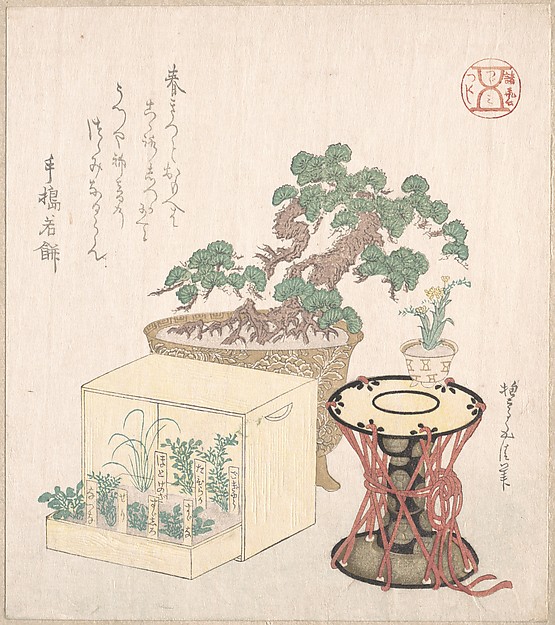
Sunayama Gosei · 18th–19th century · Woodblock print (surimono); ink and color on paper
Sunayama Gosei, Potted Pine Tree Drum and Seven Herbs Planted in a Box, 18th–19th century. The Metropolitan Museum of Art, H. O. Havemeyer Collection, Bequest of Mrs. H. O. Havemeyer, 1929 (accession JP2199). Public domain, Met Open Access. Record

Keisai Eisen · 19th century · Part of an album of woodblock prints (surimono); ink and color on paper
Keisai Eisen, Potted Pine Tree and Koto (Japanese Harp), 19th century. The Metropolitan Museum of Art, H. O. Havemeyer Collection, Bequest of Mrs. H. O. Havemeyer, 1929 (accession JP2319). Public domain, Met Open Access. Record

Utagawa Yoshishige 歌川芳重 · 1848 · Set of two woodblock printed books; ink and color on paper
Utagawa Yoshishige 歌川芳重, Views of Instructions for Bonsai along the Fifty-three Stations of the Tōkaidō (Tōkaidō gojūsantsugi hachiyama zue) 東海道五十三次鉢山図絵, 1848. The Metropolitan Museum of Art, Purchase, Mary and James G. Wallach Foundation Gift, 2013 (accession 2013.863a, b). Public domain, Met Open Access. Record

Shibata Zeshin · 1882 · Lacquer on paper
Shibata Zeshin, Lacquer Paintings of Various Subjects: Bonsai, 1882. The Metropolitan Museum of Art, The Howard Mansfield Collection, Purchase, Rogers Fund, 1936 (accession 36.100.102). Public domain, Met Open Access. Record
Suzuki Shin'ichi · 1870s · Albumen silver print from glass negative with applied color
Suzuki Shin'ichi, Florist, 1870s. The Metropolitan Museum of Art, Gilman Collection, Museum Purchase, 2005 (accession 2005.100.505.1 (24b)). Public domain, Met Open Access. Record
The Bonsai Shelf
Bonsai, viewing stones and their companions are gathered on a small shelf; it is deliberately modest, and the concierge desk can search Japan for a pot, stand or stone.
Answered plainly
Where did bonsai come from?
Wikipedia’s account traces it to the Chinese practice of penjing, brought to Japan from the sixth century onward, with Japanese handscrolls from 1195 onward showing dwarfed potted trees.
What does bonsai mean?
Literally “pot planting”. The earlier term, hachi no ki, meant a tree in a bowl and denoted a deeper pot than the shallow one the later word implies.
Is there such a thing as indoor bonsai?
Not in the Japanese tradition. The Wikipedia article states that bonsai at Japanese exhibitions have been grown outdoors for their entire lives, and that trees kept inside weaken and die.
What is the Kokufu-ten?
The annual exhibition begun in Ueno Park in 1934, held by invitation each February according to the same article.
Is a bonsai a dwarf plant?
No. It is ordinary stock kept small by pruning, root reduction and potting, not a genetic dwarf.
What is the oldest bonsai?
Wikipedia’s article says the five-needle pine Sandai Shōgun, in the Tokyo Imperial Palace collection, is thought to be at least 500 years old and was trained as a bonsai by 1610. Another famous old tree, the Yamaki Pine in Washington, is established in 1625.
What is the Hiroshima survivor bonsai?
The Yamaki Pine, a Japanese white pine established in 1625. Officials of the Potomac Bonsai Association report that a garden wall sheltered it at Hiroshima. Masaru Yamaki gave it to the United States in 1976, and it stands in the National Bonsai and Penjing Museum in Washington.
What is saikei?
A “planted landscape”: living miniature trees, rocks, soil and ground cover in one tray, with the landscape as the subject. Toshio Kawamoto developed it in postwar Japan and insisted it was not bonsai.
What is the difference between bonsai and penjing?
Penjing is the Chinese art of tray scenery, allowing a wider range of tree shapes and brightly shaped pots, and often including figurines. Bonsai is simpler, with proportionally larger trunks and low, plain, muted containers.
What is suiseki?
The Japanese art of the viewing stone, “water stone”. A stone is kept as found, fitted with a carved wooden base called a daiza or set in a shallow tray, and often shown with a scroll or a bonsai in a tokonoma.
When is the Kokufu-ten held?
In February, by invitation, at the Tokyo Metropolitan Art Museum in Ueno Park. The 100th was held from 8 to 18 February 2026.
Why is Ōmiya the home of bonsai?
Because the Great Kantō earthquake of 1923 damaged the nurseries at Dangō-zaka in Tokyo, and the professional bonsai gardeners settled in Ōsato village, now Ōmiya in Saitama, in 1925.
When did the first World Bonsai Convention take place?
In Osaka in 1980. A series of conventions was launched in 1989 in Ōmiya; the 2017 convention was in Saitama, and 2022 was virtual from Perth.
How many people practise bonsai?
Wikipedia’s article estimates at least 100,000 enthusiasts in about 1,500 clubs and associations worldwide, plus more than five million unassociated hobbyists.
How big is a shohin bonsai?
About 13 to 25 centimetres, although the sources disagree on exact sizes. Mame, shito and keshitsubo are smaller still.
Who gave bonsai to the United States?
Japan gave 53 bonsai for the American bicentennial in 1976, selected by the Nippon Bonsai Association and dedicated on 19 July 1976. They became the core of the National Bonsai and Penjing Museum collection.
Did bonsai start in Japan?
No. Wikipedia’s article says bonsai is believed to derive from the Chinese practice of penjing, and the earliest known picture of miniature trees carried by attendants is a Chinese tomb mural of 706.
Where next
References and image credits
- Bonsai, Wikipedia
- Bonsai styles, Wikipedia
- Penjing, Wikipedia
- Suiseki, Wikipedia
- Saikei, Wikipedia
- Bonsai aesthetics, Wikipedia
- Yamaki Pine, Wikipedia
- Ōmiya Bonsai Village, Wikipedia
- National Bonsai and Penjing Museum, Wikipedia
- 100th Koku-Fu Bonsai Exhibition, Part I, 2026, Valavanis Bonsai Blog
- Metropolitan Museum of Art Open Access: Asian Art collection records (credited beneath each image)
Last reviewed 28 October 2026. Every photograph is public domain or openly licensed and credited beneath it; drawn diagrams are by Japonista.
Searching for a pot, a stand or a viewing stone? The concierge desk replies within one to three business days.
Private concierge
Looking for something in particular?
Describe the piece or the project you have in mind. A senior advisor in Tokyo reads every case file personally and replies within two business days, with fees set out in writing before any work begins.